
Last updated on September 25th, 2026 at 09:40 pm
Travel idioms are common expressions in English that use travel-related words but have meanings beyond their literal sense. In simple terms, they help you talk about life, progress, challenges, and experiences in a unique way. For example, when someone says “hit the road,” they usually mean “to start a journey,” not actually hit anything.
20+ Popular Travel Idioms
Quick Navigation
Let’s walk you through more than 20 useful travel idioms with simple meanings and clear example sentences. These idioms are grouped by theme to make them easier to understand and remember.
A. Journey & Movement Idioms
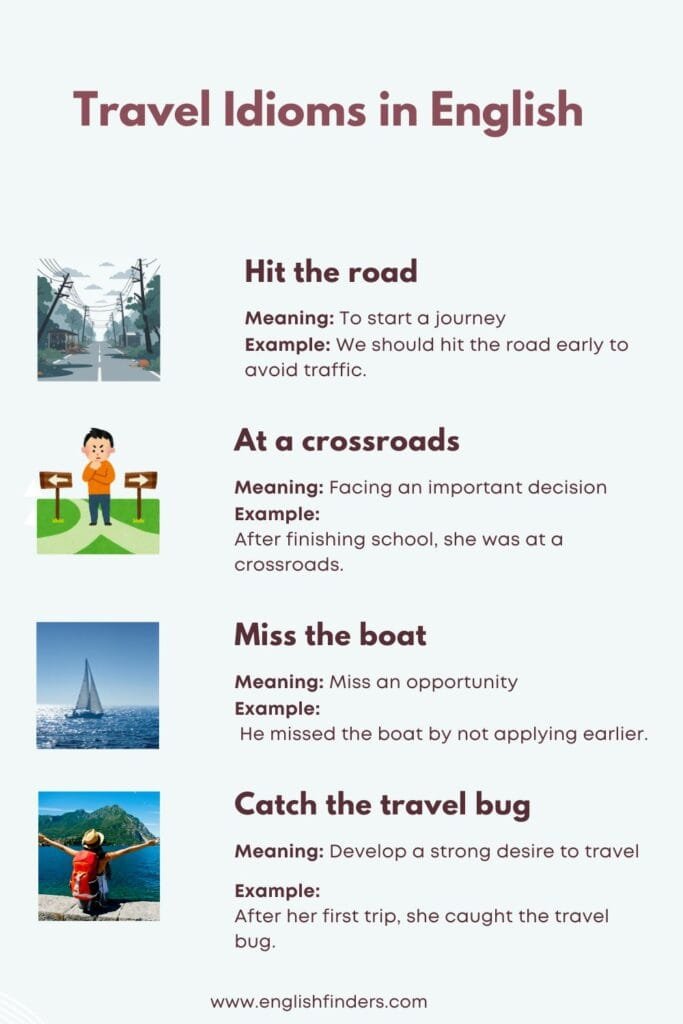
1. Hit the road
Meaning: To start a journey
Example: We should hit the road early to avoid traffic.
2. On the right track
Meaning: Doing something correctly
Example: You are on the right track with your study plan.
3. At a crossroads
Meaning: Facing an important decision
Example: After finishing school, she was at a crossroads.
4. Go the extra mile
Meaning: Make extra effort
Example: He always goes the extra mile to help his students.
5. Back on track
Meaning: Return to the correct path or plan
Example: After a short break, she is back on track with her work.
B. Adventure & Exploration Idioms
6. Off the beaten path
Meaning: A place not commonly visited
Example: They explored villages that were off the beaten path.
7. Take the scenic route
Meaning: Choose a longer but more beautiful way
Example: Let’s take the scenic route to enjoy the view.
8. A long haul
Meaning: Something that takes a long time
Example: Learning English well is a long haul, but it’s worth it.
9. Travel light
Meaning: Carry few (things)
Example: It’s easier to travel light on short trips.
10. Live out of a suitcase
Meaning: Travel frequently without staying in one place
Example: As a pilot, he lives out of a suitcase.
C. Success & Progress Idioms
11. Smooth sailing
Meaning: Easy progress without problems
Example: After the first week, the project was smooth sailing.
12. Learn the ropes
Meaning: Learn how to do something
Example: It took her a few days to learn the ropes at her new job.
13. Get the show on the road
Meaning: Start an activity or journey
Example: It’s time to get the show on the road.
14. Move forward
Meaning: Make progress
Example: We need to move forward with our plans.
15. Break new ground
Meaning: Do something new or innovative
Example: The scientist broke new ground with her research.
D. Problems & Challenges Idioms
16. Miss the boat
Meaning: Miss an opportunity
Example: He missed the boat by not applying earlier.
17. Hit a roadblock
Meaning: Face a problem or obstacle
Example: The team hit a roadblock during the project.
18. In the same boat
Meaning: In the same difficult situation
Example: We are all in the same boat, so let’s help each other.
19. Take a wrong turn
Meaning: Make a bad decision
Example: His career took a wrong turn after that choice.
20. A bumpy ride
Meaning: A difficult or challenging experience
Example: Starting a business can be a bumpy ride.
E. Fun & Interesting Travel Expressions
21. Catch the travel bug
Meaning: Develop a strong desire to travel
Example: After her first trip, she caught the travel bug.
22. Globe-trotter
Meaning: A person who travels a lot
Example: He is a globe-trotter who has visited many countries.
23. Journey of a lifetime
Meaning: A very special and unforgettable trip
Example: Visiting the mountains was a journey of a lifetime.
24. Road trip
Meaning: A long journey by car
Example: They went on a road trip across the country.
Worksheet
A. Fill in the Blanks
Choose the correct idiom from the list below and complete the sentences.
(hit the road, miss the boat, on the right track, travel light, in the same boat, smooth sailing)
- We should ______ early in the morning to avoid traffic.
- If you don’t apply now, you might ______.
- Don’t worry—you are ______ with your preparation.
- It’s easier to ______ when you don’t carry too many bags.
- We are all ______, so let’s support each other.
- After solving the problem, everything was ______.
B. Match the Idioms with Their Meanings
| Idioms | Meanings |
|---|---|
| 1. At a crossroads | A. A difficult experience |
| 2. A bumpy ride | B. Start something |
| 3. Get the show on the road | C. Facing an important decision |
| 4. Off the beaten path | D. Not commonly visited place |
C. Choose the Correct Answer
- “Go the extra mile” means:
a) Travel a long distance
b) Make extra effort
c) Take a break - “Hit a roadblock” means:
a) Travel quickly
b) Reach your goal
c) Face a problem - “Catch the travel bug” means:
a) Get sick during travel
b) Develop a love for traveling
c) Stay at home
D. Make Your Own Sentences
- Use “back on track” in a sentence.
- Use “take the scenic route” in a sentence.
- Use “miss the boat” in a sentence.
E. Short Writing Task
- Write a short paragraph (4–5 sentences) about a trip or life goal. Try to use at least two travel idioms from the list.
Answer Key
Here are the correct answers for the practice exercises. Check your responses and try to understand any mistakes.
A. Fill in the Blanks
- We should hit the road early in the morning to avoid traffic.
- If you don’t apply now, you might miss the boat.
- Don’t worry—you are on the right track with your preparation.
- It’s easier to travel light when you don’t carry too many bags.
- We are all in the same boat, so let’s support each other.
- After solving the problem, everything was smooth sailing.
B. Match the Idioms with Their Meanings
1 → C (At a crossroads = Facing an important decision)
2 → A (A bumpy ride = A difficult experience)
3 → B (Get the show on the road = Start something)
4 → D (Off the beaten path = Not commonly visited place)
C. Choose the Correct Answer
- b) Make extra effort
- c) Face a problem
- b) Develop a love for traveling
D. Make Your Own Sentences (Sample Answers)
- I am finally back on track with my studies after the holidays.
- We decided to take the scenic route to enjoy the beautiful countryside.
- He missed the boat by not preparing for the exam on time.
(Note: Your sentences may be different but still correct if the idioms are used properly.)
E. Short Writing Task (Sample Answer)
- Last year, I went on a trip with my friends. We decided to hit the road early in the morning. At first, everything was smooth sailing, but later we faced some problems. Still, we enjoyed the journey and learned a lot from the experience.
Final Words
Throughout this article, you have learned over 20 common idioms along with their meanings and example sentences. These expressions not only improve your vocabulary but also help you understand real-life conversations more easily.
Frequently Asked Questions
What are travel idioms in English?
Travel idioms are expressions that use travel-related words but have non-literal meanings. In other words, they do not always talk about real travel. Instead, they describe life situations, progress, or challenges in a creative way.
Why are travel idioms important for English learners?
Travel idioms are important because they help you understand real-life English. Native speakers use them often in conversations, movies, and books. So, learning these idioms can improve your speaking, listening, and overall fluency.
What is the best way to remember travel idioms?
The best way to remember travel idioms is to practice them regularly. Try to use them in sentences, speak them in conversations, and review them often. Also, connecting idioms with real-life situations can help you remember them better.

- Antithesis: Meaning, Examples and the Grammar of Balance - October 17, 2026
- Anaphora: Meaning, Examples and How to Use It - October 17, 2026
- Flashback: Meaning, Examples and How to Write One - October 16, 2026