Last updated on April 24th, 2026 at 10:40 pm
Animal Idioms are fun and useful expressions that use animals to describe ideas, feelings, or situations in a creative way. For example, when someone says “busy as a bee,” they do not mean a real bee—they mean a person is very active and hardworking.
In fact, animal idioms are commonly used by native speakers in their everyday activities. To help you familiarize yourself with them, we will explore 20+ Animal Idioms in English, along with their meanings and simple example sentences.
What Are Animal Idioms in English?
Quick Navigation
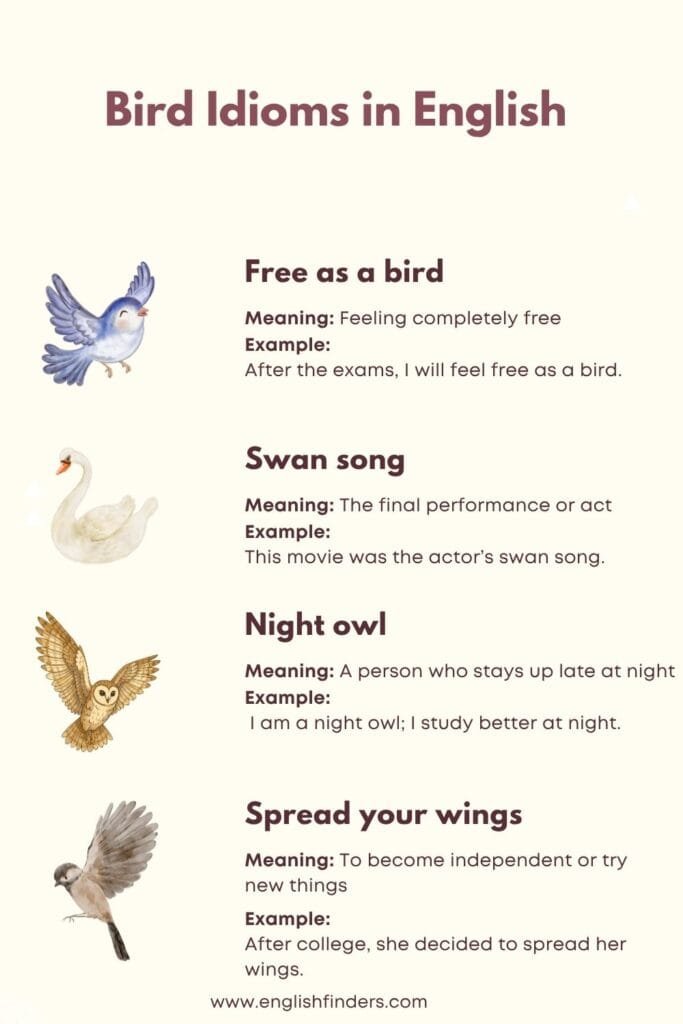
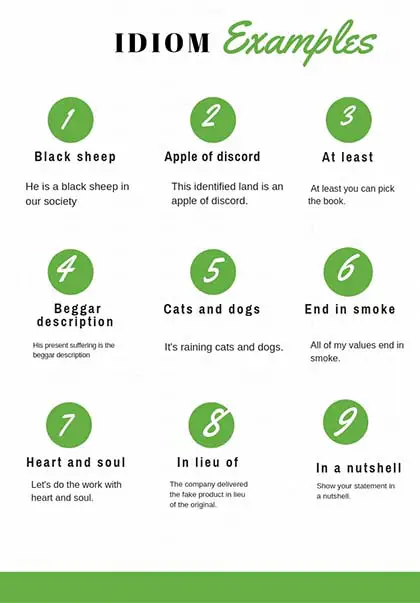
Animal Idioms are special expressions that use the names of animals to describe a situation, behavior, or feeling in a non-literal way. In other words, the meaning of the idiom is different from the actual meaning of the words.
For example, if someone says, “He is a dark horse,” it does not mean the person is a real horse. Instead, it means someone who is mysterious or has hidden talents. This shows how idioms use animals to create interesting and meaningful expressions.
These idioms are popular because animals often represent certain qualities. For instance, a fox is seen as clever, a lion as brave, and a bee as hardworking. So, we often use these animal traits to describe human behavior in a simple and creative way.
Example:
- Literal meaning: The cat is out of the bag. (A real cat escapes from a bag.)
- Idiomatic meaning: “She let the cat out of the bag.” (She revealed a secret.)
20+ Famous Animal Idioms in English
Now, let’s walk you through the 20+ famous animal idioms, including their meanings and example sentences.
| Idiom | Meaning | Example Sentence |
|---|---|---|
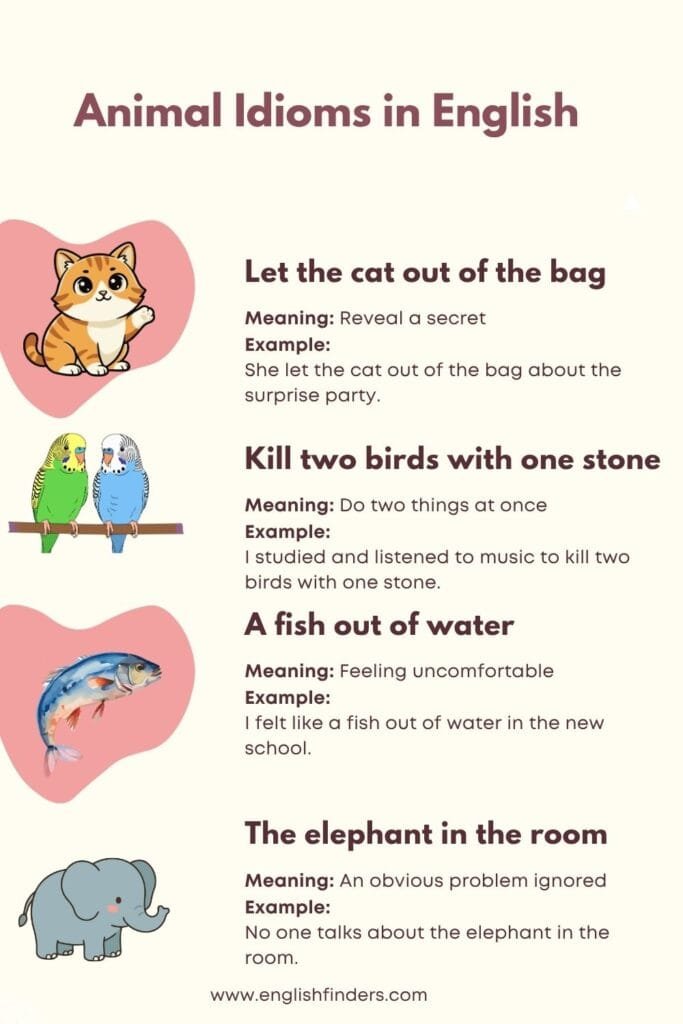
| Let the cat out of the bag | Reveal a secret | She let the cat out of the bag about the surprise party. |
| A dark horse | A person with hidden talent | He was a dark horse in the competition and won first place. |
| The lion’s share | The largest part | She took the lion’s share of the credit. |
| Busy as a bee | Very busy and active | My mother is always busy as a bee in the morning. |
| Kill two birds with one stone | Do two things at once | I studied and listened to music to kill two birds with one stone. |
| A fish out of water | Feeling uncomfortable | I felt like a fish out of water in the new school. |
| Hold your horses | Wait and be patient | Hold your horses! We will leave soon. |
| Cry wolf | Give a false alarm | Don’t cry wolf if there is no real problem. |
| Like a dog with a bone | Not giving up easily | He is like a dog with a bone when solving problems. |
| Barking up the wrong tree | Making a wrong guess | You are barking up the wrong tree if you blame me. |
| The elephant in the room | An obvious problem ignored | No one talked about the elephant in the room. |
| Straight from the horse’s mouth | From a reliable source | I heard it straight from the horse’s mouth. |
| Monkey business | Silly or dishonest behavior | The teacher told the students to stop their monkey business. |
| A snake in the grass | A hidden enemy | Be careful of him; he is a snake in the grass. |
| Take the bull by the horns | Face a problem bravely | She took the bull by the horns and solved the issue. |
| Like water off a duck’s back | No effect at all | His criticism was like water off a duck’s back. |
| Wolf in sheep’s clothing | A dangerous person pretending to be kind | He looks friendly but is a wolf in sheep’s clothing. |
| Dog-eat-dog world | Very competitive situation | It is a dog-eat-dog world in business. |
| Copycat | Someone who copies others | Stop being a copycat and be original. |
| Pig out | Eat too much | We pigged out on snacks during the movie. |
| Eagle eye | Very sharp vision or attention | She caught the mistake with her eagle eye. |
| Ants in your pants | Unable to stay still | The kids had ants in their pants before the trip. |
Final words
Throughout this article, you have learned more than 20 useful animal idioms along with their meanings and example sentences. Learning these idioms will help you improve your vocabulary skills. As you continue practicing, you will notice that these idioms become easier to remember and use in real-life situations.
Worksheet
A. Fill in the Blanks
Choose the correct idiom from the list below and complete the sentences.
Idioms:
(busy as a bee, cry wolf, a fish out of water, copycat, take the bull by the horns, let the cat out of the bag)
- She is always __________, working from morning to night.
- He felt like __________ when he moved to a new country.
- Don’t __________ or people will stop believing you.
- She accidentally __________ about the secret plan.
- Instead of waiting, he decided to __________ and fix the problem.
- Stop being a __________ and think of your own ideas.
B. Match the Idioms with Their Meanings
Write the correct letter (A–F) next to each idiom.
| Idioms | Meanings |
|---|---|
| 1. Barking up the wrong tree | A. Very competitive situation |
| 2. Dog-eat-dog world | B. Obvious problem that people ignore |
| 3. The elephant in the room | C. Making a wrong guess |
| 4. A snake in the grass | D. A hidden enemy |
| 5. Hold your horses | E. Wait and be patient |
| 6. Kill two birds with one stone | F. Do two things at once |
C. Make Your Own Sentences
Use the following Animal Idioms to create your own sentences:
- Like water off a duck’s back
- A dark horse
- Monkey business
- Eagle eye
D. Choose the Correct Meaning (MCQ)
- “Pig out” means:
a) Eat very little
b) Eat too much
c) Cook food - “A wolf in sheep’s clothing” describes:
a) A friendly person
b) A shy animal
c) A dangerous person pretending to be kind - “Cry wolf” means:
a) Tell the truth
b) Give a false alarm
c) Help someone
Answer Key
A. Fill in the Blanks
- She is always busy as a bee, working from morning to night.
- He felt like a fish out of water when he moved to a new country.
- Don’t cry wolf, or people will stop believing you.
- She accidentally let the cat out of the bag about the secret plan.
- Instead of waiting, he decided to take the bull by the horns and fix the problem.
- Stop being a copycat and think of your own ideas.
B. Match the Idioms with Their Meanings
- Barking up the wrong tree → C. Making a wrong guess
- Dog-eat-dog world → A. Very competitive situation
- The elephant in the room → B. Obvious problem that people ignore
- A snake in the grass → D. A hidden enemy
- Hold your horses → E. Wait and be patient
- Kill two birds with one stone → F. Do two things at once
C. Sample Answers (Possible Responses)
Note: Answers may vary. These are just examples.
- Like water off a duck’s back → His harsh words were like water off a duck’s back.
- A dark horse → She was a dark horse and surprised everyone by winning.
- Monkey business → The teacher warned the students to stop their monkey business.
- Eagle eye → He caught the mistake with his eagle eye.
D. Multiple Choice Questions (MCQ)
- “Pig out” → b) Eat too much
- “A wolf in sheep’s clothing” → c) A dangerous person pretending to be kind
- “Cry wolf” → b) Give a false alarm
FAQs
What are Animal Idioms in English?
Animal Idioms are expressions that use animal names to describe ideas, feelings, or situations in a non-literal way. For example, “busy as a bee” means very active, not an actual bee.
How can I learn Animal Idioms in English easily?
You can learn them by practicing regularly, using them in sentences, and grouping them by animals. In addition, watching movies and reading storybooks can help you see how idioms are used in real life.
Are Animal Idioms used in exams?
Yes, Animal Idioms are often used in school exams, especially in grammar, writing, and comprehension sections. Knowing them can improve your exam performance.

- 50 Words Ending in Less | Meanings, Examples, and Worksheet - July 26, 2026
- 5 Letter Words with 3 Vowels: 200+ Words with Meanings and Examples - July 11, 2026
- 100 Words Ending in Ful: Meanings, Example Sentences, and Worksheet - May 29, 2026