
Last updated on November 22nd, 2026 at 09:17 am
When an English speaker says it is “raining cats and dogs,” nobody looks up at the sky for falling pets. They mean it is raining very heavily. This is an idiom: a phrase whose meaning is different from the meaning of its words.
English has many idioms about animals, because people have long linked animals with certain qualities. A lion seems strong, a bee seems busy, and a snake seems sly.
This lesson gives you 30 common animal idioms, grouped by animal, each with a meaning and a natural example.
- What an animal idiom is
- 30 common animal idioms, grouped by animal
- A natural example sentence for each idiom
- Which idioms are informal or can sound rude
- How to practice and remember them
What Are Animal Idioms?
Quick Navigation
An idiom is a group of words with a special meaning. You cannot understand it just by knowing each word. Animal idioms use what people believe about animals to talk about people and situations.
| Literal meaning | Idiomatic meaning |
|---|---|
| A cat escapes from a bag. | Someone tells a secret by accident: “She let the cat out of the bag.” |
| A real horse speaks. | You heard news from the person directly involved: “I heard it straight from the horse’s mouth.” |
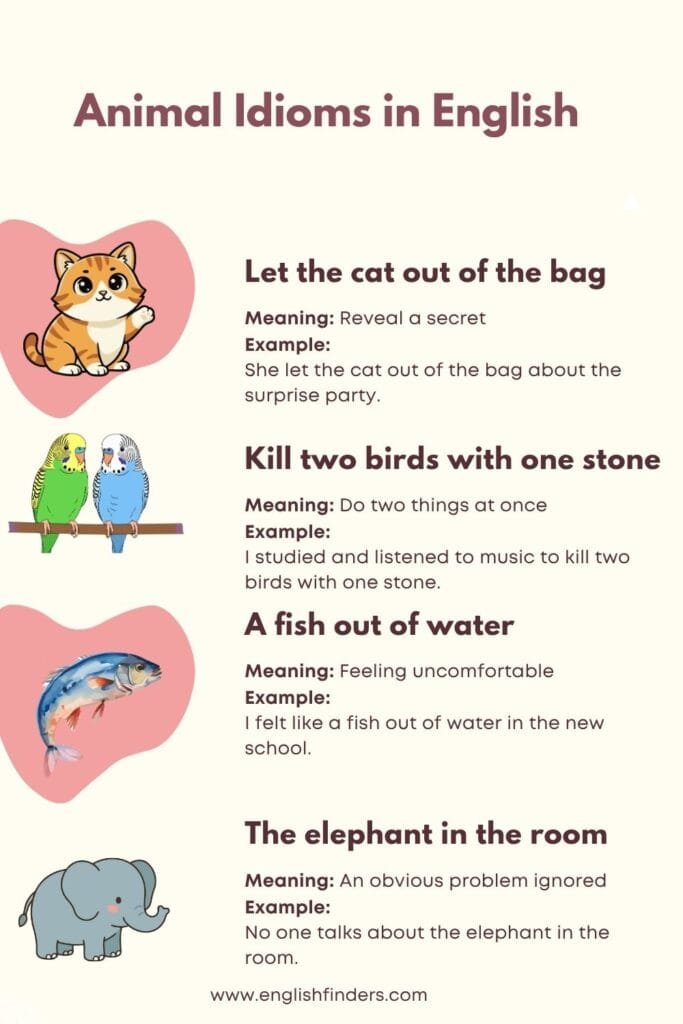
| A fish is out of the water. | Someone feels uncomfortable in a new place: “I felt like a fish out of water.” |
30 Common Animal Idioms
Cat Idioms
| Idiom | Meaning | Example |
|---|---|---|
| Let the cat out of the bag | To tell a secret by accident | Tom let the cat out of the bag about the surprise party. |
| Curiosity killed the cat | Being too curious can get you into trouble | Don’t read his messages. Curiosity killed the cat. |
| Raining cats and dogs | Raining very heavily | We stayed inside because it was raining cats and dogs. |
| Has the cat got your tongue? | Why are you so quiet? | You haven’t said a word all evening. Has the cat got your tongue? |
Dog Idioms
| Idiom | Meaning | Example |
|---|---|---|
| Barking up the wrong tree | Blaming the wrong person or following a wrong idea | If you think I took your phone, you’re barking up the wrong tree. |
| Let sleeping dogs lie | Do not bring up an old problem again | They argued last year, so let sleeping dogs lie. |
| Dog-eat-dog | Very competitive, where people care only about themselves | The fashion world can be dog-eat-dog. |
| Like a dog with a bone | Refusing to stop thinking or talking about something | When she has a question, she is like a dog with a bone. |
| Every dog has its day | Everyone has success at some time | Our team lost all season, but every dog has its day. |
Horse Idioms
| Idiom | Meaning | Example |
|---|---|---|
| Hold your horses | Wait, or slow down | Hold your horses! Let me finish reading the rules. |
| Straight from the horse’s mouth | From the person directly involved | I heard it straight from the horse’s mouth: the manager told me herself. |
| A dark horse | Someone with hidden skills who surprises people | The quiet student was a dark horse and won the debate. |
| Put the cart before the horse | To do things in the wrong order | Buying furniture before finding an apartment is putting the cart before the horse. |
Bird Idioms
| Idiom | Meaning | Example |
|---|---|---|
| Kill two birds with one stone | To achieve two things with one action | I walked to work and got some exercise, so I killed two birds with one stone. |
| The early bird catches the worm | People who start early have an advantage | I got the best seat by arriving first. The early bird catches the worm. |
| A little bird told me | I won’t say who told me | A little bird told me it’s your birthday. |
| Birds of a feather flock together | Similar people spend time together | They all love chess. Birds of a feather flock together. |
For more, see our full list of bird idioms.
Fish and Sea Idioms
| Idiom | Meaning | Example |
|---|---|---|
| A fish out of water | Uncomfortable in a new situation | I felt like a fish out of water at my first business dinner. |
| Plenty more fish in the sea | There are many other people or chances | Don’t be sad about the breakup. There are plenty more fish in the sea. |
| Something smells fishy | Something seems dishonest or suspicious | His story about the lost money sounds fishy. |
Wild Animal Idioms
| Idiom | Meaning | Example |
|---|---|---|
| The elephant in the room | An obvious problem that nobody talks about | The price was the elephant in the room at the meeting. |
| The lion’s share | The biggest part | My brother got the lion’s share of the cake. |
| A wolf in sheep’s clothing | A dangerous person who seems friendly | The friendly salesman turned out to be a wolf in sheep’s clothing. |
| Cry wolf | To give false alarms, so people stop believing you | If you cry wolf too often, nobody will help when you really need it. |
| Monkey business | Silly or dishonest behavior | The teacher told the class to stop the monkey business. |
| A snake in the grass | A person who secretly betrays you | He acted like a friend, but he was a snake in the grass. |
Farm Animal and Insect Idioms
| Idiom | Meaning | Example |
|---|---|---|
| Take the bull by the horns | To face a difficult problem directly | She took the bull by the horns and asked for a raise. |
| Like water off a duck’s back | Criticism has no effect on someone | Rude comments are like water off a duck’s back to him. |
| As busy as a bee | Very busy | My mother is as busy as a bee before family visits. |
| When pigs fly | Something that will never happen | He’ll clean his room when pigs fly! |
Formal or Informal?
Most animal idioms are informal. They are common in conversation, stories and social media. In formal essays and reports, choose a plain word instead.
| Idiom | Plain alternative for formal writing |
|---|---|
| The lion’s share | Most of, the largest part |
| A dark horse | An unexpected winner |
| Take the bull by the horns | Deal with the problem directly |
| The elephant in the room | An important issue that people avoid |
Animal Idioms to Use Carefully
- A snake in the grass and a wolf in sheep’s clothing are strong criticisms. Use them only when you mean it.
- When pigs fly sounds sarcastic, so it can hurt if you say it about someone’s plans.
- Monkey business can sound like a teacher scolding children.
- Calling a person an animal directly, such as “pig” or “cow,” is rude in English. Idioms are fine; insults are not.
Check your answer
Practice: Match the Idiom
Match each idiom with its meaning.
- The lion’s share
- Hold your horses
- A fish out of water
- When pigs fly
- Let the cat out of the bag
- Barking up the wrong tree
Show answers
- The lion’s share: the biggest part
- Hold your horses: wait or slow down
- A fish out of water: uncomfortable in a new situation
- When pigs fly: something that will never happen
- Let the cat out of the bag: tell a secret by accident
- Barking up the wrong tree: blaming the wrong person
Quiz: Test Yourself
- “It’s raining cats and dogs” means:
- If someone “let the cat out of the bag,” they:
- “Hold your horses!” means:
- What is “the lion’s share”?
- If you feel “like a fish out of water,” you feel:
- Which idiom means “something will never happen”?
- “Kill two birds with one stone” means:
- What is “the elephant in the room”?
- Which idiom is a strong criticism of a person?
- “I heard it straight from the horse’s mouth” means:
Key Takeaways
- An animal idiom uses an animal to describe people and situations in a non-literal way.
- Common examples are let the cat out of the bag, hold your horses and the lion’s share.
- Most animal idioms are informal, so use plain words in formal writing.
- Some idioms, like a snake in the grass, are strong criticisms.
- Learn each idiom in a full sentence and use it in your own example.
Frequently Asked Questions
What are animal idioms?
Animal idioms are fixed phrases that use animals to describe people or situations in a non-literal way. For example, “hold your horses” means “wait.”
What are the most common animal idioms in English?
Common ones include let the cat out of the bag, raining cats and dogs, hold your horses, the lion’s share, a fish out of water, kill two birds with one stone and when pigs fly.
What does “let the cat out of the bag” mean?
It means to tell a secret, usually by accident. Example: Tom let the cat out of the bag about the surprise party.
What does “the elephant in the room” mean?
It is an obvious problem that everyone knows about but nobody wants to talk about. Example: The price was the elephant in the room.
Can I use animal idioms in formal writing?
Most animal idioms are informal, so it is better to use plain words in essays and reports. A few, like the lion’s share, sometimes appear in news writing.
How can I remember idioms?
Learn each idiom in a full sentence, write your own example about your life, and say it aloud. Review a few idioms every week.
Related Articles

- Lay vs Lie: The Difference, Verb Forms and Examples - November 24, 2026
- Farther vs Further: Distance, Degree and Useful Phrases - November 24, 2026
- Compliment vs Complement: Meaning, Spelling and Examples - November 24, 2026