
Last updated on May 2nd, 2026 at 10:59 pm
Sometimes we need to wish and pray for someone or something. Optative sentences help us to do that. In simple words, an optative sentence is used when we want something good (or sometimes bad) to happen to someone.
For example, when we say “May you succeed in life.”, we are using an optative sentence. Now, come to the definition of an optative sentence.
What is an Optative Sentence?
Quick Navigation
A sentence that expresses a wish, prayer, hope, or strong desire for someone or something is called an optative sentence. In other words, we use them when we want something to happen, especially something good for someone.
These sentences often show our feelings in a polite and emotional way. For example, when we say “May you live a long and happy life.” we are expressing a wish. Similarly, “May God bless you.” is a prayer.
Optative sentences usually begin with words like “may” or “wish” to show strong emotion. However, sometimes they can also be written as simple statements.
In short, an optative sentence is used:
- To express a hope or desire
- To wish someone well
- To pray for someone
Let us see some examples:
- May the poor boy become established.
- May Almighty cure us from unknown diseases.
- Wish you good luck.
- May he support your family.
- Wish him all the very best.
Note: An Optative Sentence starts with ‘may’ or ‘wish’.
Structure of Optative Sentences
1. Basic Structure with “May”
The most common structure uses the word “may” at the beginning.
| Structure | Example |
|---|---|
| May + subject + base verb + (object/complement) | May you succeed in life. |
| May + subject + be + adjective | May you be happy. |
Here, the verb always stays in its base form (no -s, -ed, etc.).
2. Structure with “Wish”
Sometimes, optative sentences use “wish” to express desire.
| Structure | Example |
|---|---|
| Wish + object + extension | Wish him a happy life. |
Examples of Optative Sentences
Now that you understand the structure, let’s look at some easy and practical examples of Optative Sentences. These examples will help you use them correctly in real-life situations.
1. Examples of Wishes
These sentences express good wishes for someone’s future.
- May you succeed in your exams.
- May you have a bright future.
- Wish you happiness and success.
- Wish you a wonderful day.
2. Examples of Prayers and Blessings
These are commonly used in religious or respectful contexts.
- May God bless you.
- May Allah guide you always.
- May you live a long life.
- May God endow your family.
3. Examples Used in Celebrations
We often use optative sentences during special occasions.
- May your birthday be full of joy.
- Wish you a happy New Year.
- May your dreams come true.
- May you achieve all your goals.
4. Examples Showing Strong Feelings
- Long live our country.
- Long live friendship.
- May peace prevail in the world.
5. Mild Negative Wishes
Sometimes, optative sentences can express negative wishes, but these should be used carefully.
- May you learn from your mistakes.
- Wish you understood the truth.
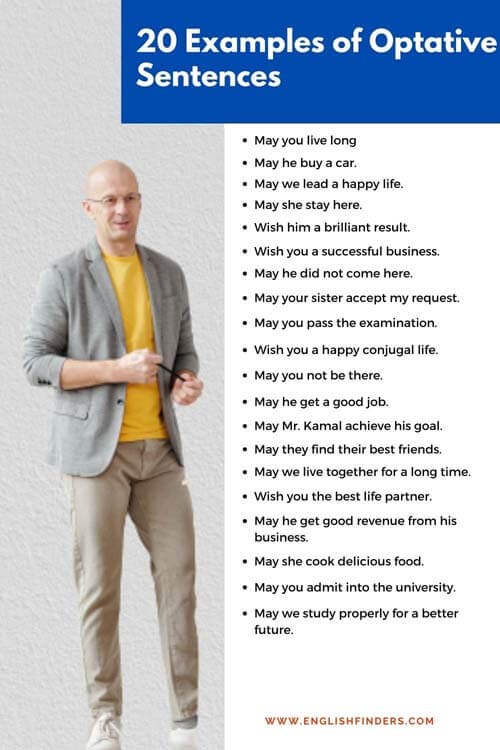
20 Mixed Examples of Optative Sentences
Let us see 20 mixed examples of Optative Sentences:
- May you live long.
- May he get a good result.
- May we lead a happy life.
- May she stay here.
- Wish him a brilliant result.
- Wish you a successful business.
- May he not come here.
- May your sister accept my request.
- May you pass the examination.
- Wish you a happy conjugal life.
- May you not be there.
- May he get a good job.
- May Mr. Kamal achieve his goal.
- May they find their best friends.
- May we live together for a long time.
- Wish you the best life partner.
- May he get good revenue from his business.
- May she cook delicious food.
- May you admit into the university.
- May we study properly for a better future.
Final Words
Optative Sentences play an important role in English grammar as they help us express our wishes, prayers, hopes, and good feelings for others. They are simple to learn and very useful in daily communication, especially in greetings, blessings, and special occasions.
Throughout this lesson, you have learned what optative sentences are, how they are formed, and how to use them with correct structure and examples. Words like “May,” “Wish,” “God bless,” and “Long live” are commonly used to make these sentences meaningful and expressive.
Worksheet
A. Fill in the Blanks with Suitable Words
Complete the sentences using words like may, wish, God bless, long live, etc.
- ______ you succeed in your exams.
- ______ you a very happy life.
- ______ our country.
- ______ God protect you from danger.
- ______ you all the best.
B. Identify the Optative Sentences
Read the sentences and write “Optative” or “Not Optative”.
- May you live long. ______
- She is going to school. ______
- Wish you good luck. ______
- Open the door. ______
- May peace be upon you. ______
C. Rewrite as Optative Sentences
Change the following sentences into optative sentences.
- I hope you win the match.
- I pray that God helps you.
- We want our team to win.
- I hope you have a good day.
- I pray for your success.
D. Make Your Own Optative Sentences
Write 3 optative sentences of your own based on the situations below:
- Your friend has an exam.
- Someone is celebrating a birthday.
- You want peace in the world.
E. Match the Sentence with Its Purpose
Match Column A with Column B.
| Column A | Column B |
|---|---|
| 1. May God bless you. | a. Celebration |
| 2. Wish you a happy birthday. | b. Prayer |
| 3. Long live our nation. | c. Support/Emotion |
Answer Key
Here are the correct answers to the practice exercises. Check your work and try to understand your mistakes.
A. Fill in the Blanks
- May you succeed in your exams.
- Wish you a very happy life.
- Long live our country.
- May God protect you from danger.
- Wish you all the best.
B. Identify the Optative Sentences
- May you live long. — Optative
- She is going to school. — Not Optative
- Wish you good luck. — Optative
- Open the door. — Not Optative
- May peace be upon you. — Optative
C. Rewrite as Optative Sentences
- I hope you win the match. → May you win the match.
- I pray that God helps you. → May God help you.
- We want our team to win. → May our team win.
- I hope you have a good day. → May you have a good day.
- I pray for your success. → May you succeed.
D. Make Your Own Optative Sentences
- May you pass your exam with good marks.
- Wish you a very happy birthday.
- May there be peace in the world.
(Note: Answers may vary. These are just examples.)
E. Match the Sentence with Its Purpose
- May God bless you. — b. Prayer
- Wish you a happy birthday. — a. Celebration
- Long live our nation. — c. Support/Emotion
Frequently Asked Questions
What is an optative sentence?
An optative sentence is a sentence that expresses a wish, prayer, hope, or strong desire.
Example: May you succeed in life.
How do optative sentences usually start?
Most optative sentences start with words like “May” or “Wish”.
Example: May God bless you.
Can optative sentences be used in daily life?
Yes, they are commonly used in daily life, especially in:
Greetings
Blessings
Prayers
Special occasions

- Zeugma: Meaning, Examples and the Verbs That Make It Work - October 24, 2026
- Dramatic Irony: Meaning, Examples and the Language Behind It - October 24, 2026
- Satire: Meaning, Types, Examples and How to Spot It - October 24, 2026