
Last updated on October 8th, 2026 at 03:51 pm
“I can swim.” “Can I sit here?” “It can get cold at night.” One small word, three different jobs.
Can is one of the first modal verbs learners meet. Below you will find its four uses, the forms you need, and 50 easy example sentences.
- The four main uses of can
- How to make positive, negative and question sentences
- 50 example sentences, grouped by use
- When to use can, could or be able to
- The mistakes learners make most with can
The Four Uses of Can
Quick Navigation
| Use | Example |
|---|---|
| Ability | She can play the piano. |
| Permission | Can I go outside now? |
| Possibility | It can get very cold in December. |
| Requests and offers | Can you help me? Can I carry that for you? |
How to Use Can: Forms
The verb after can never changes. There is no to, no -s and no -ing.
| Sentence type | Form | Example |
|---|---|---|
| Positive | Subject + can + verb | I can ride a bike. |
| Negative | Subject + can’t (cannot) + verb | She can’t speak French. |
| Question | Can + subject + verb? | Can he come with us? |
| Short answer | Yes, + subject + can. / No, + subject + can’t. | Yes, he can. No, he can’t. |
Cannot is one word. Can’t is the short form, and it is more common in speech.
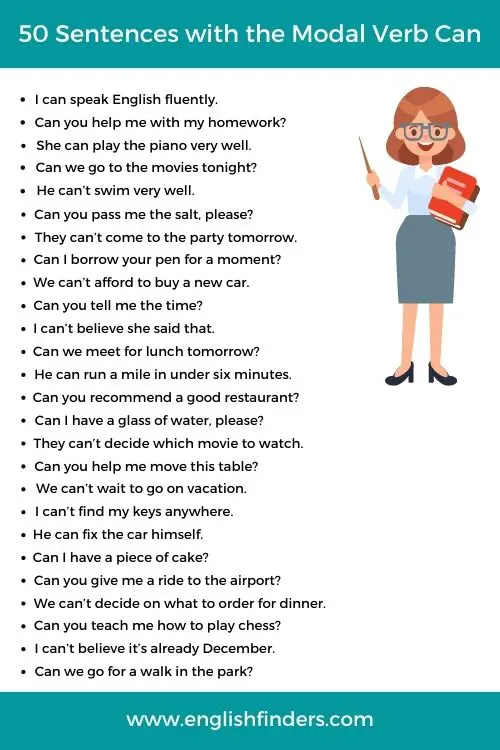
50 Sentences With Can
Can for Ability
- I can ride a bicycle without falling.
- She can speak three languages.
- We can solve this problem together.
- He can cook delicious meals.
- They can draw really well.
- My brother can run very fast.
- I can sing, but I’m a little shy.
- You can lift that box if you try.
- The baby can walk now.
- Our teacher can explain things clearly.
Can for Permission
- Can I go to the bathroom, please?
- You can borrow my pen.
- Can we play outside after lunch?
- She can stay here tonight.
- Can I have another cookie?
- Students can use the library after school.
- Can I watch TV now?
- You can sit wherever you like.
- Can we take a short break?
- My parents said I can go to the party.
Can for Possibility
- It can rain a lot in July.
- Accidents can happen at any time.
- You can get sick if you don’t rest.
- Too much noise can be harmful.
- This phone can break easily.
- A simple idea can change the world.
- Learning English can be fun.
- The road can get slippery when it is wet.
- Problems can be solved with teamwork.
- Anyone can win if they try hard enough.
Can for Requests and Offers
- Can you help me with this question?
- Can I carry that bag for you?
- Can you pass the salt, please?
- Can we talk after class?
- Can I call you later?
- Can you show me how to do this?
- Can we meet tomorrow?
- Can I join your group?
- Can you tell me the time?
- Can I open the window?
Negative Sentences With Can’t
- He can swim, but he can’t dive.
- I can’t find my keys.
- You can’t bring pets into the store.
- He can’t eat peanuts because he’s allergic.
- We can’t go out because it is raining.
- She can’t come to the party tonight.
- I can’t hear you. Please speak louder.
- My grandmother can’t use a smartphone.
- They can’t play football today.
- You cannot park here.
Can, Could or Be Able To?
| Word | Use it for | Example |
|---|---|---|
| Can | Ability now, permission, requests | I can swim. Can I sit here? |
| Could | Past ability, polite requests, a possible event | I could swim at five. Could you help me? It could rain later. |
| Be able to | Ability in other tenses | I will be able to drive next year. |
Use can for things that are generally true: It can rain a lot in July. For one possible event, use could or might: It could rain later, so take an umbrella.
Check your answer
Common Mistakes With Can
| Mistake | Wrong | Right |
|---|---|---|
| Adding to | She can to swim. | She can swim. |
| Adding -s to the verb | He can sings well. | He can sing well. |
| Using -ing | I can swimming. | I can swim. |
| Adding -s to can | She cans drive. | She can drive. |
| Using do in questions | Do you can help me? | Can you help me? |
Practice: Can
Correct the mistake in each sentence.
- My sister can speaks English.
- Do you can come tomorrow?
- I can to read Arabic.
- It can snow later, so wear a coat.
Show answers
- My sister can speak English. 2. Can you come tomorrow? 3. I can read Arabic. 4. It could (or might) snow later, so wear a coat.
Quiz: Test Yourself
- “She can ______ the piano.”
- Which question is correct?
- “Can he cook?” Which short answer is correct?
- What is the negative of can?
- “______ I open the window?” You are asking for permission.
- “I ______ swim when I was five.”
- “It ______ rain later, so take an umbrella.” You mean one possible event.
- “I will ______ drive next year.”
- Which sentence is correct?
- How does can usually sound in a normal sentence?
Key Takeaways
- Can shows ability, permission, possibility and requests.
- After can, use the base verb: no to, no -s, no -ing.
- Make questions with can first: Can you…? Never use do.
- Can’t and cannot mean the same thing.
- For one possible event, use could or might, not can.
Ready for the next modal? Compare can with its past and polite form in our 50 sentences with could.
Frequently Asked Questions
What are 10 examples of can?
I can swim. Can I sit here? You can borrow my pen. Can you help me? It can get cold at night. She can’t drive. We can meet tomorrow. He can speak French. Can I open the window? Anyone can learn English.
What are 5 sentences with can?
I can ride a bike. Can you pass the salt? You can sit here. This road can be dangerous. I can’t find my phone.
How do you use can in a sentence for kids?
Put can before an action word: “I can jump.” “Can I play?” “The bird can fly.” The action word never changes, so do not say “can jumps” or “can to jump”.
Can “can” be used in the past tense?
No. The past form is could: “I could swim when I was five.” For other tenses, use be able to: “I will be able to swim soon.”
What is the difference between can and could?
Can is for the present and for general truths. Could is for the past, for more polite requests and for one possible event: “Could you help me?” “It could rain later.”
Is it can’t or cannot?
Both are correct and mean the same. Can’t is more common in speech and informal writing. Cannot is written as one word, not “can not”, in most sentences.
Related Articles

- Antithesis: Meaning, Examples and the Grammar of Balance - October 17, 2026
- Anaphora: Meaning, Examples and How to Use It - October 17, 2026
- Flashback: Meaning, Examples and How to Write One - October 16, 2026