

Last updated on October 8th, 2026 at 08:52 pm
Every morning, my alarm rings at six. I make tea, and my cat waits by the door. These things happen again and again.
English uses one simple tense for habits, facts and routines. This lesson shows you how to make it and when to use it. Then you can study 100 sentences, starting with 10 short ones.
- What the present indefinite tense is, and its other name
- How to make positive sentences, negatives and questions
- When to add -s, -es or -ies, and how to say the ending
- Where to put words like always and never
- 100 example sentences and a worksheet with answers
What Is the Present Indefinite Tense?
Quick Navigation
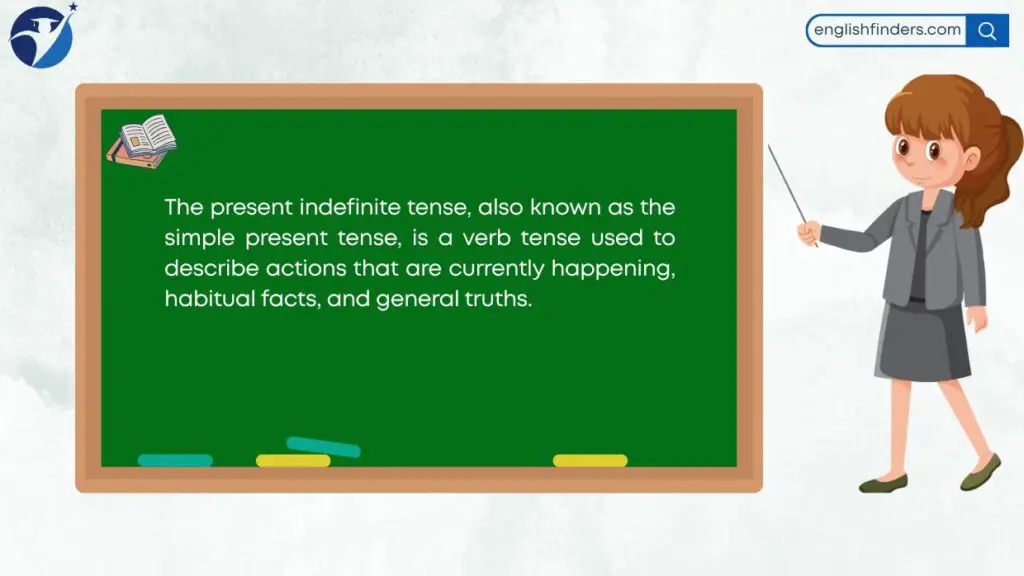
The present indefinite tense talks about things that happen often or are always true. It is one of the most common tenses in English.
Many books call it the simple present tense. The two names mean the same thing.
How to Make the Present Indefinite Tense
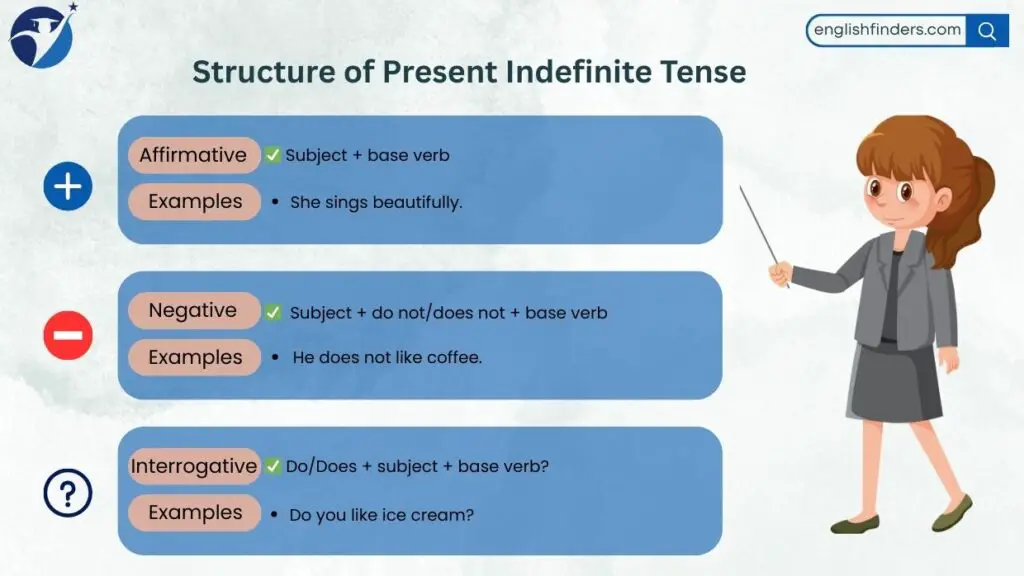
| Sentence type | I / you / we / they | He / she / it |
|---|---|---|
| Positive | I play football. | She plays football. |
| Negative | I do not (don’t) play football. | She does not (doesn’t) play football. |
| Question | Do you play football? | Does she play football? |
| Short answer | Yes, I do. / No, I don’t. | Yes, she does. / No, she doesn’t. |
With he, she and it, the verb takes -s. In negatives and questions, the -s moves to does. The main verb goes back to its base form.
Adding -s, -es or -ies
| Rule | Verb | He / she / it |
|---|---|---|
| Most verbs: add -s | Play, read, work | Plays, reads, works |
| Verbs ending in -ch, -sh, -ss, -x, -o: add -es | Watch, wash, miss, fix, go | Watches, washes, misses, fixes, goes |
| Consonant + y: change y to i, add -es | Study, cry, try | Studies, cries, tries |
| Irregular | Have, be | Has, is |
How to Say the -s Ending
| Sound | When | Examples |
|---|---|---|
| /s/ | After sounds like p, t, k, f | Works, eats, stops |
| /z/ | After vowels and sounds like b, d, g, l, m, n, v | Plays, reads, lives |
| /ɪz/ (an extra syllable) | After s, z, sh, ch, x sounds | Watches, washes, fixes |
When Do We Use the Present Indefinite Tense?
- Habits and routines: I wake up at 7 a.m.
- Facts that are always true: Water boils at 100 degrees Celsius.
- General statements: They speak English well.
- Timetables: The train leaves at 5 p.m.
Words Like Always, Often and Never
Frequency words tell us how often something happens. Put them before the main verb, but after am, is, are.
| Word | Example with a verb | Example with be |
|---|---|---|
| Always | She always walks to school. | She is always happy. |
| Usually | I usually drink tea. | He is usually late. |
| Often | We often play chess. | They are often tired. |
| Sometimes | He sometimes cooks dinner. | It is sometimes cold. |
| Never | I never eat meat. | You are never bored. |
You can practice this in our A1 lesson on adverbs of frequency.
100 Sentences of Present Indefinite Tense
Start With These 10
- I drink tea every morning.
- She walks to school.
- We live in a small town.
- He works in a bank.
- The sun rises in the east.
- They play football on Fridays.
- I don’t like cold coffee.
- She doesn’t eat meat.
- Do you speak English?
- Does he have a car?
Affirmative Sentences
- I play football every evening.
- She sings very well.
- They eat lunch at noon.
- He watches cartoons on weekends.
- We study together after school.
- You speak clearly.
- My brother loves chocolate.
- I go to school by bus.
- She reads books in her free time.
- We enjoy board games.
- It rains a lot in July.
- You write neatly.
- They walk to the market.
- He drinks coffee in the morning.
- I visit my grandma on Sundays.
- She dances beautifully.
- The dog barks loudly.
- Birds fly south in winter.
- We play cricket after school.
- He likes action movies.
- I listen to music every night.
- She wears glasses.
- The train stops at this station.
- We clean our room every day.
- Water freezes at 0 degrees Celsius.
Negative Sentences
- I do not play video games.
- He does not eat spicy food.
- They do not go to school on Sundays.
- She does not drink milk.
- We do not like noise.
- You do not watch horror movies.
- It does not snow here.
- He does not speak loudly.
- I do not wake up late.
- She does not dance.
- They do not understand the lesson.
- You do not visit the park often.
- My sister does not cook.
- We do not live in a big city.
- He does not write neatly.
- I do not skip breakfast.
- She does not like rain.
- Our dog does not bite.
- They do not know the answer.
- Lora does not forget her homework.
- He does not swim well.
- I do not wear glasses.
- She does not listen to me.
- We do not watch TV during dinner.
- My parents do not allow phones at dinner.
Questions
- Do you like chocolate?
- Does he play cricket?
- Do they go to school every day?
- Does she cook well?
- Do we have homework today?
- Does your brother read books?
- Do you wake up early?
- Does she sing?
- Do birds fly at night?
- Does he clean his room?
- Do they enjoy the game?
- Does it look good?
- Do you play the guitar?
- Does your father drive a car?
- Do we need a ticket?
- Does the sun rise in the east?
- Do I talk too much?
- Does she like your dress?
- Do you drink coffee?
- Does your cat sleep a lot?
- Do they finish work at five?
- Does he play video games?
- Do we go to the same class?
- Does she watch TV every day?
- Do you call your friend every day?
- Does it work well?
- Do children play outside?
- Does she speak French?
- Do they travel a lot?
- Does he visit you often?
Mixed: One Sentence, Three Forms
- I read books. / I do not read books. / Do I read books?
- He plays the piano. / He does not play the piano. / Does he play the piano?
- They go to school. / They do not go to school. / Do they go to school?
- She drinks tea. / She does not drink tea. / Does she drink tea?
- We like music. / We do not like music. / Do we like music?
- You speak English. / You do not speak English. / Do you speak English?
- The baby cries. / The baby does not cry. / Does the baby cry?
- I watch cartoons. / I do not watch cartoons. / Do I watch cartoons?
- He eats apples. / He does not eat apples. / Does he eat apples?
- They dance well. / They do not dance well. / Do they dance well?
Present Indefinite vs Present Continuous
| Present indefinite (habits, facts) | Present continuous (now) |
|---|---|
| I walk to school every day. | I am walking to school now. |
| She reads a lot. | She is reading a book at the moment. |
| It rains a lot in July. | Look! It is raining. |
Words like every day, often and never go with the present indefinite. Words like now and at the moment go with the present continuous. Learn more in our A1 lesson on present simple vs present continuous.
Check your answer
Worksheet: Present Indefinite Tense
Part A. Write the correct form of the verb.
- She ___ (read) the newspaper every morning.
- They ___ (play) football after school.
- He ___ (not like) spicy food.
- My father ___ (drive) to work every day.
- The baby ___ (cry) at night.
Show answers for Part A
- Reads 2. Play 3. Does not like 4. Drives 5. Cries
Part B. Make these sentences negative.
- She sings beautifully.
- They play video games every weekend.
- He eats breakfast at 7 a.m.
Show answers for Part B
- She does not sing beautifully. 2. They do not play video games every weekend. 3. He does not eat breakfast at 7 a.m.
Part C. Make yes/no questions.
- You speak English.
- He watches TV after dinner.
- They go to school by bus.
Show answers for Part C
- Do you speak English? 2. Does he watch TV after dinner? 3. Do they go to school by bus?
Part D. Correct the mistakes.
- He go to school every day.
- They doesn’t like swimming.
- I walks to the park.
- Does she plays the piano?
- We not eat fish.
Show answers for Part D
- He goes to school every day. 2. They don’t like swimming. 3. I walk to the park. 4. Does she play the piano? 5. We don’t eat fish.
Part E. Write five sentences about your daily routine. You can check them with our AI Writing Feedback tool.
Quiz: Test Yourself
- “She ______ to school every day.”
- What is another name for the present indefinite tense?
- Which question is correct?
- What is the he/she/it form of watch?
- What is the he/she/it form of study?
- Which sentence is correct?
- Where does always go? “She ______ late.”
- Which sentence is about a habit?
- How many syllables does watches have?
- What is the he/she/it form of have?
Key Takeaways
- The present indefinite tense (simple present) is for habits, routines, facts and timetables.
- With he, she, it, add -s, -es or -ies to the verb.
- Use do/does + base verb for negatives and questions. The -s moves to does.
- Frequency words go before the main verb, but after am, is, are.
- For actions happening now, use the present continuous instead.
Next, learn how to talk about finished actions with our 50 examples of the past indefinite tense.
Frequently Asked Questions
What are 10 examples of present indefinite tense?
I drink tea. She walks to school. We live in a town. He works in a bank. The sun rises in the east. They play football. I don’t like coffee. She doesn’t eat meat. Do you speak English? Does he have a car?
What is the present indefinite tense used for?
We use it for habits, routines, facts that are always true and timetables. For example: I wake up at seven. Water boils at 100 degrees.
What is the structure of the present indefinite tense?
Subject + base verb, with -s or -es for he, she and it. Negatives use do not or does not, and questions start with Do or Does.
When do we add -es to a verb?
Add -es after -ch, -sh, -ss, -x and -o with he, she and it: watches, washes, misses, fixes, goes.
What is the difference between present indefinite and present continuous?
The present indefinite is for habits and facts: I walk to school. The present continuous is for actions happening now: I am walking to school now.
What is another name for the present indefinite tense?
It is also called the simple present tense. Both names mean the same tense.
Related Articles

- Antithesis: Meaning, Examples and the Grammar of Balance - October 17, 2026
- Anaphora: Meaning, Examples and How to Use It - October 17, 2026
- Flashback: Meaning, Examples and How to Write One - October 16, 2026