Last updated on September 11th, 2026 at 11:57 am
Modal Auxiliaries in English
Quick Navigation
Modal Auxiliaries are kinds of auxiliary verbs or helping verbs. But they are different from traditional or regular auxiliary verbs for several reasons.
The main difference between modal auxiliaries and common auxiliaries is that modal auxiliaries do not change their primary form. In contrast, common auxiliaries can change their main form according to the use of tenses.
Let us see the definition of the modal auxiliary verb in English. A modal auxiliary verb is a helping verb that describes the mood or manner, such as ability, possibility, permission, obligation, necessity, etc. Let us see some examples of modal auxiliaries:
Modal auxiliaries are underlined for easy identification:
- I can help you.
- He could go there.
- You may make your decision.
- They might approve the agreement.
- She must avoid bad things.
- I used to meet them.
- Mr. Kopil should face the challenge.
- You ought to fulfill your responsibility.
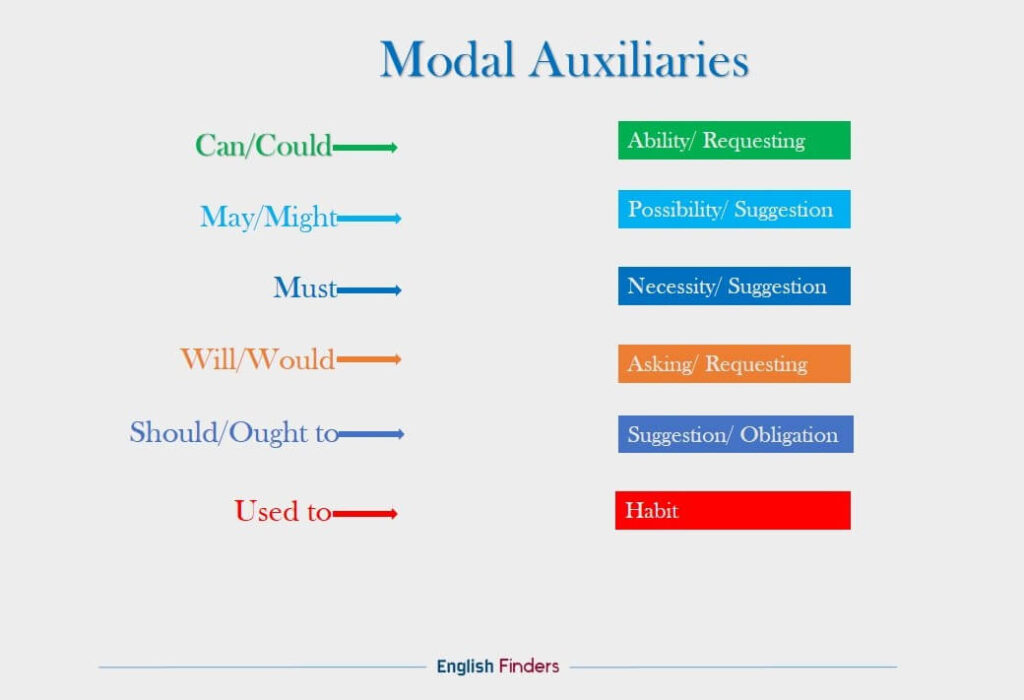
Let us see the functions of modal auxiliary verbs with examples in the table below:
| Modal Auxiliary | Function | Example |
|---|---|---|
| Can | Ability | I can solve the math. |
| Could | Ability, requesting | Could you help me make a study plan? |
| May | Possibility, prayer, permission | May I drink a glass of water? |
| Might | Possibility, suggestion | He might go on a trip. |
| Must | Obligation | You must take responsibility. |
| Will | Asking | Will you give me a book? |
| Would | Requesting | Would you allow us to visit the place? |
| Should | Suggestion | They should concentrate on studying. |
| Ought to | Suggestion, moral obligation | You ought to change your bad habits. |
| Used to | Habit | I used to meet my friends every evening. |
Usage of Modal Auxiliaries
Let us see how we can use different modal auxiliaries in our everyday life:
Can/Could
They are both used to express ability, capability, or request. Examples are in the following sentences:
- I can play football.
- You can take your dinner.
- He can make my dream come true.
- Can she make good food?
- They can fix the issue.
- Mr Lenin could see you.
- We could miss the chance.
- Could you help me fix the problem?
- She could help you.
- The teacher could take the class.
May/Might
They used to express possibility, prayer, suggestion, and obligation. Examples are in the following sentences:
- You may go there.
- He may come here.
- They may choose the topic.
- She may accept it.
- May I accept the challenge?
- He might offer you a good facility.
- You might take it normally.
- They might make the decision.
- Salina might join the program.
- Kamal might offer you a new proposal.
Must
‘Must’ usually expresses certainty or suggestion. Examples are in the following sentences:
- You must do this.
- They must attend the meeting.
- We must respect our parents.
- He must stop his bad habits.
- She must take a break.
Will
‘Will’ is used to express future action or ask for information. Examples are in the following sentences:
- I will buy a smartphone.
- Will you give me a pen?
- He will take this opportunity.
- Will they help themselves?
- Will you make my day happy?
Would
‘Would’ is used to express requesting or mentioning past habitual facts. Examples are in the following sentences:
- Would you lend me a book?
- I would like to play football.
- He would buy a book.
- Would he make a new plan?
- Would you like to join the party?
Should/Ought to
‘Should’ or ‘Ought to’ is usually used to address suggestions or moral obligation. Examples are in the following sentences:
- You should give up bad habits.
- He should study properly.
- They should be present in the classroom.
- We should obey our parents.
- She should accept the real situation.
- You ought to be present there.
- He ought to take proper treatment.
- They ought to understand the true facts.
Used to
‘Used to’ usually indicates habit. Examples are in the following sentences:
- I used to wake up early in the morning.
- He used to play cricket.
- She used to walk in the street.
- They used to participate in different types of programs.
- Mr Labib used to sing beautiful songs.
Rules for Using Modal Auxiliaries
Modal auxiliaries follow a few fixed grammar rules that never change, no matter which subject or tense is used:
- Modals never take an -s, -es, -ed, or -ing ending, even with third-person singular subjects like he, she, or it.
- “To” never follows a modal, except in the two fixed phrases “ought to” and “used to.”
- Two modal auxiliaries are never combined together, such as “will can” or “might should.”
- Modals have no infinitive or -ing form of their own. When one is needed, use “be able to” or “have to” instead, as in “I have been able to solve it.”
Negative Form of Modal Auxiliaries
To make a modal auxiliary negative, add “not” directly after the modal: Subject + Modal + not + base verb. Examples are in the following sentences:
- I cannot (can’t) finish this today.
- She couldn’t attend the meeting.
- You may not enter the room right now.
- He might not (mightn’t) come to the party.
- They mustn’t ignore the safety rules.
- We shouldn’t waste our time.
- He won’t accept the offer.
- I wouldn’t do that if I were you.
Questions with Modal Auxiliaries
To form a yes/no question, put the modal before the subject: Modal + Subject + base verb? Examples are in the following sentences:
- Can you help me with this?
- Could they finish it on time?
- May I ask you a question?
- Should she talk to the manager?
- Would you like some tea?
For a wh-question, add the question word before the modal: Wh-word + Modal + Subject + base verb? Examples are in the following sentences:
- What should I do next?
- Where can we park the car?
- Why would he say that?
Common Mistakes to Avoid
These are the mistakes ESL learners make most often with modal auxiliaries:
- Adding -s for third-person singular: “She cans swim” is incorrect. Modals never change form, so the correct sentence is “She can swim.”
- Adding “to” after a modal: “He must to go” is incorrect. Only “ought to” and “used to” include “to”; the correct sentence is “He must go.”
- Combining two modals: “I will can help” is incorrect. Use “be able to” instead, as in “I will be able to help.”
- Confusing “must” and “should”: “Must” expresses a strong obligation or near-certainty, while “should” expresses advice or a suggestion. “You must wear a seatbelt” is a rule; “You should exercise more” is advice.
Frequently Asked Questions
What are modal auxiliaries?
Modal auxiliaries are a type of helping verb that shows the mood or manner of the main verb, such as ability, possibility, permission, obligation, or necessity. Common modal auxiliaries include can, could, may, might, must, will, would, should, ought to, and used to.
What are some examples of modal auxiliaries?
Examples include “I can solve the math,” “You must take responsibility,” “She should accept the real situation,” and “Would you allow us to visit the place?” Each modal is followed directly by the base form of the main verb.
How many modal auxiliaries are there in English?
English has 10 common modal auxiliaries: can, could, may, might, must, will, would, should, ought to, and used to. Some grammar guides also treat semi-modals like “need to” and “had better” as related forms.
Do modal auxiliaries change form for different subjects?
No. Unlike regular verbs, modal auxiliaries never take an -s, -es, -ed, or -ing ending, even with third-person singular subjects such as he, she, or it. “She can swim” is correct, not “She cans swim.”
Can “to” follow a modal auxiliary?
Generally no. Most modals are followed directly by the base form of the verb with no “to,” such as “He must go.” The only exceptions are “ought to” and “used to,” where “to” is part of the fixed phrase.
What is the difference between must and should?
“Must” expresses a strong obligation, rule, or near-certainty, while “should” expresses advice or a suggestion that can be reasonably declined. “You must wear a seatbelt” is a rule; “You should exercise more” is friendly advice.
Related Articles

- Imagery: Meaning, 7 Types and Examples in Writing - October 10, 2026
- Literary Devices: 30 Common Devices with Meanings and Examples - October 9, 2026
- Bandwagon Fallacy: Meaning, Examples and Origin - October 8, 2026