
Last updated on September 11th, 2026 at 11:57 am
Active and passive voice are the forms of verbs that show whether the subject performs the action or receives the action. In simple words, the active voice tells us who does the action, while the passive voice focuses on what receives the action.
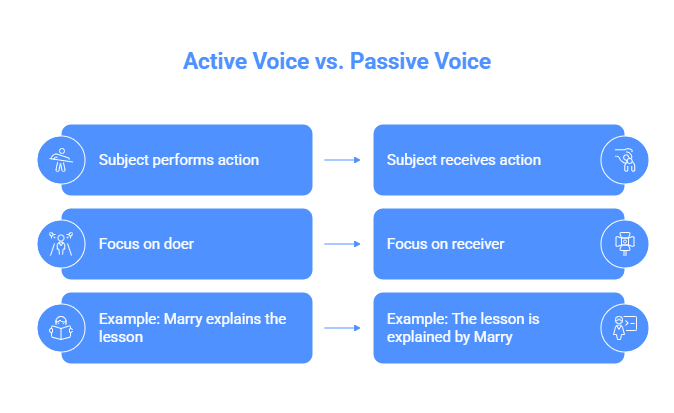
For example, “Mary explains the lesson” (active) can change to “The lesson is explained by Mary” (passive).
So, how do we change active voice into passive voice? First, we take the object of the active sentence and make it the subject.
Then, we use a suitable helping verb and change the main verb into its past participle form. Finally, we can add “by + the doer” if needed.
In this article on Active Voice Vs Passive Voice, you will learn their definitions, structures, uses, and examples in a simple and friendly way.
What Is Voice in English Grammar?
Quick Navigation
In English grammar, voice shows the relationship between the subject and the action of a verb. In other words, it tells us whether the subject is doing the action or receiving the action.
There are two types of voice in English:
1. Active Voice
In the active voice, the subject performs the action.
Structure: Subject + Verb + Object
Example:
- The boy kicks the ball.
Here, the boy (subject) is doing the action.
2. Passive Voice
In passive voice, the subject receives the action.
Structure: Object + Helping Verb + Past Participle + (by Subject)
Example:
- The ball is kicked by the boy.
Here, the ball (subject) receives the action.
As you can see, both sentences have the same meaning, but the focus is different. Active voice focuses on the doer, while passive voice focuses on the action or the receiver.
What Is Active Voice?
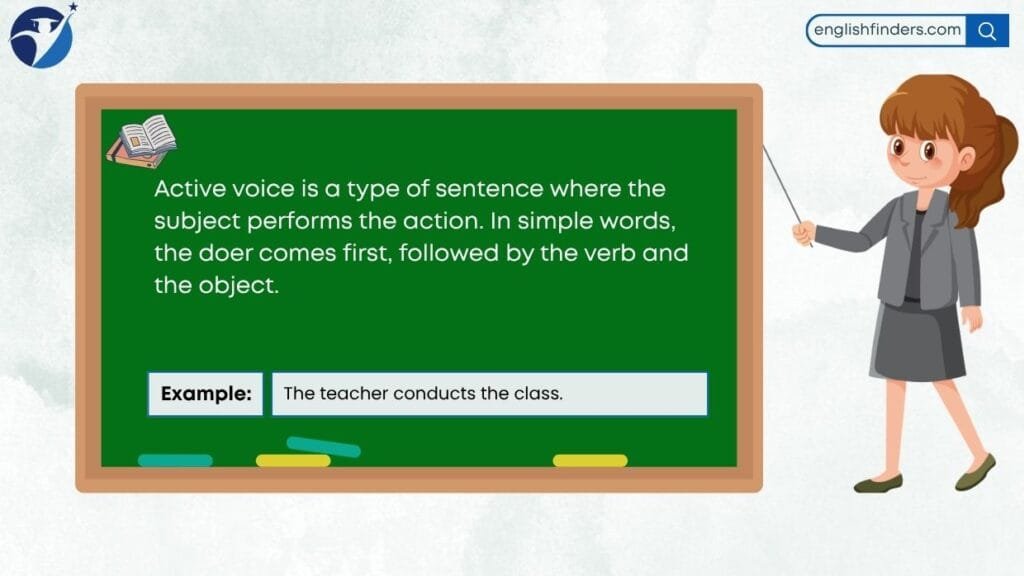
Active voice is a type of sentence where the subject performs the action. In simple words, the doer comes first, followed by the verb and the object.
Because of this clear structure, the active voice is easy to understand and commonly used in everyday speaking and writing.
Structure of Active Voice
Subject + Verb + Object
Examples:
- The teacher conducts the class.
- She writes a letter.
- They play football.
In each sentence, the subject (the teacher, she, they) is doing the action. This makes the meaning direct and clear.
Why Use Active Voice?
Active voice is preferred because it is:
- Clear – The doer of the action is easy to identify
- Direct – Sentences are short and simple
- Strong – It makes writing more lively and engaging
For example:
- Active: The chef cooked the meal.
- Passive: The meal was cooked by the chef.
As you can see, the active sentence sounds more natural and easier to read.
What Is Passive Voice?
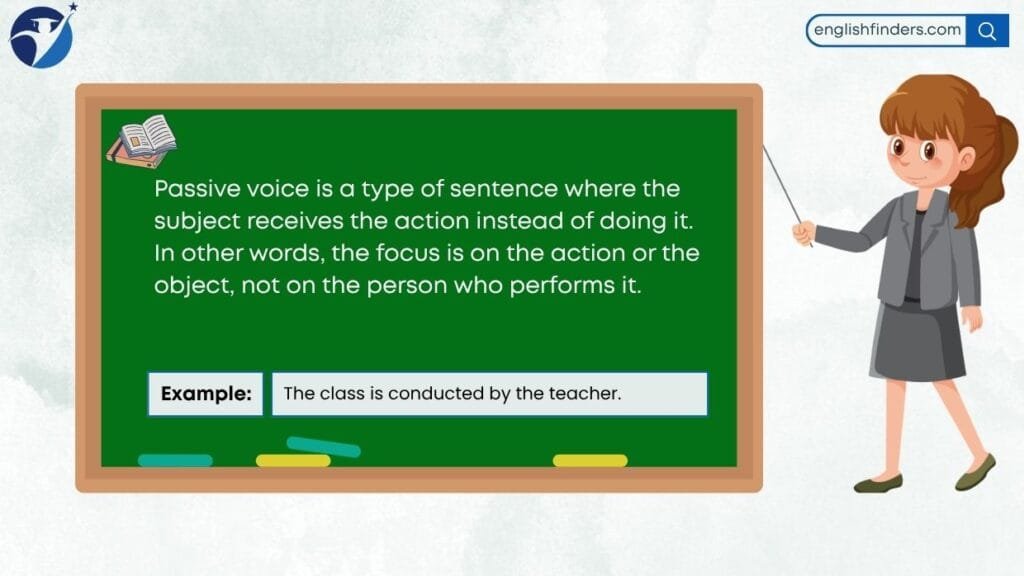
Passive voice is a type of sentence where the subject receives the action instead of doing it. In other words, the focus is on the action or the object, not on the person who performs it.
Structure of Passive Voice
Object + Helping Verb + Past Participle (V3) + (by Subject)
Examples:
- The class is conducted by the teacher.
- A letter is written by her.
- Football is played by them.
In these sentences, the subjects (the class, a letter, football) receive the action.
When Do We Use Passive Voice?
We use passive voice in the following situations:
- When the doer is unknown:
- The window was broken.
- When the action is more important than the doer:
- English is spoken all over the world.
- When we want to be formal or polite:
- Your request has been accepted.
Active Voice Vs Passive Voice (Key Differences)
Understanding the key differences between active voice and passive voice will help you choose the right style for your writing. While both forms are correct, they serve different purposes and create different effects.
Here is a simple comparison to make things clear:
| Feature | Active Voice | Passive Voice |
|---|---|---|
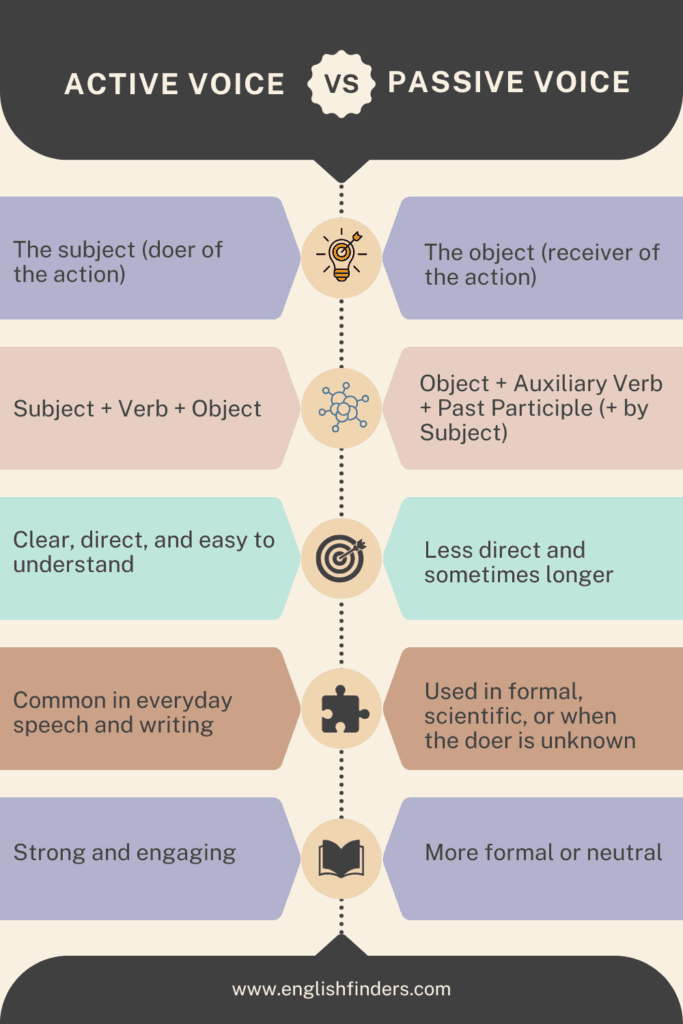
| Focus | The subject (doer of the action) | The object (receiver of the action) |
| Structure | Subject + Verb + Object | Object + Auxiliary Verb + Past Participle (+ by Subject) |
| Clarity | Clear, direct, and easy to understand | Less direct and sometimes longer |
| Usage | Common in everyday speech and writing | Used in formal, scientific, or when the doer is unknown |
| Tone | Strong and engaging | More formal or neutral |
| Example | She writes a letter. | A letter is written by her. |
In Active Voice Vs Passive Voice, the main difference lies in what the sentence emphasizes. Active voice highlights who is doing the action, while passive voice highlights what is happening.
Key Rules for Voice Change (Active to Passive)
To master Voice Change in English Grammar, you need to follow some simple and clear rules. These rules will help you easily change a sentence from active voice to passive voice.
Step-by-Step Method
Follow these steps carefully:
1. Identify the Subject, Verb, and Object
First, find the parts of the sentence:
- Subject → the doer
- Verb → the action
- Object → the receiver
Example:
- The boy (subject) kicks (verb) the ball (object).
2. Make the Object the New Subject
In passive voice, the object of the active sentence becomes the subject.
Example:
- The ball becomes the subject.
3. Use the Correct Helping Verb
Choose the correct helping verb (am, is, are, was, were, will be, etc.) based on the tense of the original sentence.
Example:
- The ball is…
4. Change the Main Verb into Past Participle (V3)
The main verb must always be in its third form (V3) in passive voice.
Example:
- kicks → kicked
5. Add “by + Subject” (if needed)
Finally, add the doer using “by + subject”. However, you can skip it if it is not important or unknown.
Example:
- The ball is kicked by the boy.
Full Transformation Example
- Active: The boy kicks the ball.
- Passive: The ball is kicked by the boy.
Important Tips
- Always keep the tense the same while changing the voice.
- Use the correct form of the helping verb.
- Do not forget to use the past participle (V3).
- Omit “by + subject” if the doer is unknown or unimportant.
Tense-wise Voice Change Rules
To fully understand active and passive voice, it is important to learn how sentences change in different tenses. Although the basic steps stay the same, the helping verb changes according to the tense.
The good news is that the main verb in passive voice is always in past participle form (V3). Let’s look at the rules clearly:
Table: Active to Passive Voice (Tense-wise)
| Tense | Active Voice Structure | Passive Voice Structure | Example (Active → Passive) |
|---|---|---|---|
| Present Simple | Subject + V1 + Object | Object + am/is/are + V3 | She writes a letter → A letter is written by her |
| Present Continuous | Subject + am/is/are + V-ing + Object | Object + am/is/are + being + V3 | She is writing a letter → A letter is being written by her |
| Present Perfect | Subject + has/have + V3 + Object | Object + has/have + been + V3 | She has written a letter → A letter has been written by her |
| Past Simple | Subject + V2 + Object | Object + was/were + V3 | She wrote a letter → A letter was written by her |
| Past Continuous | Subject + was/were + V-ing + Object | Object + was/were + being + V3 | She was writing a letter → A letter was being written by her |
| Past Perfect | Subject + had + V3 + Object | Object + had + been + V3 | She had written a letter → A letter had been written by her |
| Future Simple | Subject + will + V1 + Object | Object + will be + V3 | She will write a letter → A letter will be written by her |
Key Points to Remember
- The object of the active sentence becomes the subject in passive voice.
- The tense does not change, only the structure changes.
- The main verb is always in V3 (past participle) form.
- The helping verb changes depending on the tense (am, is, was, has been, will be, etc.).
Examples of Active to Passive Voice
Now that you understand the rules and structures, let’s look at some clear examples. These examples will help you practice active and passive voice step by step. Each sentence shows how an active sentence changes into a passive one.
1. Present Simple Tense
- Active: She writes a letter.
- Passive: A letter is written by her.
- Active: They clean the room.
- Passive: The room is cleaned by them.
2. Present Continuous Tense
- Active: She is writing a letter.
- Passive: A letter is being written by her.
- Active: They are watching a movie.
- Passive: A movie is being watched by them.
3. Present Perfect Tense
- Active: She has written a letter.
- Passive: A letter has been written by her.
- Active: They have completed the work.
- Passive: The work has been completed by them.
4. Past Simple Tense
- Active: She wrote a letter.
- Passive: A letter was written by her.
- Active: He helped me.
- Passive: I was helped by him.
5. Past Continuous Tense
- Active: She was writing a letter.
- Passive: A letter was being written by her.
- Active: They were playing football.
- Passive: Football was being played by them.
6. Past Perfect Tense
- Active: She had written a letter.
- Passive: A letter had been written by her.
- Active: They had finished the task.
- Passive: The task had been finished by them.
7. Future Simple Tense
- Active: She will write a letter.
- Passive: A letter will be written by her.
- Active: They will build a house.
- Passive: A house will be built by them.
Special Cases in Voice Change
While learning Voice Change from active to passive, you will notice that some sentences do not follow the basic pattern. These are called special cases. However, if you understand a few simple rules, you can handle them easily.
1. Imperative Sentences (Commands, Requests, Advice)
Imperative sentences usually begin with a verb and give an order, request, or advice. In passive voice, we often use “let” or “should be”.
Examples:
- Active: Open the door.
- Passive: Let the door be opened.
- Active: Complete the work.
- Passive: Let the work be completed.
- Active: Respect your teachers.
- Passive: Your teachers should be respected.
2. Interrogative Sentences (Questions)
When changing questions, the helping verb comes before the subject in passive voice.
Examples:
- Active: Do you write a letter?
- Passive: Is a letter written by you?
- Active: Did she finish the work?
- Passive: Was the work finished by her?
3. Sentences Without Object
Some active sentences do not have an object. These sentences cannot be changed into passive voice.
Examples:
- He runs fast. ❌ (No passive form)
- She is sleeping. ❌ (No passive form)
👉 Remember: Without an object, passive voice is not possible.
4. Use of “by + Doer”
In passive voice, we can mention the doer using “by + subject”. However, we often omit it when:
- The doer is unknown
- The doer is not important
Examples:
- Passive: The thief was arrested. (Doer not needed)
- Passive: The homework was completed by the student. (Doer important)
5. Modal Verbs (Can, May, Must, etc.)
When a sentence has a modal verb, the passive form uses:
👉 Modal + be + V3
Examples:
- Active: She can solve the problem.
- Passive: The problem can be solved by her.
- Active: You must follow the rules.
- Passive: The rules must be followed by you.
Final Words
Throughout this lesson, you have learned the basic rules, tense-wise structures, and special cases of changing active voice into passive voice. Although it may seem difficult at first, it becomes much easier with regular practice and careful attention to verb forms.
Moreover, using the active voice makes your sentences direct and strong, while the passive voice helps you sound more formal or focus on the action. So, both forms are useful in different situations.
Frequently Asked Questions
What is Voice Change in English Grammar?
Voice Change in English Grammar means changing a sentence from active voice to passive voice or from passive to active. It changes the focus of the sentence—from the doer of the action to the receiver of the action.
What is the main difference between active and passive voice?
In active voice, the subject does the action, while in passive voice, the subject receives the action.
Active: Jonny drinks water.
Passive: Water is drunk by Jonny.
What are the basic rules for changing active to passive voice?
To change a sentence:
Make the object the subject
Use the correct helping verb
Change the main verb into past participle (V3)
Add “by + subject” if needed
Can every active sentence be changed into passive voice?
No. Only sentences with an object can be changed into passive voice, since the object becomes the new subject. Sentences without an object, such as He runs fast, have no passive form.
When should I use passive voice instead of active voice?
Passive voice works well when the doer is unknown, when the action matters more than the doer, or when you want a more formal or polite tone, such as in scientific writing or official notices.
Does the tense change when converting active voice to passive voice?
No, the tense stays the same. Only the sentence structure changes, and the helping verb shifts to match that same tense, such as is for present simple or was for past simple.
Related Articles

- Synecdoche: Meaning, Pronunciation and Examples - October 20, 2026
- Metonymy: Meaning, Types and Examples in the News - October 20, 2026
- Figures of Speech: Meaning, Types and Examples - October 19, 2026