

Last updated on June 13th, 2026 at 09:07 pm
The Past Indefinite Tense (also called the Simple Past Tense) is used to describe actions, events, or situations that started and finished in the past. In simple words, we use the Past Indefinite Tense when we talk about something that happened at a specific time before now.
For example, “I visited the place last weekend” and “She completed her project yesterday” are both sentences in the Past Indefinite Tense.
What Is the Past Indefinite Tense?
Quick Navigation
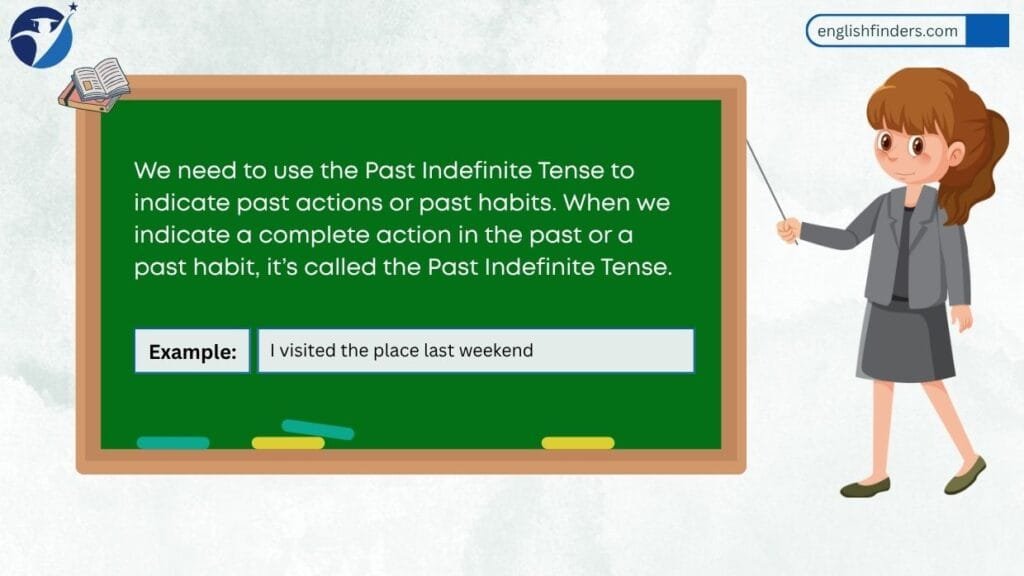
We need to use the Past Indefinite Tense to indicate past actions or past habits. Past Indefinite Tense is also known as the ‘Simple Past’ tense. But the question is, what is the definition of Past Indefinite Tense? The definition is very simple. When we indicate a complete action in the past or a past habit, it’s called the Past Indefinite Tense.
Why Is It Called “Past Indefinite”?
The tense is called Past because it refers to actions that happened before the present. It is called Indefinite because the focus is on the completed action itself rather than on its duration or ongoing nature.
For example:
- I visited my uncle last Sunday.
- She wrote a letter yesterday.
- I did my duty correctly.
- He retired from his job.
- She controlled her weight.
- Lopa completed her homework.
- They missed their childhood.
- We watched a documentary last night.
In each sentence, the action happened in the past and ended there.
Another Name: Simple Past Tense
Many grammar books and English teachers use the term Simple Past Tense instead of Past Indefinite Tense. Both names refer to the same tense and follow the same rules.
Example:
- Past Indefinite: He played cricket yesterday.
- Simple Past: He played cricket yesterday.
There is no difference in meaning or structure.
Key Features of the Past Indefinite Tense
The Past Indefinite Tense has several important characteristics:
- It describes completed actions in the past.
- It often uses the second form of the verb (V2).
- It may include a specific past time expression.
- It is commonly used in storytelling and narration.
- It helps us talk about past experiences and historical events.
Here are some simple examples:
| Sentence | Explanation |
|---|---|
| I finished my homework. | The action was completed in the past. |
| She traveled to Cox’s Bazar last year. | The trip happened and ended last year. |
| They played football after school. | The activity took place in the past. |
| We visited the museum yesterday. | The visit was completed yesterday. |
| He bought a new bicycle. | The purchase happened in the past. |
Quick Summary
The Past Indefinite Tense is used for actions that happened and finished in the past. It is one of the most frequently used tenses in English because it allows us to describe past events, tell stories, and share experiences clearly and effectively. Understanding this tense is the first step toward speaking and writing confidently about the past.
Structure of the Past Indefinite Tense
We need to understand the structure of the Past Indefinite Tense to form correct sentences. Fortunately, the rules are simple. In affirmative sentences, we usually use the second form of the verb (V2). However, in negative and interrogative sentences, we use the helping verb did, and the main verb returns to its base form (V1).
Let’s examine each sentence type in detail.
A. Affirmative Sentences
Affirmative sentences are used to state that an action happened in the past.
Structure:
Subject + Verb (V2) + Object/Complement
Examples:
- I visited my grandparents last weekend.
- She completed her project on time.
- They played football after school.
- We watched a movie yesterday.
- He bought a new laptop.
Explanation:
Notice that the main verb appears in its past form (V2):
- visit → visited
- complete → completed
- play → played
- watch → watched
- buy → bought
B. Negative Sentences
Negative sentences show that an action did not happen in the past.
Structure:
Subject + did not (didn’t) + Verb (V1) + Object/Complement
Examples:
- I did not visit my grandparents last weekend.
- She didn’t complete her project on time.
- They did not play football after school.
- We didn’t watch the movie yesterday.
- He did not buy a new laptop.
Important Rule:
After did not (didn’t), always use the base form (V1) of the verb.
✅ Correct: She did not go to school.
❌ Incorrect: She did not went to school.
C. Interrogative Sentences
Interrogative sentences are used to ask questions about past actions.
Structure:
Did + Subject + Verb (V1) + Object/Complement?
Examples:
- Did you finish your homework?
- Did she complete the assignment?
- Did they play football yesterday?
- Did we meet the teacher last week?
- Did he buy a new laptop?
Explanation:
Just like negative sentences, the main verb remains in its base form (V1) after did.
D. Interrogative Negative Sentences
Interrogative negative sentences ask questions in a negative form. They are often used to express surprise or seek confirmation.
Structure:
Did + Subject + not + Verb (V1) + Object/Complement?
Or
Didn’t + Subject + Verb (V1) + Object/Complement?
Examples:
- Did you not attend the meeting?
- Didn’t she finish her homework?
- Did they not play in the tournament?
- Didn’t we visit that museum before?
- Didn’t he call you yesterday?
Quick Structure Summary Table
| Sentence Type | Structure | Example |
|---|---|---|
| Affirmative | Subject + V2 + Object | She wrote a letter. |
| Negative | Subject + did not + V1 + Object | She did not write a letter. |
| Interrogative | Did + Subject + V1 + Object? | Did she write a letter? |
| Interrogative Negative | Didn’t + Subject + V1 + Object? | Didn’t she write a letter? |
Key Points to Remember
- Use V2 (past form) in affirmative sentences.
- Use did/did not in questions and negative sentences.
- After did or did not, always use V1 (base form).
- The structure remains the same for all subjects (I, you, he, she, it, we, and they).
Let us see the different forms of the Past Indefinite Tense in sentences:
| Affirmative | Interrogative | Negative | Negative Interrogative |
| I forgot to send the file. | Did I forget to send the file? | I did not forget to send the file. | Did I not forget to send the file? |
| I missed my old days. | Did I miss my old days? | I did not miss my old days. | Did I not miss my old days? |
| He joined the conversation. | Did he join the conversation? | He did not join the conversation. | Did he not join the conversation? |
| We arranged a farewell program. | Did we arrange a farewell program? | We did not arrange a farewell program. | Did we not arrange a farewell program? |
| You failed in English. | Did you fail in English? | You did not fail in English. | Did you not fail in English? |
Examples of The Past Indefinite Tense
Let us see some examples of the Past Indefinite Tense:
- I got the point.
- He went to a historical place yesterday.
- You observed the situation.
- We found our weakness.
- Alim attended the program.
- Lee passed the last examination.
- Did you miss your friend?
- We enjoyed the party last night.
- They watched a horror movie.
- I forgot to participate in the program.
- I improved my English skills slowly.
- You did not catch the fish.
- Did you not accept the proposal?
- He ate good food yesterday.
- She waited for you two days ago.
- Brendon reached his campus.
- Kamran borrowed a book from his friend.
- Did they solve the issue correctly?
- We missed our old days.
- He was appointed as an officer in charge.

- Synecdoche: Meaning, Pronunciation and Examples - October 20, 2026
- Metonymy: Meaning, Types and Examples in the News - October 20, 2026
- Figures of Speech: Meaning, Types and Examples - October 19, 2026
Good.
Good