
Last updated on October 8th, 2026 at 03:51 pm
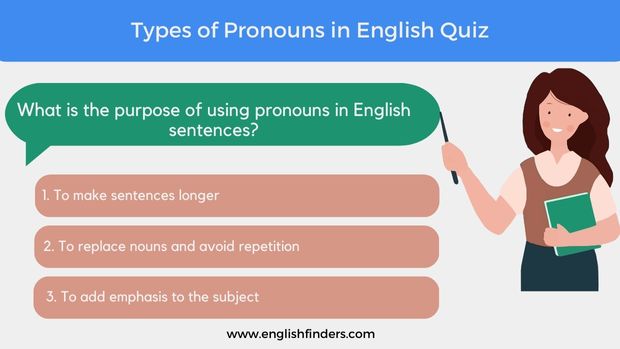
Ten questions, four choices each, about five minutes. The quiz checks personal, object, possessive, reflexive and demonstrative pronouns.
Not sure about a type? Read the quick review first. After the quiz, you will find extra practice on four more types.
- Nine kinds of pronouns in one short table
- How well you know them, with a 10-question quiz
- Extra practice on indefinite, relative, interrogative and reciprocal pronouns
- The pronoun mistakes learners make most
- Where to study each type in more detail
Quick Review Before You Start
Quick Navigation
A pronoun takes the place of a noun. It helps us avoid saying the same noun again and again.
| Type | What it does | Examples |
|---|---|---|
| Personal | Names a person or thing | I, you, he, she, it, we, they |
| Object | Receives the action | Me, him, her, us, them |
| Possessive | Shows who owns something | Mine, yours, his, hers, ours, theirs |
| Reflexive | Refers back to the subject | Myself, yourself, herself, themselves |
| Demonstrative | Points to something | This, that, these, those |
| Interrogative | Asks a question | Who, whom, whose, which, what |
| Indefinite | Talks about people or things in general | Someone, anything, everybody, nobody |
| Relative | Adds information about a noun | Who, which, that, whose |
| Reciprocal | Shows two people doing the same thing to each other | Each other, one another |
Want more detail first? Read our full lesson on the 8 types of pronouns.
Pronouns Quiz

Got some answers wrong? Look at the review table again. Then try the quiz one more time.
Extra Practice: Four More Types
The quiz above does not test these types, so try them here. What type of pronoun is the word in bold?
- Someone left a bag on the bus.
- The girl who lives next door is my friend.
- Who broke the window?
- Sara and Tom help each other with homework.
- Everybody loves summer.
- This is the book that I told you about.
- Which is your bag?
- The two teams respect one another.
Show answers
- Indefinite. Someone does not name a person.
- Relative. Who adds information about the girl.
- Interrogative. Who asks a question.
- Reciprocal. Sara helps Tom, and Tom helps Sara.
- Indefinite. Everybody means all people in general.
- Relative. That adds information about the book.
- Interrogative. Which asks a question, and no noun comes after it.
- Reciprocal. Each team respects the other.
Common Pronoun Mistakes
| Mistake | Wrong | Right |
|---|---|---|
| Your / you’re | Your welcome. | You’re welcome. |
| Its / it’s | The dog wagged it’s tail. | The dog wagged its tail. |
| Me / I as a subject | Me and Sara went home. | Sara and I went home. |
| I / me after a preposition | This gift is for you and I. | This gift is for you and me. |
| Their / there | There bags are here. | Their bags are here. |
Check your answer
Key Takeaways
- A pronoun takes the place of a noun.
- Subject pronouns (I, she) do the action. Object pronouns (me, her) receive it.
- My bag needs a noun, but mine stands alone.
- Reflexive pronouns end in -self or -selves.
- Its shows ownership and never takes an apostrophe.
Want to keep going? Practice with 50 examples of possessive pronouns, or learn more about reflexive pronouns.
Frequently Asked Questions
What is a pronoun?
A pronoun is a word that takes the place of a noun. In “Tom is tall. He plays basketball.”, the word “he” is a pronoun.
How many types of pronouns are there?
Many grammar books list eight types: personal, possessive, reflexive, demonstrative, indefinite, relative, interrogative and distributive pronouns. Some books also add reciprocal pronouns, like each other.
What is the difference between your and yours?
“Your” comes before a noun: “your bag”. “Yours” stands alone: “This bag is yours.” Never write “your’s”.
What is a reflexive pronoun?
A reflexive pronoun ends in -self or -selves, like myself or themselves. It refers back to the subject: “She made herself a cup of tea.”
Is it “Sara and I” or “Sara and me”?
Use “Sara and I” as the subject: “Sara and I went home.” Use “Sara and me” after a verb or preposition: “The teacher called Sara and me.”
How many questions are in this pronouns quiz?
The quiz has ten multiple-choice questions. Each question has four answers, and only one answer is correct.
Related Articles

- Antithesis: Meaning, Examples and the Grammar of Balance - October 17, 2026
- Anaphora: Meaning, Examples and How to Use It - October 17, 2026
- Flashback: Meaning, Examples and How to Write One - October 16, 2026