
Last updated on November 22nd, 2026 at 08:36 am
The fastest way to feel at home with compound sentences is to read a lot of them. This page gives you 50, sorted by the word that joins the two halves.
In each example, the joining word is in bold. You can see the pattern at once.
After the examples, there are three short exercises with answers and a quiz. If you want the full rules first, read our lesson on compound sentences with 10 examples.
- 50 compound sentences, grouped by joining word
- What each joining word means
- How to use a semicolon, however and therefore
- How to spot sentences that look compound but are not
- Three exercises with answers
How These Sentences Work
Quick Navigation
Each sentence below has two parts. Both parts have a subject and a verb, and both could stand alone as a sentence. A comma and a joining word connect them, or a semicolon does.
50 Examples of Compound Sentences
With “And” (Adds an Idea)
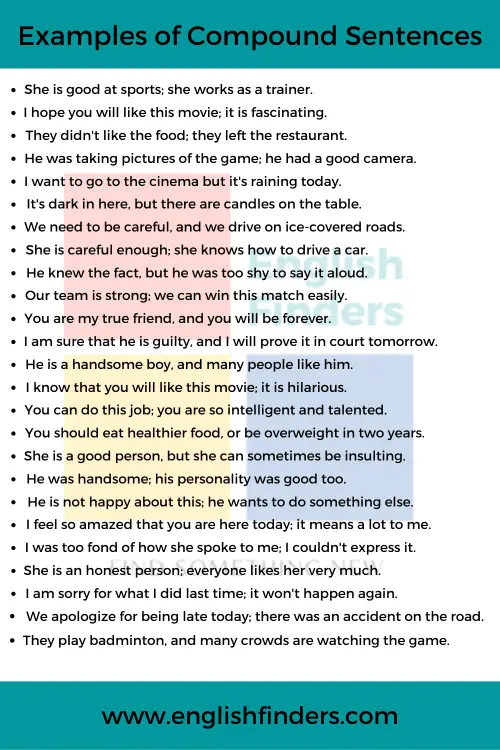
- She went to the store, and he stayed at home.
- I cooked dinner, and my brother washed the dishes.
- The sun was shining, and the birds were singing.
- Maria speaks Spanish, and her husband speaks Portuguese.
- We finished our homework, and then we played outside.
- The museum opens at nine, and it closes at five.
- My phone was charging, and my laptop was updating.
- He scored the first goal, and his friend scored the second.
With “But” (Shows a Contrast)
- I enjoy reading, but I also love watching movies.
- It’s dark in here, but there are candles on the table.
- He knew the truth, but he was too shy to say it.
- She is a kind person, but she can be very direct.
- The hotel was cheap, but the rooms were clean.
- I called him twice, but he didn’t answer.
- We wanted to go out, but it was raining.
- The test was long, but the questions were easy.
With “Or” (Gives a Choice)
- We can go to the beach, or we can go to the park.
- You can pay now, or you can pay later.
- Hurry up, or we will miss the train.
- Do you want tea, or would you prefer coffee?
- You should eat healthier food, or you may have health problems later.
- We can watch a film, or we can play a board game.
With “So” (Shows a Result)
- He didn’t want to tell me his age, so I didn’t ask again.
- Our team trained hard, so we won the match easily.
- The shop was closed, so we went home.
- I was thirsty, so I drank a glass of water.
- She missed the bus, so she took a taxi.
- The road was icy, so we drove slowly.
- It was my birthday, so my friends baked a cake.
- The film was very funny, so we laughed all evening.
With “Yet” (Shows a Surprising Contrast)
- She was aware of the risks, yet she agreed to take them.
- He is very rich, yet he lives in a small house.
- The task was difficult, yet we finished it on time.
- I studied all night, yet I forgot the answers.
- It was sunny, yet the air was cold.
With “For” (Gives a Reason, Formal)
- He was ready to go out, for he had already put on his shoes.
- We stayed inside, for it was too cold to play.
- She smiled, for she had good news.
- They walked quickly, for the train was leaving soon.
With “Nor” (Adds a Second Negative)
- He doesn’t like tea, nor does he like coffee.
- I didn’t see the film, nor did I read the book.
- She can’t swim, nor can she ride a bike.
- We haven’t finished the report, nor have we started the slides.
With a Semicolon
- They didn’t like the food; they left the restaurant.
- I have known him for years; he is honest.
- Our team is strong; we can win this match.
- It was late; the streets were empty.
With “However” or “Therefore”
- I have considered your offer; however, I need more time.
- She practiced every day; therefore, she played very well.
- The tickets were expensive; however, the show was worth it.
What Each Joining Word Means
| Joining word | Meaning | Example |
|---|---|---|
| And | Adds an idea | I cooked, and he cleaned. |
| But | Shows a contrast | It was cheap, but it was good. |
| Or | Gives a choice | Pay now, or pay later. |
| So | Shows a result | It rained, so we stayed in. |
| Yet | Shows a surprising contrast | He is rich, yet he lives simply. |
| For | Gives a reason (formal) | She smiled, for she had good news. |
| Nor | Adds a second negative | He can’t sing, nor can he dance. |
| Semicolon | Joins two closely linked ideas | It was late; the streets were empty. |
Looks Compound, But Isn’t
- One subject, two verbs: “My brother plays the guitar and sings.” There is only one subject, so this is a simple sentence.
- Two subjects, one verb: “Tom and Ana went to the park.” This is one clause, so it is simple.
- A dependent clause: “I stayed home because I was sick.” Because makes the second part depend on the first, so the sentence is complex.
- A comma alone: “It was late, we went home.” This is a mistake called a comma splice. Add a joining word or a semicolon.
Check your answer
Exercises With Answers
Part A: Find the Joining Word
- I was tired, but I finished my work.
- You can come with us, or you can stay here.
- She lost her phone, so she bought a new one.
- It rained all night; the roads were wet.
- He doesn’t eat fish, nor does he eat eggs.
Show answers for Part A
- But
- Or
- So
- A semicolon
- Nor
Part B: Compound or Not?
- My brother plays the guitar and sings.
- My brother plays the guitar, and my sister sings.
- I stayed home because I was sick.
- I was sick, so I stayed home.
- Tom and Ana went to the park.
Show answers for Part B
- Not compound: one subject with two verbs.
- Compound: two subjects and two verbs.
- Not compound: it is a complex sentence.
- Compound: two clauses joined by so.
- Not compound: one clause with two names.
Part C: Join the Sentences
Use the word in brackets.
- The coffee was hot. I drank it slowly. (so)
- He is young. He is very wise. (yet)
- I wanted to call you. My phone was dead. (but)
- We can eat now. We can wait for Dad. (or)
- She opened the window. Fresh air came in. (and)
Show answers for Part C
- The coffee was hot, so I drank it slowly.
- He is young, yet he is very wise.
- I wanted to call you, but my phone was dead.
- We can eat now, or we can wait for Dad.
- She opened the window, and fresh air came in.
Quiz: Test Yourself
- “I was thirsty, ___ I drank some water.”
- Which sentence is compound?
- “He is rich, ___ he lives in a small house.”
- Which joining word gives a reason?
- “She can’t swim, nor ___ ride a bike.”
- Choose the correct punctuation.
- “Hurry up, ___ we will miss the train.”
- Is “Tom and Ana went to the park” a compound sentence?
- Which word needs a semicolon before it?
- “We wanted to go out, ___ it was raining.”
Key Takeaways
- Read many examples to learn the pattern: clause + joining word + clause.
- Each joining word has a job: and adds, but contrasts, so shows a result.
- Yet shows a surprise, for gives a reason, and nor adds a second negative.
- Put a semicolon before however and therefore.
- Check for two subjects and two verbs before you call a sentence compound.
Frequently Asked Questions
What is a compound sentence?
A compound sentence joins two complete sentences (independent clauses) with a word like and, but or so, or with a semicolon. Example: The hotel was cheap, but the rooms were clean.
What are 5 examples of compound sentences?
I was thirsty, so I drank some water. She went out, and he stayed home. We can walk, or we can take the bus. He is rich, yet he lives simply. It was late; the streets were empty.
How do you make a compound sentence?
Take two complete sentences and join them with a comma and a joining word (for, and, nor, but, or, yet, so). You can also join them with a semicolon.
Can a compound sentence have three clauses?
Yes, for example: I cooked, my sister cleaned, and my brother set the table. Even so, two clauses are usually clearer, so avoid long chains.
Is “I like tea and coffee” a compound sentence?
No. It has only one subject and one verb, so it is a simple sentence. A compound version is: I like tea, and my sister likes coffee.
Where can I practice compound sentences?
Try the three exercises with answers on this page, then take the simple, compound and complex sentences quiz on English Finders.
Related Articles

- Who vs Whom: The Simple Test and When Whom Still Matters - November 22, 2026
- Advice vs Advise: Noun or Verb, Sound and Examples - November 22, 2026
- Oxford Comma: What It Is, Examples and When to Use It - November 21, 2026