
Last updated on October 17th, 2026 at 08:07 pm
A kind teacher. A small house. A happy child. The words in italics are adjectives. They tell us more about a person or a thing.
An adjective is a describing word. We use adjectives all the time, to say what people, places and things are like. A good list of adjectives is the fastest way to build your vocabulary.
This lesson gives 100 common adjectives with meanings, opposites and example sentences. It also has exercises, a quiz and a FAQ.
- What an adjective is and where it goes in a sentence
- 100 common adjectives in five groups
- The meaning, the opposite and an example for each adjective
- How to avoid common mistakes, with exercises and a quiz
What Is an Adjective?
Quick Navigation
An adjective describes a noun or a pronoun. It answers questions such as What kind? and How big?
We put an adjective in two places. It can come before a noun, or after a verb such as be, look or feel.
| Place | Example |
|---|---|
| Before a noun | I have a red car. |
| After be | The car is red. |
| After look or feel | She looks happy. |
An adjective does not change for singular or plural. We say a tall boy and two tall boys.
100 Common Adjectives with Meanings
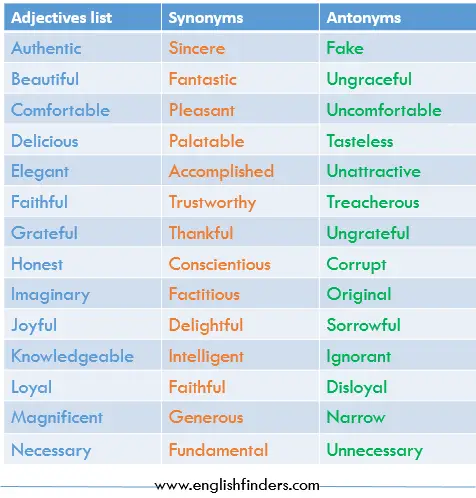
The adjectives are in five groups. Each row shows the meaning, an opposite and a short example.
Adjectives for People
| No. | Adjective | Meaning | Opposite | Example |
|---|---|---|---|---|
| 1 | Kind | Nice to other people | Unkind | She is kind to everyone. |
| 2 | Brave | Not afraid of danger | Cowardly | The brave man saved the boy. |
| 3 | Honest | Always telling the truth | Dishonest | He is an honest shopkeeper. |
| 4 | Polite | Having good manners | Rude | The polite girl said thank you. |
| 5 | Friendly | Open and nice to others | Unfriendly | Our neighbours are friendly. |
| 6 | Clever | Quick to learn | Foolish | My sister is a clever student. |
| 7 | Lazy | Not wanting to work | Hardworking | The lazy boy sleeps all day. |
| 8 | Generous | Happy to give to others | Selfish | He is generous with his time. |
| 9 | Shy | Nervous with new people | Confident | The shy girl sat alone. |
| 10 | Calm | Quiet and not worried | Nervous | Stay calm and listen to me. |
| 11 | Patient | Able to wait without anger | Impatient | A good teacher is patient. |
| 12 | Funny | Making you laugh | Serious | My uncle tells funny stories. |
| 13 | Loyal | Always on your side | Disloyal | A dog is a loyal friend. |
| 14 | Gentle | Soft and careful | Rough | Be gentle with the baby. |
| 15 | Careful | Taking care to avoid errors | Careless | Be careful on the stairs. |
| 16 | Strong | Having a lot of power | Weak | The strong man lifted the box. |
| 17 | Helpful | Giving help | Unhelpful | The helpful clerk found my bag. |
| 18 | Cheerful | Happy and full of life | Gloomy | She is always cheerful. |
| 19 | Wise | Knowing what is right | Silly | My grandfather is a wise man. |
| 20 | Curious | Wanting to know more | Uninterested | Children are curious by nature. |
Adjectives for Feelings and Health
| No. | Adjective | Meaning | Opposite | Example |
|---|---|---|---|---|
| 21 | Happy | Feeling joy | Sad | I am happy today. |
| 22 | Angry | Feeling strong dislike | Pleased | He was angry about the noise. |
| 23 | Afraid | Feeling fear | Fearless | The child is afraid of dogs. |
| 24 | Excited | Full of joy about something | Bored | We are excited about the trip. |
| 25 | Tired | Needing rest | Energetic | I am tired after work. |
| 26 | Hungry | Needing food | Full | The kids are hungry. |
| 27 | Worried | Thinking about problems | Relaxed | She is worried about the exam. |
| 28 | Proud | Happy about what you did | Ashamed | He is proud of his son. |
| 29 | Comfortable | Feeling at ease | Uncomfortable | This chair is comfortable. |
| 30 | Satisfied | Happy with what you have | Unsatisfied | The customer was satisfied. |
| 31 | Jealous | Unhappy about what others have | Content | He is jealous of his brother. |
| 32 | Grateful | Thankful | Ungrateful | I am grateful for your help. |
| 33 | Hopeful | Thinking good things will come | Hopeless | We are hopeful about the result. |
| 34 | Confused | Not able to understand | Certain | I am confused by this map. |
| 35 | Glad | Pleased | Sorry | I am glad to see you. |
| 36 | Healthy | Not ill | Ill | Fruit keeps you healthy. |
| 37 | Sleepy | Ready to sleep | Awake | The baby is sleepy. |
| 38 | Surprised | Shocked by something new | Unsurprised | She was surprised by the gift. |
| 39 | Lucky | Having good chances | Unlucky | You are lucky to be here. |
| 40 | Busy | Having a lot to do | Free | My mother is busy today. |
Adjectives for Size and Appearance
| No. | Adjective | Meaning | Opposite | Example |
|---|---|---|---|---|
| 41 | Big | Large in size | Small | They live in a big house. |
| 42 | Tall | High from bottom to top | Short | My brother is very tall. |
| 43 | Long | Having great length | Short | The river is long. |
| 44 | Heavy | Weighing a lot | Light | This bag is heavy. |
| 45 | Thin | Not thick | Thick | I need a thin blanket. |
| 46 | Wide | Large from side to side | Narrow | The road is wide. |
| 47 | Deep | Going far down | Shallow | The lake is deep. |
| 48 | High | Far above the ground | Low | The tower is very high. |
| 49 | Huge | Very big | Tiny | The elephant is huge. |
| 50 | Young | Not old | Old | The young girl plays outside. |
| 51 | Beautiful | Very nice to look at | Ugly | The garden is beautiful. |
| 52 | Clean | Free from dirt | Dirty | My room is clean. |
| 53 | Neat | Tidy and in order | Messy | His desk is always neat. |
| 54 | Bright | Giving a lot of light | Dark | The sun is bright today. |
| 55 | Smooth | Flat with no bumps | Rough | The table feels smooth. |
| 56 | Soft | Not hard | Hard | The bed is soft. |
| 57 | Shiny | Reflecting light | Dull | She wore shiny shoes. |
| 58 | Flat | Level and even | Curved | The land is flat here. |
| 59 | Straight | With no bend | Crooked | Draw a straight line. |
| 60 | Pretty | Pleasing to see | Plain | She wore a pretty dress. |
Adjectives for Things and Places
| No. | Adjective | Meaning | Opposite | Example |
|---|---|---|---|---|
| 61 | New | Made not long ago | Old | I bought a new phone. |
| 62 | Modern | Of the present time | Ancient | They live in a modern flat. |
| 63 | Cheap | Costing little money | Expensive | The bus ticket is cheap. |
| 64 | Empty | With nothing inside | Crowded | The room is empty. |
| 65 | Quiet | Making little noise | Noisy | The library is quiet. |
| 66 | Safe | Free from danger | Dangerous | This road is safe. |
| 67 | Hot | Having a high heat | Cold | The tea is hot. |
| 68 | Warm | A little hot | Cool | The water is warm. |
| 69 | Wet | Covered with water | Dry | The grass is wet. |
| 70 | Sweet | Tasting like sugar | Bitter | This mango is sweet. |
| 71 | Fresh | New and not old | Stale | The bread is fresh. |
| 72 | Delicious | Tasting very good | Awful | The cake is delicious. |
| 73 | Rich | Having a lot of money | Poor | The rich man owns a hotel. |
| 74 | Public | Open to everyone | Private | We met in a public park. |
| 75 | Open | Not closed | Closed | The shop is open. |
| 76 | Local | From the same area | Foreign | I buy local fruit. |
| 77 | Real | Not fake | Fake | This is a real diamond. |
| 78 | Free | Costing no money | Paid | The museum is free. |
| 79 | Sharp | Able to cut well | Blunt | Be careful with the sharp knife. |
| 80 | Popular | Liked by many people | Unknown | It is a popular game. |
Adjectives for Opinions and Quality
| No. | Adjective | Meaning | Opposite | Example |
|---|---|---|---|---|
| 81 | Good | Of high quality | Bad | It was a good film. |
| 82 | Great | Very good | Terrible | We had a great holiday. |
| 83 | Important | Needing attention | Unimportant | Sleep is important. |
| 84 | Easy | Not hard to do | Difficult | The test was easy. |
| 85 | Simple | Not complicated | Complicated | Here is a simple plan. |
| 86 | Interesting | Making you want to know more | Boring | This book is interesting. |
| 87 | Useful | Helpful for a job | Useless | A map is useful on a trip. |
| 88 | Possible | Able to happen | Impossible | It is possible to learn quickly. |
| 89 | True | Agreeing with the facts | False | The story is true. |
| 90 | Right | Correct | Wrong | You gave the right answer. |
| 91 | Necessary | Needed | Unnecessary | Water is necessary for life. |
| 92 | Famous | Known by many people | Obscure | He is a famous singer. |
| 93 | Special | Different and better | Ordinary | Today is a special day. |
| 94 | Perfect | With no mistakes | Imperfect | Her English is perfect. |
| 95 | Correct | Without errors | Incorrect | Is this answer correct? |
| 96 | Normal | Usual | Strange | It was a normal day. |
| 97 | Common | Seen often | Rare | Rice is a common food. |
| 98 | Fair | Treating all people the same | Unfair | The judge is fair. |
| 99 | Excellent | Extremely good | Poor | She wrote an excellent essay. |
| 100 | Different | Not the same | Same | We have different ideas. |
Opposites at a Glance
Many adjectives come in pairs. You can learn two words at once if you learn the opposite as well.
| Adjective | Opposite | How to make the opposite |
|---|---|---|
| Kind | Unkind | Add un- |
| Possible | Impossible | Add im- before p |
| Honest | Dishonest | Add dis- |
| Necessary | Unnecessary | Add un- |
| Big | Small | A different word |
| Hot | Cold | A different word |
Check your answer
Common Mistakes
| Common mistake | Better sentence | Why |
|---|---|---|
| She is a girl beautiful. | She is a beautiful girl. | The adjective comes before the noun. |
| I have two reds cars. | I have two red cars. | Adjectives do not take -s. |
| I am boring in class. | I am bored in class. | Use -ed for how you feel. |
| The film is bored. | The film is boring. | Use -ing for what causes the feeling. |
| He is more taller than me. | He is taller than me. | Do not use more with a short adjective. |
Practice: Exercises on Adjectives
Exercise 1: Find the Adjective
Write the adjective in each sentence.
- The soup is hot.
- She wore a pretty dress.
- My brother is very tall.
- We live in a quiet town.
- The test was easy.
Show answers for Exercise 1
- Hot
- Pretty
- Tall
- Quiet
- Easy
Exercise 2: Write the Opposite
Write the opposite of each adjective.
- Big
- Kind
- Clean
- Rich
- Noisy
Show answers for Exercise 2
- Small (a different word)
- Unkind (add un-)
- Dirty (a different word)
- Poor (a different word)
- Quiet (a different word)
Exercise 3: Correct the Mistake
Each sentence has one mistake. Write the correct sentence.
- She is a girl beautiful.
- I have three reds pens.
- The story is bored.
- He is more taller than me.
- They are very tireds.
Show answers for Exercise 3
- She is a beautiful girl.
- I have three red pens.
- The story is boring.
- He is taller than me.
- They are very tired.
Quiz: Test Yourself
- What does an adjective do?
- Which word is an adjective?
- Which sentence is correct?
- What is the opposite of kind?
- What is the opposite of hot?
- Which sentence is correct?
- Which adjective describes size?
- Which adjective describes a feeling?
- Which word can go after the verb be?
- Which sentence is correct?
Key Takeaways
- An adjective describes a noun.
- It goes before a noun or after be.
- It does not take -s in the plural.
- Learn adjectives in pairs of opposites.
- Use -ed for a feeling and -ing for the cause.
Frequently Asked Questions
What is an adjective?
An adjective is a word that describes a noun or a pronoun. It tells us what a person, place or thing is like. For example: a new bag, a tall boy.
Where does an adjective go in a sentence?
An adjective goes before a noun, as in a red car. It also goes after be, look or feel, as in The car is red.
Do adjectives have a plural form?
No. Adjectives do not change for singular or plural. We say a tall boy and two tall boys.
What are the most common adjectives?
Some of the most common adjectives are good, new, big, small, happy, easy, important and different. You can find 100 of them with meanings in the lists above.
How can I make the opposite of an adjective?
Some adjectives take a prefix, such as un- in unkind, im- in impossible and dis- in dishonest. Others have a different word, such as big and small.
What is the difference between bored and boring?
Use bored for how a person feels: I am bored. Use boring for what causes the feeling: The film is boring.
Related Articles

- Antithesis: Meaning, Examples and the Grammar of Balance - October 17, 2026
- Anaphora: Meaning, Examples and How to Use It - October 17, 2026
- Flashback: Meaning, Examples and How to Write One - October 16, 2026
The adjectives with meanings, opposites, and examples of sentences were so useful and helpful as a teacher. Thank you so much.