
Last updated on October 14th, 2026 at 06:46 am
Look outside. It is raining, and people are running to the bus stop. Each action is in progress at this moment.
This is the present continuous tense. We use it to talk about actions that are happening now.
This lesson shows the form, the spelling rules and the main uses. Then you get 50 examples, exercises with answers and a short quiz.
- How to form the tense with am, is or are and a verb + -ing
- How to spell verbs with -ing
- The four main uses of the tense
- How it is different from the present simple
- 50 examples, exercises with answers and a quiz
What Is the Present Continuous Tense?
Quick Navigation
The present continuous tense describes an action that is happening now. The action has started, and it is not finished yet.
We make it with the verb be (am, is or are) and the -ing form of the main verb. For a short definition page, see our present continuous tense guide.
Choose am, is or are to match the subject:
| Subject | Form of be | Example |
|---|---|---|
| I | Use am | I am studying. |
| He, she, it | Use is | She is studying. |
| You, we, they | Use are | They are studying. |
This is the pattern for each sentence type:
| Sentence type | Formula | Example |
|---|---|---|
| Positive | Subject + am/is/are + verb-ing | I am working. |
| Negative | Subject + am/is/are + not + verb-ing | She is not working. |
| Question | Am/Is/Are + subject + verb-ing? | Are you working? |
| Wh-question | Question word + am/is/are + subject + verb-ing? | What are you doing? |
In speech, we use short forms: I’m, she’s, they’re, isn’t and aren’t. For example: She isn’t working. They’re playing.
Short Answers
Answer a yes/no question with yes or no and the verb be. Do not repeat the main verb.
| Question | Short answers |
|---|---|
| Is he sleeping? | Yes, he is. / No, he isn’t. |
| Are they coming? | Yes, they are. / No, they aren’t. |
| Am I disturbing you? | Yes, you are. / No, you aren’t. |
How to Spell Verbs with -ing
Most verbs just add -ing. A few verbs change before -ing.
| Rule | Base verb | With -ing |
|---|---|---|
| Most verbs: add -ing | Work, play, eat | Working, playing, eating |
| Verb ends in a silent e: drop the e | Make, write, dance | Making, writing, dancing |
| Short verb with consonant-vowel-consonant: double the last letter | Run, sit, swim | Running, sitting, swimming |
| Verb ends in ie: change ie to y | Lie, die | Lying, dying |
When Do We Use the Present Continuous?
We use the tense in four main ways.
1. Actions Happening Now
Use the tense for an action that is in progress at the moment of speaking.
- The phone is ringing right now.
- My father is washing the car.
- Listen! Someone is knocking at the door.
2. Temporary Situations
Use it for a situation that is true for a short time, not forever. The action may not be happening at this exact moment.
- She is staying with her aunt this week.
- I am reading a long novel these days.
- My brother is working at a bakery this summer.
3. Future Plans
Use it for a plan that you have already arranged. A time word such as tomorrow or next week shows the future meaning.
- We are having dinner at my uncle’s house tonight.
- Our team is playing a match on Saturday.
- I am meeting my teacher at five o’clock.
4. Annoying Habits with Always
With always, the tense can show that a repeated action is annoying. Compare these two sentences. Bob always runs late is a plain fact. Bob is always running late shows that the speaker is annoyed.
- She is always losing her keys.
- You are always forgetting your homework.
Time Words to Use
| Time word | Example |
|---|---|
| Now, right now | I am doing my homework right now. |
| At the moment | She is studying at the moment. |
| Today, this week, this year | They are working from home this week. |
| These days | I am learning to cook these days. |
| Tomorrow, next week | We are traveling tomorrow. |
| Always | She is always talking in class. |
Present Continuous vs Present Simple
Use the present simple for habits and facts. Use the present continuous for actions in progress and temporary situations.
| Feature | Present simple | Present continuous |
|---|---|---|
| Form | Base verb (+ s) | Am/is/are + verb-ing |
| Use | Habits, routines and facts | Actions now, temporary situations and plans |
| Time words | Every day, always, usually | Now, at the moment, these days |
| Example | She walks to school every day. | She is walking to school now. |
| Another example | He lives in London. | He is living in London for a few months. |
Check your answer
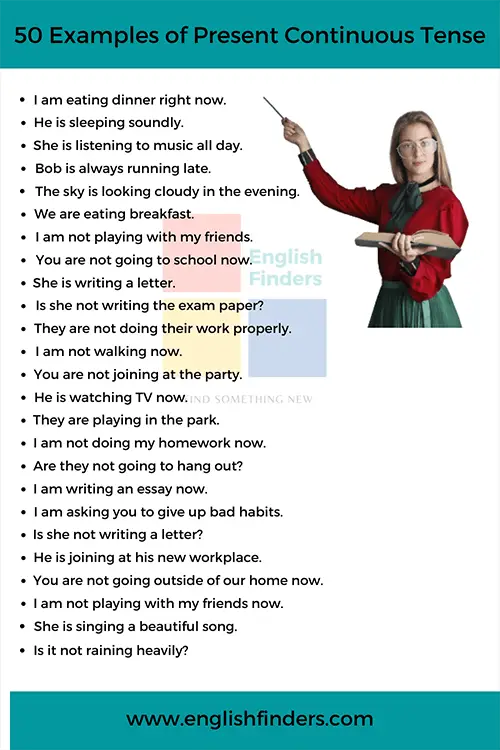
50 Examples of Present Continuous Tense
Here are 50 examples in four groups. Read them aloud and notice the pattern: am, is or are, then a verb with -ing.
Positive Sentences
- I am eating dinner right now.
- He is sleeping soundly.
- She is listening to music in her room.
- The sky is getting cloudy.
- I am running in the park.
- The baby is crying.
- We are having lunch together.
- She is cooking dinner in the kitchen.
- The children are sleeping upstairs.
- We are playing cricket on the ground.
- She is writing a letter.
- You are sitting in my seat.
- It is raining heavily.
- He is watching TV now.
- They are playing in the park.
- I am writing an essay now.
- You are playing with your friends now.
- She is singing a beautiful song.
- The teacher is explaining the lesson.
- The students are taking a test.
Negative Sentences
- I am not playing with my friends now.
- You are not going to school today.
- They are not doing their homework now.
- I am not going to the market now.
- He is not talking to his friends now.
- They are not doing their work properly.
- I am not walking to school today.
- You are not joining the party tonight.
- She is not studying now.
- It is not raining now.
- We are not watching TV.
- The students are not listening.
Questions
- Are you writing an essay?
- Is she writing the exam paper?
- Is your friend watching TV?
- Is your mother preparing lunch?
- Are we going to the market now?
- Is it raining?
- Are they coming to the party?
- What are you doing?
- Where is he going?
- Why are they running?
Future Plans and Temporary Situations
- We are going to the cinema tomorrow.
- He is joining a new company next month.
- I am meeting my friends this evening.
- She is flying to London on Friday.
- My parents are visiting us next week.
- I am staying with my cousin this week.
- They are living in a small apartment this year.
- He is studying English these days.
Common Mistakes
| Incorrect | Correct | Rule |
|---|---|---|
| She working now. | She is working now. | Do not forget am, is or are. |
| She is work now. | She is working now. | Add -ing to the main verb. |
| I am knowing the answer. | I know the answer. | Verbs like know do not take -ing. |
| He is runing in the park. | He is running in the park. | Double the last letter of run before -ing. |
| Is she is cooking? | Is she cooking? | Use only one form of be in a question. |
Practice: Exercises on the Present Continuous
Exercise 1: Complete the Sentences
Write the verb in brackets in the present continuous tense.
- Look! The children __________ (play) in the garden.
- I __________ (not watch) TV now.
- She __________ (write) an email at the moment.
- __________ you __________ (listen) to me?
- They __________ (run) to the bus stop.
- He __________ (not sleep).
- We __________ (make) lunch today.
- It __________ (rain) now. Take an umbrella.
- What __________ she __________ (do)?
- Our neighbors __________ (move) to a new house next month.
Show answers for Exercise 1
- Look! The children are playing in the garden.
- I am not watching TV now.
- She is writing an email at the moment.
- Are you listening to me?
- They are running to the bus stop.
- He is not sleeping.
- We are making lunch today.
- It is raining now. Take an umbrella.
- What is she doing?
- Our neighbors are moving to a new house next month.
Exercise 2: Choose the Correct Sentence
- A) She is cook dinner. B) She is cooking dinner.
- A) They are playing football now. B) They playing football now.
- A) I am knowing his name. B) I know his name.
- A) He is runing in the park. B) He is running in the park.
- A) We are not going to school today. B) We not going to school today.
Show answers for Exercise 2
- B (She is cooking dinner.)
- A (They are playing football now.)
- B (I know his name.)
- B (He is running in the park.)
- A (We are not going to school today.)
Exercise 3: Change the Sentences
Follow the instruction in brackets.
- She is reading a book. (Make it negative.)
- They are watching TV. (Make it a question.)
- I am cooking dinner. (Make it negative.)
- He is playing football. (Make it a question.)
- They are eating lunch. (Ask a question with What.)
Show answers for Exercise 3
- She is not reading a book.
- Are they watching TV?
- I am not cooking dinner.
- Is he playing football?
- What are they eating?
Quiz: Test Yourself
- Which formula builds the present continuous?
- Which sentence is correct?
- What is the -ing form of make?
- What is the -ing form of run?
- Which sentence talks about a future plan?
- Which verb does NOT normally take -ing?
- Which question is correct?
- Which is the correct negative sentence?
- Which time word goes best with the present continuous?
- What does “He is always losing his keys” show?
Key Takeaways
- Use am, is or are + verb-ing.
- Use the tense for actions happening now and for temporary situations.
- Use it for plans when there is a future time word.
- Use the present simple for habits, facts and verbs like know and like.
- Check the spelling: make becomes making and run becomes running.
Frequently Asked Questions
What is the present continuous tense?
It describes an action that is happening now, or a temporary situation. For example: She is cooking dinner now.
How do you form the present continuous tense?
Use am, is or are and the -ing form of the main verb. For example: They are playing football.
When do we use the present continuous tense?
Use it for actions happening now, temporary situations and future plans. For example: We are flying to Paris next week.
What is the difference between the present simple and the present continuous?
The present simple is for habits and facts: She walks to school every day. The present continuous is for actions now: She is walking to school now.
Which verbs do not use the present continuous tense?
Verbs of state, such as know, like, love, want and need, usually do not take -ing. Say I know the answer, not I am knowing the answer.
How do you spell verbs with -ing?
Most verbs just add -ing. Drop a silent e (make, making). Double the last letter of short verbs like run (running). Change ie to y (lie, lying).
Related Articles

- Antithesis: Meaning, Examples and the Grammar of Balance - October 17, 2026
- Anaphora: Meaning, Examples and How to Use It - October 17, 2026
- Flashback: Meaning, Examples and How to Write One - October 16, 2026
great work I will share
Thank u!
Ilove it
Thank u!