
Last updated on November 22nd, 2026 at 02:38 pm
Look at two short phrases: “a dress” and “a red dress.” The word red tells you more about the dress. Words like red are adjectives.
Adjectives describe people, places and things. They tell you what something looks like, how it feels, or what kind it is.
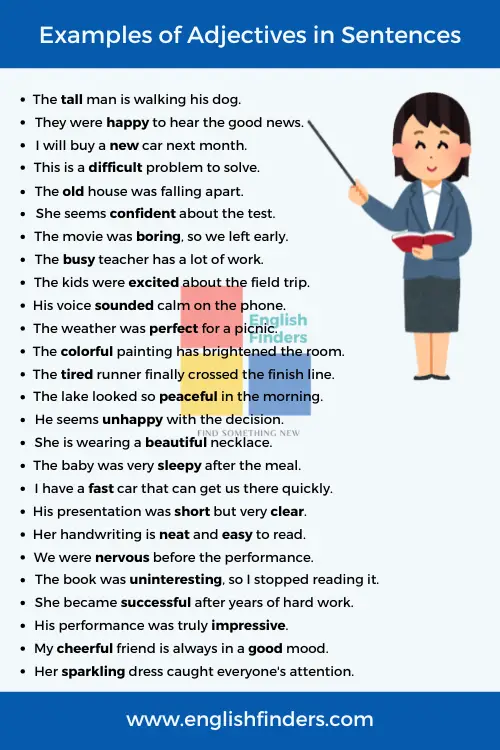
This page has 100 short sentences. In each one, the adjective is in bold, so you can see where it goes.
- What an adjective is
- The two places an adjective can go in a sentence
- 100 easy example sentences, in 10 groups
- How to use two adjectives together
- A common mistake with adjectives and plural nouns
Where Do Adjectives Go?
Quick Navigation
An adjective usually goes in one of two places. Look at the examples first.
| Place | Example |
|---|---|
| Before a noun | It is a cold day. |
| After be (am, is, are, was, were) | The day is cold. |
| After look, feel, smell, taste, sound, seem | The soup tastes good. |
The adjective stays the same in all three places. It does not change for he, she or they.
100 Examples of Adjectives in Sentences
Colors and Size
- She has a red bag.
- The sky is blue today.
- I like your green shirt.
- The school bus is yellow.
- My cat has white paws.
- They live in a big house.
- This box is too small.
- My brother is very tall.
- We walked down a long road.
- Her hair is short now.
Shape and Age
- We have a round table in the kitchen.
- The window is square.
- The land here is flat.
- He is reading a thin book.
- I need a thick coat in winter.
- My grandfather has an old bike.
- Do you like my new shoes?
- The young teacher smiles a lot.
- They live in a modern apartment.
- We visited an ancient temple.
Feelings
- The children are happy today.
- Why are you sad?
- My dad was angry about the broken window.
- I am tired after work.
- Are you hungry? Lunch is ready.
- The little boy is scared of the dark.
- We are excited about the trip.
- He was bored in the meeting.
- She is worried about her test.
- I was surprised by the gift.
People and Personality
- Our neighbor is very kind.
- The new students are friendly.
- My sister is shy with new people.
- My uncle tells funny stories.
- She is a clever girl.
- Do not be lazy. Help me, please.
- He is an honest man.
- Please be polite to the guests.
- The brave firefighter saved the cat.
- My mom is always busy.
Food and Taste
- This cake is delicious.
- The soup is too salty.
- Lemons are sour.
- I love spicy food.
- We buy fresh bread every morning.
- Be careful. The tea is hot.
- I want a cold drink.
- Apples are crunchy.
- Fruit is a healthy snack.
- My mom makes tasty pancakes.
Weather
- It is sunny today.
- I do not like rainy days.
- It was windy at the beach.
- The sky is cloudy this morning.
- We had a snowy winter.
- Drive slowly on foggy roads.
- The sea is warm in summer.
- Spring evenings are cool.
- My shoes are wet.
- The desert is very dry.
Places and Things
- The library is quiet.
- Our street is noisy at night.
- Is the kitchen clean?
- Your hands are dirty. Wash them, please.
- The train was crowded this morning.
- The shop is empty on Mondays.
- This phone is cheap.
- That hotel is expensive.
- The bag is very heavy.
- My watch is broken.
After Look, Feel, Smell, Taste and Sound
- You look beautiful in that dress.
- I feel sick today.
- The flowers smell sweet.
- This coffee tastes bitter.
- His idea sounds strange.
- The new boy seems nervous.
- It gets dark early in winter.
- The singer became famous last year.
- The blanket feels soft.
- Your plan sounds great.
Comparing Things
These adjectives compare two or more things. Short adjectives add -er or -est. Long adjectives use more or most.
- A car is faster than a bike.
- This test is easier than the last one.
- The park is safer than the street.
- My brother is stronger than me.
- Please be more careful next time.
- Health is more important than money.
- Your English is better than mine.
- The traffic is worse today.
- This is the most difficult question.
- He is the best player on the team.
Two Adjectives Together
When you use two adjectives, the one that gives your opinion usually comes first. Facts like size, age and color come after it.
- We stayed in a lovely little hotel.
- She has a pretty pink dress.
- I saw a huge brown dog.
- He bought a tiny black puppy.
- This is a comfortable wooden chair.
- There is a wonderful Italian restaurant near our house.
- I want a light cotton shirt for summer.
- She wears a shiny gold ring.
- We have two fluffy orange cats.
- He drives an ugly old car.
The Usual Order of Adjectives
You do not often need more than two adjectives. When you do, this is the usual order.
| Order | Type | Example |
|---|---|---|
| 1 | Opinion | Lovely, ugly, nice |
| 2 | Size | Big, small, tiny |
| 3 | Age | Old, new, young |
| 4 | Shape | Round, square |
| 5 | Color | Red, black, pink |
| 6 | Where it is from | Italian, Chinese |
| 7 | Material | Wooden, cotton, gold |
So we say “a beautiful old Italian table,” not “an Italian old beautiful table.”
Check your answer
Practice: Find and Fix
Part A: Find the Adjective
- The baby is sleepy.
- I bought a new phone.
- This street is very busy.
- He has a kind face.
- The pizza smells good.
Show answers
- Sleepy
- New
- Busy
- Kind
- Good
Part B: Correct the Mistake
- I have three greens pens.
- She is a girl beautiful.
- This is a wooden lovely table.
- The film was very bored.
- My sister is more tall than me.
Show answers
- I have three green pens. (No -s on adjectives.)
- She is a beautiful girl. (The adjective goes before the noun.)
- This is a lovely wooden table. (Opinion comes first.)
- The film was very boring. (Boring describes the film. Bored is how you feel.)
- My sister is taller than me. (Short adjectives add -er.)
Quiz: Test Yourself
- Which word is the adjective? “She has a small garden.”
- Which sentence is correct?
- Choose the correct word: “The soup tastes ___.”
- Which sentence has the adjective after the verb be?
- Choose the correct order.
- “I was ___ because the movie was very long and slow.”
- Which is the correct comparative?
- “Health is ___ important than money.”
- Which word is NOT an adjective?
- Choose the correct sentence.
Key Takeaways
- An adjective describes a noun: “a red bag,” “a kind man.”
- It goes before a noun or after verbs like be, look, feel and taste.
- Adjectives never take -s: “two big dogs.”
- Short adjectives add -er and -est. Long adjectives use more and most.
- With two adjectives, opinion comes before facts like size and color.
Frequently Asked Questions
What is an adjective?
An adjective is a word that describes a noun. It tells you what kind, which one or how many, as in “a big house” or “three cats.”
Where do adjectives go in a sentence?
Usually before a noun, as in “a cold drink.” They can also go after be, look, feel, taste and similar verbs: “The drink is cold.”
Can an adjective come after a noun?
Yes, after be and verbs like look and seem: “The room is clean.” It also comes after words like something and nobody: “something new.”
What is the difference between an adjective and an adverb?
An adjective describes a noun: “a quick lunch.” An adverb usually describes a verb: “She eats quickly.” Many adverbs end in -ly.
What order do adjectives go in?
The usual order is opinion, size, age, shape, color, origin and material. For example: “a lovely little hotel” and “an ugly old car.”
What is the difference between bored and boring?
Bored is how a person feels. Boring describes the thing that makes them feel that way: “I am bored because the film is boring.”
Related Articles

- Lay vs Lie: The Difference, Verb Forms and Examples - November 24, 2026
- Farther vs Further: Distance, Degree and Useful Phrases - November 24, 2026
- Compliment vs Complement: Meaning, Spelling and Examples - November 24, 2026