
Last updated on November 22nd, 2026 at 03:07 pm
Compare “She sings” with “She sings beautifully.” The new word tells you how she sings. Words like beautifully are adverbs.
Adverbs give extra information. They can tell you how, when, where or how often something happens.
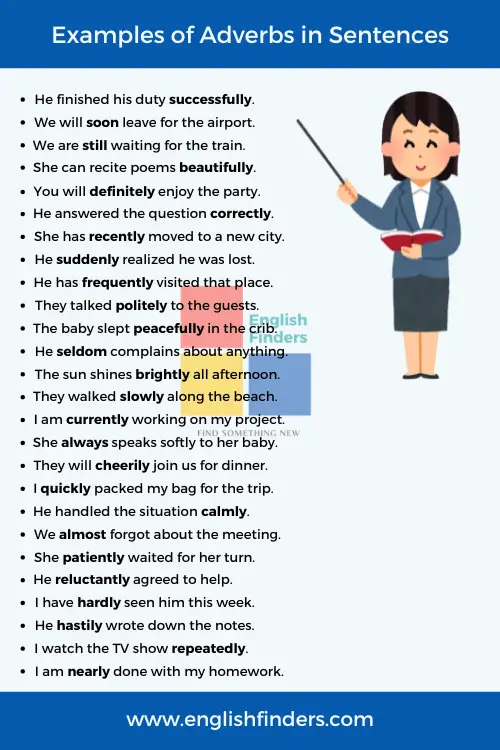
This page has 100 short sentences. In each one, the adverb is in bold, and the sentences are grouped by type.
- What adverbs describe
- 100 example sentences, grouped by type
- Where adverbs usually go in a sentence
- When to use an adjective and when to use an adverb
- Adverbs that do not end in -ly
What Do Adverbs Describe?
Quick Navigation
| An adverb can describe | Example |
|---|---|
| A verb | She drives carefully. |
| An adjective | The soup is very hot. |
| Another adverb | He speaks really fast. |
| A whole sentence | Luckily, nobody was hurt. |
Many adverbs end in -ly, like quickly and slowly. But some common ones do not, like fast, well, often and here.
100 Examples of Adverbs in Sentences
How: Adverbs of Manner
- She runs quickly to the bus stop.
- The old man walks slowly.
- Please drive carefully.
- The children are singing loudly.
- He closed the door quietly.
- Maria dances beautifully.
- I slept badly last night.
- She passed the test easily.
- The dog wagged its tail happily.
- He asked politely for help.
More Adverbs of Manner
- Hold the baby gently.
- The teacher speaks clearly.
- He shouted angrily at the driver.
- She spoke softly to the child.
- We arrived home safely.
- Write your name neatly.
- They waited patiently for the doctor.
- The firefighter acted bravely.
- She answered the question calmly.
- Please answer honestly.
When: Adverbs of Time
- I am busy now.
- We have a test today.
- I saw Tom yesterday.
- The shop opens again tomorrow.
- The bus will come soon.
- I will call you later.
- She has already eaten lunch.
- Have you finished yet?
- He is still asleep.
- They recently moved to a new house.
How Often: Adverbs of Frequency
- I always brush my teeth before bed.
- We usually have rice for dinner.
- She often reads in the evening.
- It sometimes snows in April.
- He rarely watches TV.
- I have never been to London.
- My grandmother hardly ever drives.
- The newspaper comes daily.
- We clean the house weekly.
- I visit my aunt once a month.
Where: Adverbs of Place
- Come here, please.
- Put the box there.
- The kids are playing outside.
- It is cold, so let’s stay inside.
- My room is upstairs.
- The kitchen is downstairs.
- I looked everywhere for my keys.
- There is a bank nearby.
- The bird flew away.
- She wants to study abroad.
How Much: Adverbs of Degree
- It is very hot today.
- This tea is too sweet.
- The film was quite long.
- I almost missed the train.
- Are you old enough to drive?
- The test was extremely difficult.
- I really like your new bag.
- I completely forgot your birthday.
- We are nearly home.
- I am so tired.
Adverbs Before Adjectives and Other Adverbs
- The lake is incredibly beautiful.
- I am terribly sorry.
- The test was fairly easy.
- It is rather cold for June.
- The food was pretty good. (informal)
- You are absolutely right.
- I feel slightly better today.
- She is a highly skilled nurse.
- He was deeply hurt by her words.
- She speaks English amazingly well.
How Sure: Adverbs of Certainty
- It will probably rain tonight.
- I will definitely come to your party.
- Maybe we can meet on Friday.
- Perhaps she is at home.
- I will certainly help you.
- He could possibly be late.
- Surely you know the answer!
- Obviously, we need more chairs.
- Apparently, the shop is closed today.
- I thought he was 20, but he is actually 30.
Adverbs for the Whole Sentence
These adverbs usually come first, followed by a comma. They show the speaker’s opinion or feeling.
- Luckily, nobody was hurt.
- Unfortunately, I forgot my umbrella.
- Hopefully, the weather will be nice tomorrow.
- Sadly, the café closed last year.
- Fortunately, the bus was late too.
- Frankly, I didn’t like the film.
- Personally, I prefer the beach.
- Interestingly, cats sleep for most of the day.
- Generally, the trains here are on time.
- Finally, the rain stopped.
Adverbs Without -ly
These adverbs look the same as adjectives.
- He drives too fast.
- She works hard every day.
- You did that well.
- The train arrived late.
- I get up early on Mondays.
- Go straight to the end of the road.
- The plane flew high above the clouds.
- The birds are flying low today.
- Did I spell your name right?
- Everything went wrong today.
Where Do Adverbs Go?
| Type | Usual place | Example |
|---|---|---|
| Manner | After the verb or the object | She closed the door quietly. |
| Frequency | Before the main verb, but after be | I often walk. She is often late. |
| Time | At the end, or at the start | I will call you later. |
| Place | After the verb or the object | Put it there. |
| Degree | Before the adjective or adverb | It is very cold. |
| Whole sentence | At the start, with a comma | Luckily, it stopped raining. |
Adjective or Adverb?
An adjective describes a noun. An adverb describes a verb.
| Adjective | Adverb | Example |
|---|---|---|
| Quick | Quickly | A quick lunch. / She eats quickly. |
| Good | Well | A good singer. / She sings well. |
| Fast | Fast | A fast car. / He drives fast. |
| Hard | Hard | Hard work. / They work hard. |
| Late | Late | A late train. / The train arrived late. |
Be careful with two words. Hardly means “almost not,” and lately means “recently.” They are not the -ly forms of hard and late.
Check your answer
Practice With Answers
Part A: Find the Adverb
- We often eat fish.
- Please speak slowly.
- The cat is upstairs.
- I will see you tomorrow.
- The water is very cold.
Show answers
- Often
- Slowly
- Upstairs
- Tomorrow
- Very
Part B: Correct the Mistake
- She sings very good.
- He drives fastly.
- I go always to school by bus.
- She is late often.
- They work hardly to pass the exam.
Show answers
- She sings very well.
- He drives fast.
- I always go to school by bus.
- She is often late.
- They work hard to pass the exam.
Quiz: Test Yourself
- Which word is the adverb? “She closed the window quietly.”
- Choose the correct word: “He plays the piano ___.”
- Which sentence is correct?
- Which sentence is correct?
- What is the adverb of fast?
- “He hardly studied” means:
- Which adverb answers the question “Where?”
- Which adverb answers the question “How often?”
- “The test was ___ easy.” Which word fits?
- Which sentence uses a comma correctly?
Key Takeaways
- An adverb describes a verb, an adjective, another adverb or a whole sentence.
- Many adverbs end in -ly, but fast, well, hard and often do not.
- Frequency adverbs go before the main verb but after be.
- Good is an adjective; well is the adverb.
- Hardly means “almost not,” not “in a hard way.”
Frequently Asked Questions
What is an adverb?
An adverb is a word that describes a verb, an adjective or another adverb. It often tells you how, when, where or how often something happens.
Do all adverbs end in -ly?
No. Many do, like quickly and slowly, but some common adverbs do not, like fast, well, hard, often, here and soon.
What are the main types of adverbs?
The main types are manner (how), time (when), frequency (how often), place (where) and degree (how much). Some adverbs, like luckily, comment on the whole sentence.
Where do adverbs go in a sentence?
It depends on the type. Frequency adverbs go before the main verb but after be. Manner and place adverbs usually go after the verb or object. Time adverbs often go at the end.
What is the difference between good and well?
Good is an adjective, so it describes a noun: “a good singer.” Well is the adverb, so it describes a verb: “She sings well.”
Does hardly mean the same as hard?
No. Hard means with a lot of effort: “She works hard.” Hardly means almost not: “She hardly works.” The two sentences have opposite meanings.
Related Articles

- Lay vs Lie: The Difference, Verb Forms and Examples - November 24, 2026
- Farther vs Further: Distance, Degree and Useful Phrases - November 24, 2026
- Compliment vs Complement: Meaning, Spelling and Examples - November 24, 2026