
Last updated on October 11th, 2026 at 07:12 pm
Prepositional phrases are everywhere in everyday English, even when you don’t notice them. In this lesson, you’ll find 50 examples of prepositional phrases, grouped by meaning, with simple explanations of how each type works.
A prepositional phrase starts with a preposition, such as in, on, or at, and ends with a noun or pronoun. It adds detail to a sentence: where something happens, when it happens, or why.
What is a Prepositional Phrase?
Quick Navigation
A prepositional phrase is a group of words that begins with a preposition and ends with the object of that preposition, which can be a noun, pronoun, or noun phrase.
Prepositions show relationships between other words in a sentence, such as in, on, at, by, and under. These phrases tell us where, when, how, or why something happens.
For example, in the sentence, “The cat is under the table,” the prepositional phrase is under the table. Here, under is the preposition, and the table is the object of the preposition, giving us more detail about where the cat is.
Prepositional phrases do two main jobs: they describe nouns or pronouns (adjective phrases), or they describe verbs (adverbial phrases).
In “The book on the shelf is mine,” the phrase on the shelf describes the noun book. In “She ran across the street,” the phrase across the street tells us where she ran, modifying the verb ran.
Structure of a Prepositional Phrase
A prepositional phrase has a simple structure: it starts with a preposition and ends with the object of the preposition. The object can be a noun, a pronoun, or even a noun phrase. Here’s a quick breakdown:
- Preposition: This is the word that shows the relationship between the object and the rest of the sentence. Common prepositions include in, on, at, by, with, for, and under.
- Object of the Preposition: This is the noun, pronoun, or noun phrase that follows the preposition. It tells us what or whom the preposition is referring to.
Let’s look at an example:
- “She is sitting on the chair.”
In this sentence, on is the preposition, and the chair is the object of the preposition. Together, they form the prepositional phrase on the chair, which tells us where she is sitting.
Another example:
- “We are going to the new restaurant.”
Here, to is the preposition, and the new restaurant is the object, forming the prepositional phrase to the new restaurant, which tells us where we are going.
Choosing the right preposition matters. In and on can both show location, but in the room means inside the room, while on the table means resting on its surface.
Types of Prepositional Phrases
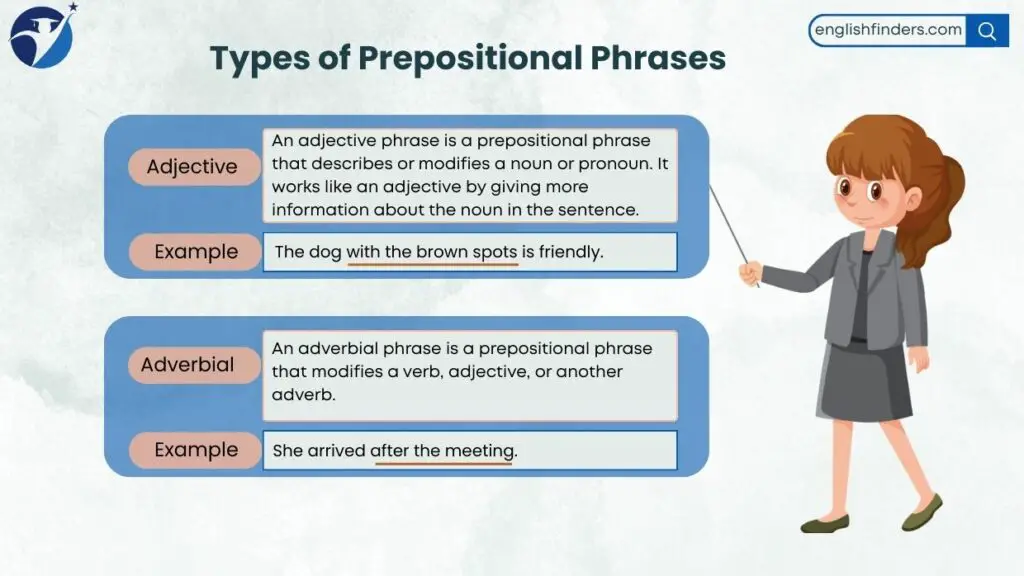
Prepositional phrases can serve different purposes in a sentence, depending on how they are used. They typically fall into two main categories: adjective phrases and adverbial phrases. Let’s break down what each type does and how they add meaning to your sentences.
1. Adjective Phrases
An adjective phrase is a prepositional phrase that describes or modifies a noun or pronoun. It works like an adjective by giving more information about the noun in the sentence. These phrases answer questions like Which one? or What kind?
Example:
- “The laptop in the drawer is mine.”
In this sentence, in the drawer is the prepositional phrase that tells us more about the noun laptop. It helps us understand which laptop we’re talking about.
Another example:
- “The dog with the brown spots is friendly.”
Here, with the brown spots is an adjective phrase that tells us more about the dog, helping to identify which dog is being described.
2. Adverbial Phrases
An adverbial phrase is a prepositional phrase that modifies a verb, adjective, or another adverb. These phrases provide details about how, when, where, or why something happens, just like adverbs do.
Example:
- “She arrived after the meeting.”
In this sentence, after the meeting is a prepositional phrase that modifies the verb arrived, telling us when she arrived.
Another example:
- “They have played cricket at the Melbourne Cricket Ground.”
Here, at the Melbourne Cricket Ground is an adverbial phrase that tells us where they played, giving more context to the action of playing.
Recognizing the Difference
- If the prepositional phrase describes a noun, it’s an adjective phrase.
- If it’s giving more information about a verb, adjective, or adverb, it’s an adverbial phrase.
| Type | Describes | Answers | Example |
|---|---|---|---|
| Adjective phrase | A noun or pronoun | Which one? What kind? | The laptop in the drawer |
| Adverbial phrase | A verb, adjective, or adverb | When? Where? How? Why? | She arrived after the meeting |
50 Examples of Prepositional Phrases in Sentences
Here are 50 examples of prepositional phrases, each used in a sentence. The sentences use a mix of verb tenses, so you can see how these phrases fit different sentence structures.
Prepositional Phrases Showing Location
- She was reading in the library.
- The book on the shelf is a bestseller.
- We met at the cafe last night.
- The cat is hiding under the bed.
- The paintings in the museum are priceless.
- They were standing in front of the house.
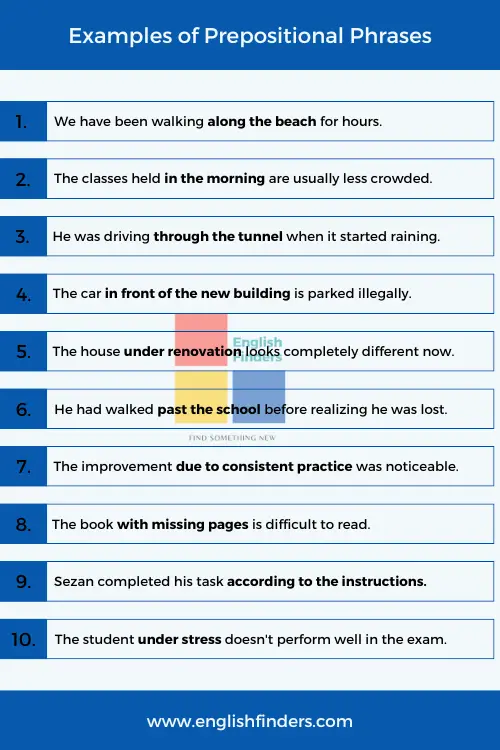
- We have been walking along the beach for hours.
- The students in the classroom are studying.
- I found my notebook between the cushions.
- The flowers in the garden bloom every spring.
Prepositional Phrases Showing Time
- I will finish the project by tomorrow.
- She studied during the night for the exam.
- They had already left before sunrise.
- The meeting before lunch was very productive.
- The classes held in the morning are usually less crowded.
- The picnic planned for this weekend is weather-dependent.
- She had completed her homework before the deadline.
- The movie released on Friday was highly anticipated.
- He visited his grandparents on the weekend.
- The festival in the spring celebrates local culture.
Prepositional Phrases Showing Direction
- The road to the city is under construction.
- She is heading to the grocery store now.
- The path toward the mountains is steep and rocky.
- The dog ran into the garden chasing the squirrel.
- He was driving through the tunnel when it started raining.
- She moved away from the door when it opened.
- The cyclist rode around the park twice.
- The kids were jumping over the fence to get the ball.
- He had walked past the school before realizing he was lost.
- The bird flew out of the cage when we weren’t looking.
Prepositional Phrases Showing Cause/Reason
- She is staying home because of the severe flu.
- They canceled the event due to bad weather.
- He didn’t go to the party for personal reasons.
- We had to leave early on account of the traffic.
- They missed the flight owing to the delay.
- I am grateful for all your help.
- She couldn’t finish the exam due to lack of time.
- She won the prize thanks to her team.
- The concert was postponed as a result of the rain.
- The improvement from consistent practice was noticeable.
Prepositional Phrases Showing Contrast and Condition
- She was calm in spite of the chaos around her.
- He worked hard despite his illness.
- We were happy with the results of the test.
- The house under renovation looks completely different now.
- The book with missing pages is difficult to read.
- All the games were canceled except for the finals.
- I am confident in my ability to succeed.
- He completed his task according to the instructions.
- We solved the problem with the help of a mentor.
- The student under stress doesn’t perform well in the exam.
Final Thoughts
Prepositional phrases add the detail that makes a sentence clear: where something happened, when it happened, and why. With the 50 examples above, you can already spot the pattern: a preposition, then its object.
To practice, pick five examples and write your own sentences with the same prepositions. Then underline each prepositional phrase and decide whether it describes a noun or a verb.
When you’re ready, try our prepositional phrases quiz with answers or browse the list of 150 prepositions.
Frequently Asked Questions
What is a prepositional phrase?
A prepositional phrase is a group of words that begins with a preposition and ends with its object, which can be a noun, pronoun, or noun phrase. In in the garden, in is the preposition and the garden is the object.
What is the difference between an adjective phrase and an adverbial phrase?
An adjective phrase describes a noun or pronoun: in the book on the table, on the table describes the book. An adverbial phrase describes a verb, adjective, or adverb: in She runs in the street, in the street tells us where she runs.
Can a prepositional phrase be more than two words?
Yes. A prepositional phrase always starts with a preposition and ends with an object, but the object can include modifiers. In in the bright, sunny morning, in is the preposition and the bright, sunny morning is the object.
How many prepositional phrases can a sentence have?
A sentence can have as many as it needs. In The book on the shelf in my room is old, there are two: on the shelf and in my room. Too many in a row can be hard to follow.
How do I find the prepositional phrase in a sentence?
Look for a preposition such as in, on, at, or under, then include every word through the noun or pronoun that ends the phrase. In She sat on the old chair, the phrase is on the old chair.
What are the most common prepositions used in prepositional phrases?
Common ones include in, on, at, by, for, with, to, from, under, and over. For a longer list with meanings, see our list of 150 prepositions.
Related Articles

- Antithesis: Meaning, Examples and the Grammar of Balance - October 17, 2026
- Anaphora: Meaning, Examples and How to Use It - October 17, 2026
- Flashback: Meaning, Examples and How to Write One - October 16, 2026