
Last updated on October 8th, 2026 at 03:52 pm
“Call me when you get home.” That short sentence hides a rule many learners miss. After when, we use the present tense, even for the future.
Below are 50 sentences with when, grouped by the way it is used. First comes a short grammar section. It covers the tense rule, the comma rule, and when vs if and while.
- The three ways to use when in a sentence
- 50 example sentences, grouped by use
- Which tense to use after when, and where the comma goes
- The difference between when, if and while
- A short practice with answers
Three Ways to Use When
Quick Navigation
| Use | What it does | Example |
|---|---|---|
| Question word | Asks about time | When does the class start? |
| Time conjunction | Joins two events in time | I was sleeping when the phone rang. |
| Relative word | Adds information about a time | I remember the day when we met. |
The Grammar Behind When
The Tense After When
When we talk about the future, the verb after when stays in the present tense. The will goes in the other part of the sentence.
- Right: When I get home, I will call you.
- Wrong: When I will get home, I will call you.
Where the Comma Goes
Use a comma when the when-part comes first. Do not use one when it comes second.
- When it rains, we stay inside.
- We stay inside when it rains.
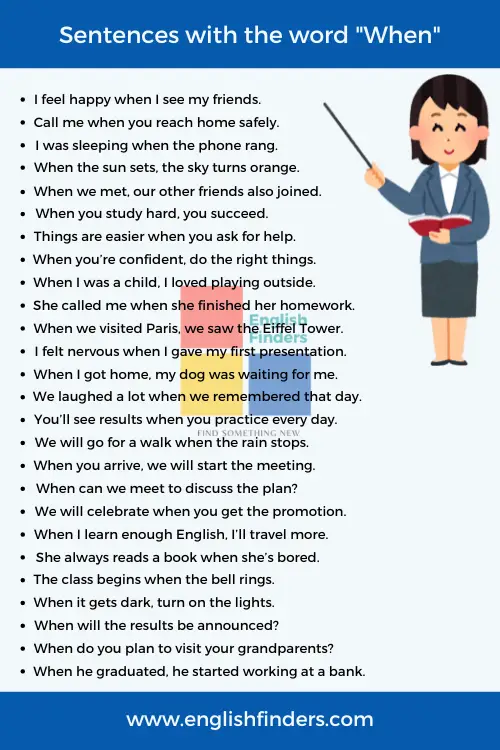
50 Sentences With When
Questions With When
- When will you finish your project?
- When are we leaving for the trip?
- When did you learn how to swim?
- When do you usually wake up?
- When will the results be announced?
- When are you going to the dentist?
- When can we meet to discuss the plan?
- When did you start learning English?
- When do you plan to visit your grandparents?
- When will the next lesson be available?
When for Past Events
- When I was a child, I loved playing outside.
- We moved to a new city when I was 10.
- She called me when she finished her homework.
- When we visited Paris, we saw the Eiffel Tower.
- I was in class when I heard the news.
- When he graduated, he started working at a bank.
- I felt nervous when I gave my first presentation.
- When I got home, my dog was waiting for me.
- We laughed a lot when we remembered that day.
- When I first tried sushi, I didn’t like it.
When for Habits and General Truths
- I feel happy when I see my friends.
- When the sun sets, the sky turns orange.
- She always reads a book when she’s bored.
- The class begins when the bell rings.
- When it rains, we stay indoors.
- Things are easier when you ask for help.
- When the water boils, add the pasta.
- When I’m tired, I usually take a nap.
- When it gets dark, turn on the lights.
- I feel more productive when I’m organized.
When for Future Events
- When I grow up, I want to be a doctor.
- Let’s meet when the movie ends.
- You’ll see results when you practice every day.
- We will go for a walk when the rain stops.
- I will visit you when I have time.
- When you arrive, we will start the meeting.
- Call me when you reach home safely.
- I’ll be there when you need me.
- We will celebrate when you get the promotion.
- I will let you know when I am ready.
Two More Patterns: Interrupted Actions and Relative When
A short action can interrupt a longer one. The longer action uses the past continuous.
- I was sleeping when the phone rang.
- He was laughing when he tripped.
- We were watching TV when the lights went out.
- She was cooking when the guests arrived.
When can also describe a time, like which describes a thing.
- I remember the day when we met.
- Summer is the season when we travel most.
- There are times when I need to be alone.
- Do you remember the time when we got lost?
- Morning is the time when I feel most awake.
- That was the moment when everything changed.
When, If or While?
| Word | Use it for | Example |
|---|---|---|
| When | Something you expect to happen | When I get home, I’ll call you. |
| If | Something that may or may not happen | If it rains, we’ll stay inside. |
| While | A longer action happening at the same time | I listened to music while I cooked. |
The first sentence means you will get home. The second means it might rain, or it might not.
Check your answer
Practice: Using When
Part A: When, If or While?
- ______ I was walking home, I saw an old friend.
- ______ you see Sara, tell her I said hello.
- ______ it is sunny tomorrow, we’ll go to the beach.
- I was reading ______ the phone rang.
Show answers for Part A
- While (a longer action), 2. When (you expect to see her), 3. If (it may not be sunny), 4. When (a short action interrupts)
Part B: Correct the Mistake
- When I will finish, I’ll call you.
- When it rains we stay inside.
- I was reading a book while the phone rang.
Show answers for Part B
- When I finish, I’ll call you. 2. When it rains, we stay inside. 3. I was reading a book when the phone rang.
Quiz: Test Yourself
- “I’ll call you when I ______ home.”
- Which sentence needs a comma?
- “I was sleeping ______ the phone rang.”
- Which sentence is a question with when?
- “______ it is sunny tomorrow, we’ll go to the beach.” You are not sure it will be sunny.
- “Summer is the season ______ we travel most.”
- “When she ______ her homework, she called me.” It happened yesterday.
- Which word fits best for two long actions happening at the same time?
- “When ______ you start learning English?”
- Can a sentence start with when?
Key Takeaways
- When can ask a question, join two events or describe a time.
- For the future, use the present tense after when: when I get home.
- Add a comma when the when-part comes first.
- Use when for things you expect and if for things that may not happen.
- A short action interrupting a longer one takes when: I was sleeping when the phone rang.
For more practice with time words, see our lessons on conjunctions in sentences and subordinating conjunctions.
Frequently Asked Questions
Can a sentence start with when?
Yes. “When the bell rings, the class begins” is correct. Put a comma after the when-part when it comes first.
What tense comes after when?
For the future, use the present tense: “I’ll call you when I arrive.” For the past, use the past tense: “I was happy when I saw her.”
What are 5 sentences with when?
When is your birthday? I smile when I see my dog. When I was young, I lived in a village. Call me when you get home. I remember the day when we met.
What is the difference between when and if?
Use when for something you expect to happen: “When I get home, I’ll call you.” Use if for something that may not happen: “If it rains, we’ll stay inside.”
How do you use when in a question?
Put when at the start, then a helping verb and the subject: “When do you…?”, “When did she…?” or “When will they…?”
Is when a conjunction or an adverb?
It can be both. In a question, it is an adverb: “When did you arrive?” When it joins two parts of a sentence, it is a conjunction: “I left when it got dark.”
Related Articles

- Foreshadowing: Meaning, Types and Examples in Stories - October 12, 2026
- Symbolism: Meaning, Common Symbols and Examples in Literature - October 11, 2026
- Imagery: Meaning, 7 Types and Examples in Writing - October 10, 2026