
Last updated on October 8th, 2026 at 08:49 pm
Yesterday I missed the bus. I walked to work and arrived ten minutes late. Three actions, all finished, all in the past.
English uses one simple tense for actions like these. Below, you will learn how to make it and when to use it. You will also learn to say the -ed ending. Then you can study 50 example sentences.
- What the past indefinite tense is, and its other name
- How to make positive sentences, negatives and questions
- The spelling and the three sounds of the -ed ending
- The 20 most common irregular verbs
- 50 example sentences, from daily life to history
What Is the Past Indefinite Tense?
Quick Navigation
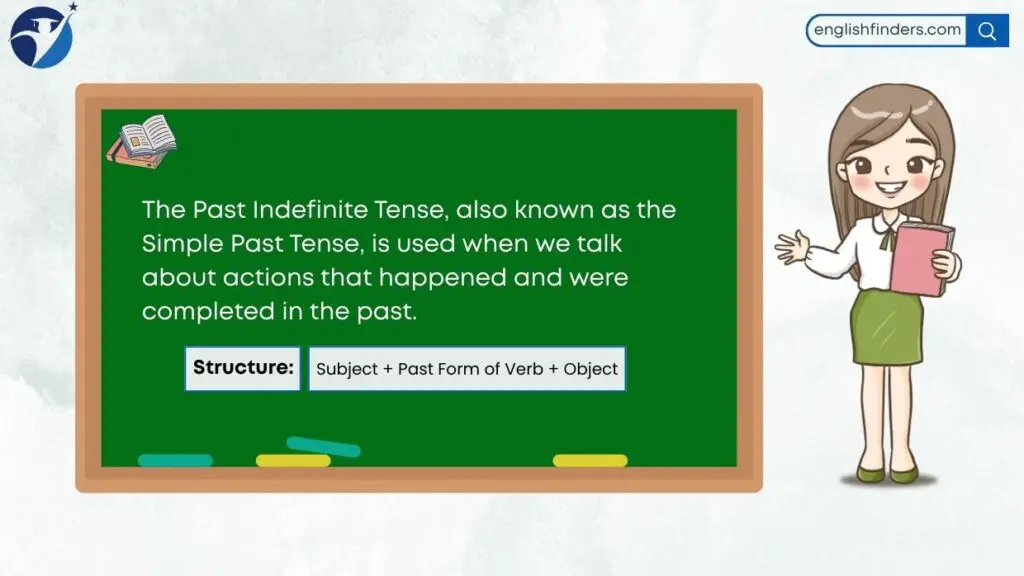
The past indefinite tense talks about finished actions. It does not matter if the action was a minute ago or a hundred years ago. If it is over, we use this tense.
Many books call it the simple past tense. The two names mean the same thing.
Look at this sentence: I watched a movie last night. The action (watching a movie) is finished, and we know when it happened.
How to Make the Past Indefinite Tense
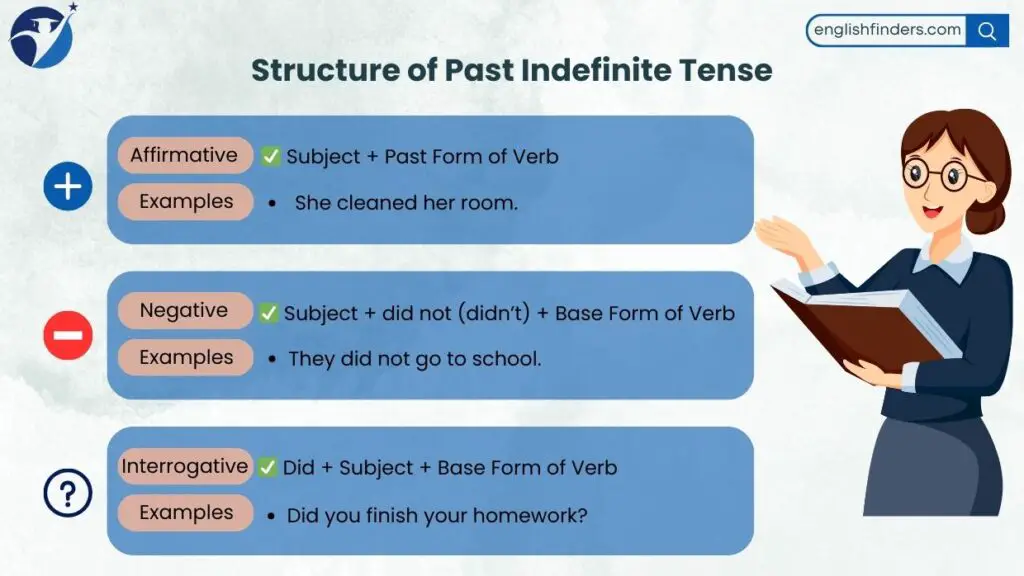
| Sentence type | Form | Example |
|---|---|---|
| Positive | Subject + past form | She cleaned her room. |
| Negative | Subject + did not (didn’t) + base verb | She did not clean her room. |
| Question | Did + subject + base verb? | Did she clean her room? |
| Short answer | Yes, + subject + did. / No, + subject + didn’t. | Yes, she did. No, she didn’t. |
The past form is the same for every subject: I worked, she worked, they worked. There is no -s for he, she or it.
Regular Verbs: Spelling the -ed Ending
Most verbs add -ed to make the past form. These verbs are called regular verbs. A few spelling rules help.
| Rule | Base verb | Past form |
|---|---|---|
| Most verbs: add -ed | Walk, play, work | Walked, played, worked |
| Verb ends in -e: add -d | Like, dance, live | Liked, danced, lived |
| Consonant + y: change y to i, add -ed | Study, cry, try | Studied, cried, tried |
| Short verb, one vowel + one consonant: double it | Stop, plan, drop | Stopped, planned, dropped |
How to Say the -ed Ending
The -ed ending has three sounds. Many learners say “walk-ED” for every verb, but that is not correct.
| Sound | When | Examples |
|---|---|---|
| /t/ | After sounds like p, k, s, sh, ch, f | Walked, stopped, watched, laughed |
| /d/ | After vowels and sounds like b, g, l, m, n, v | Played, cleaned, lived, called |
| /ɪd/ (an extra syllable) | After t or d | Wanted, needed, visited, decided |
Only the /ɪd/ group adds a syllable. Walked has one syllable. Wanted has two.
Irregular Verbs: The 20 Most Common
Some verbs do not use -ed. These are irregular verbs, and you need to learn their past forms.
| Base verb | Past form | Base verb | Past form |
|---|---|---|---|
| Be | Was / were | Make | Made |
| Have | Had | Know | Knew |
| Do | Did | Take | Took |
| Go | Went | See | Saw |
| Get | Got | Come | Came |
| Say | Said | Think | Thought |
| Eat | Ate | Give | Gave |
| Buy | Bought | Find | Found |
| Write | Wrote | Tell | Told |
| Leave | Left | Sleep | Slept |
For more verbs, see our list of 80 useful irregular verbs.
When Do We Use the Past Indefinite Tense?
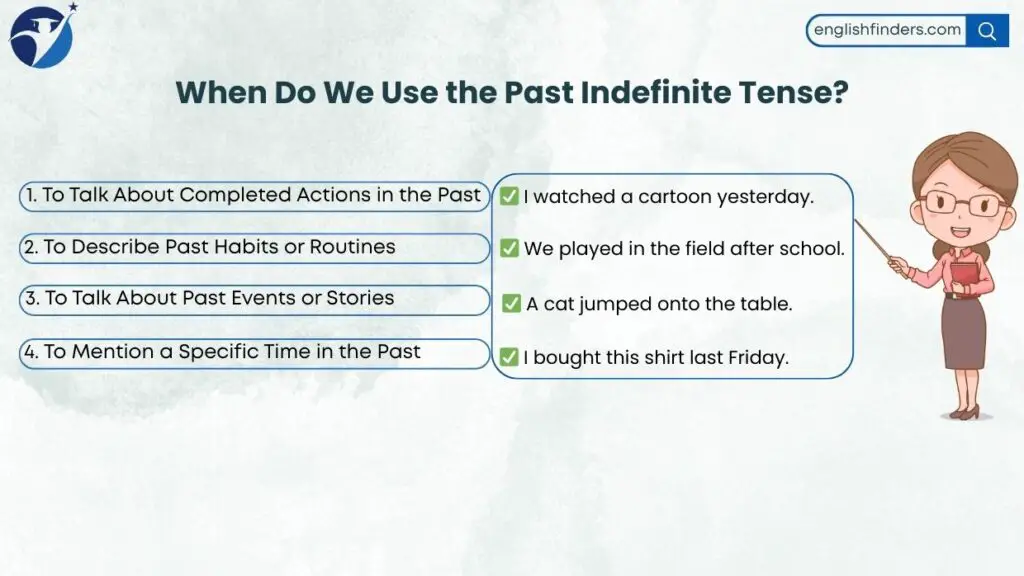
We use it in four main ways.
- Finished actions: They visited the zoo last weekend.
- Past habits: We played in the park after school every day.
- Stories and memories: A cat jumped onto the table and broke a glass.
- Actions at a known time: He left the party at 9 p.m.
Time words often show the past indefinite tense.
| Time word | Example |
|---|---|
| Yesterday | I called my aunt yesterday. |
| Last (week, year, Sunday) | We moved house last year. |
| Ago | She arrived two hours ago. |
| In + a past year | He finished school in 2019. |
| When I was… | When I was ten, I lived in a village. |
50 Examples of Past Indefinite Tense
10 Quick Examples
- I went to school yesterday.
- She cooked breakfast this morning.
- We watched a film last night.
- He didn’t finish his homework.
- They visited their grandparents last month.
- Did you see the match?
- My father bought a new car.
- The bus arrived late.
- I didn’t sleep well last night.
- Did she call you?
Daily Life
- I woke up at 6 a.m. yesterday.
- My brother walked the dog.
- We cleaned our rooms after school.
- They didn’t wash the dishes.
- Did your mom make lunch for you?
- He forgot his umbrella at home.
- I paid for the shopping by card.
- She lost her keys last night.
School
- We had a math test last Friday.
- I answered all the questions.
- The teacher checked our notebooks.
- She didn’t forget her homework.
- Did the exam start on time?
- Our class visited the science lab.
- The students didn’t make any noise.
- He wrote a short story in English.
Free Time
- She danced at the party.
- We played video games all afternoon.
- He didn’t enjoy the concert.
- Did they go to the beach?
- My friends came over after school.
- I read two books last month.
- Did you listen to music before bed?
- They swam in the lake.
Family
- We celebrated my birthday last week.
- Dad cooked dinner for everyone.
- I told my grandma a funny story.
- He didn’t take any photos at the wedding.
- Did your parents enjoy the trip?
- My sister sent me a letter.
- Our cousins stayed with us for a week.
- Mom gave me a new watch.
History
- The Romans built many roads.
- Neil Armstrong walked on the Moon in 1969.
- The Wright brothers flew their first plane in 1903.
- Did the king fight in the war?
- The Titanic sank in 1912.
- People didn’t have phones 200 years ago.
- Marie Curie won two Nobel Prizes.
- The first football World Cup took place in 1930.
Past Indefinite vs Present Perfect vs Past Perfect
| Tense | Use | Example |
|---|---|---|
| Past indefinite | A finished action at a past time | I saw that film last week. |
| Present perfect | A past action with no time, linked to now | I have seen that film. |
| Past perfect | An action before another past action | I had seen the film before I read the book. |
When you say when (yesterday, last week, in 2020), use the past indefinite. Don’t say “I have seen it yesterday”. You can practice this in our A2 lesson on present perfect vs past simple.
Check your answer
Practice: Past Indefinite Tense
Part A. Make each sentence negative. Then make it a question.
- She visited Paris.
- They played tennis.
- He bought a new phone.
Show answers for Part A
- She didn’t visit Paris. Did she visit Paris? 2. They didn’t play tennis. Did they play tennis? 3. He didn’t buy a new phone. Did he buy a new phone?
Part B. Write the past form.
- Go 2. Study 3. Stop 4. Eat 5. Like
Show answers for Part B
- Went 2. Studied 3. Stopped 4. Ate 5. Liked
Quiz: Test Yourself
- “I ______ to the market yesterday.”
- Which question is correct?
- What is another name for the past indefinite tense?
- What is the past form of study?
- How many syllables does wanted have?
- Which verb ends with a /t/ sound in the past?
- “He ______ his homework last night.” (negative)
- Which sentence is correct?
- What is the past form of stop?
- “Did you enjoy the film?” What is the correct short answer?
Key Takeaways
- The past indefinite tense (simple past) is for finished actions in the past.
- Positive: subject + past form. Negative and questions: did + base verb.
- Regular verbs add -ed, which can sound like /t/, /d/ or /ɪd/.
- Irregular verbs have their own past forms, such as go → went.
- With a finished time (yesterday, last week), use this tense, not the present perfect.
Ready to look ahead? Next, practice talking about plans and predictions with our 50 examples of the future indefinite tense.
Frequently Asked Questions
What are 10 examples of past indefinite tense?
I went to school yesterday. She cooked dinner. We watched a film. He didn’t call me. Did you see the match? They visited Rome. I slept well. The bus arrived late. She bought a dress. Did he win?
What is the rule for past indefinite?
Positive: subject + past form (She worked). Negative: subject + did not + base verb (She did not work). Question: Did + subject + base verb (Did she work?).
What is another name for the past indefinite tense?
It is also called the simple past tense. Both names mean the same tense, used for actions that started and finished in the past.
What is the difference between past indefinite and past perfect tense?
The past indefinite shows a finished past action: I left at six. The past perfect shows an action before another past action: The train had left when I arrived.
What are the four past tenses?
English has four past tenses: past indefinite (simple past), past continuous, past perfect and past perfect continuous. The past indefinite is the one used most often.
How do you say the -ed ending?
It has three sounds: /t/ as in walked, /d/ as in played, and /ɪd/ as in wanted. Only the /ɪd/ sound adds an extra syllable.
Related Articles

- Who vs Whom: The Simple Test and When Whom Still Matters - November 22, 2026
- Advice vs Advise: Noun or Verb, Sound and Examples - November 22, 2026
- Oxford Comma: What It Is, Examples and When to Use It - November 21, 2026