Last updated on September 14th, 2026 at 09:40 pm
A noun names a person, place, thing, or idea, and it’s one of the most basic building blocks of English grammar. You use nouns constantly, often without noticing, because almost every sentence needs at least one.
But nouns aren’t all the same. English groups them into different types of nouns, each playing its own role in a sentence.
This guide covers the five main types, with a plain-language definition and real examples for each one, so you can start using them correctly right away.
What Is a Noun in English?
Quick Navigation
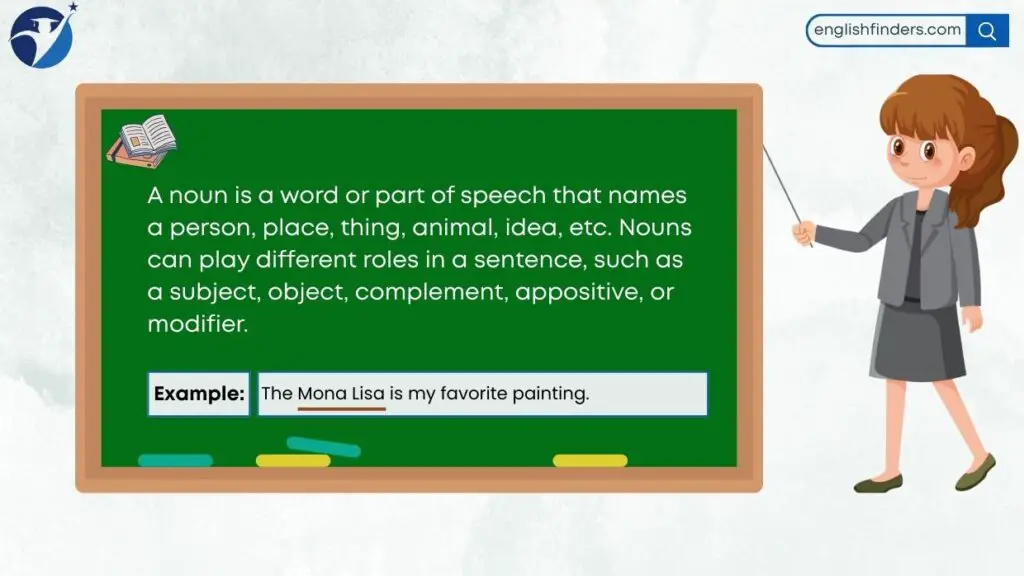
The definition of a noun in English is very simple. A noun is a word or part of speech that names a person, place, thing, animal, idea, etc. Nouns can play different roles in a sentence, such as a subject, object, complement, appositive, or modifier.
Here are a few examples:
- Person: teacher, doctor, Reema
- Place: school, city, London
- Thing: pencil, phone, car
- Idea: love, happiness, freedom
Let’s look at some examples of nouns in sentences to understand them clearly. Nouns are marked in bold for easy identification:
- The name of my brother is John.
- He lives in the United States.
- London is a beautiful city.
- The stadium is full of crowds.
- I pray to the Almighty so that I will pass the examination.
- She looks like an Angel.
- Iron is a good material.
- I have a beautiful Cat.
Types of Nouns in English
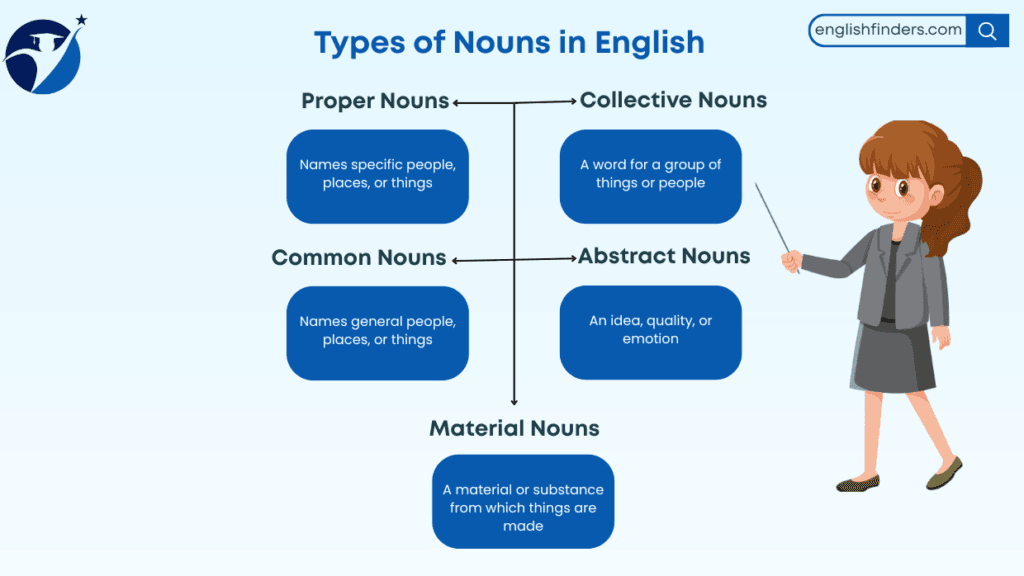
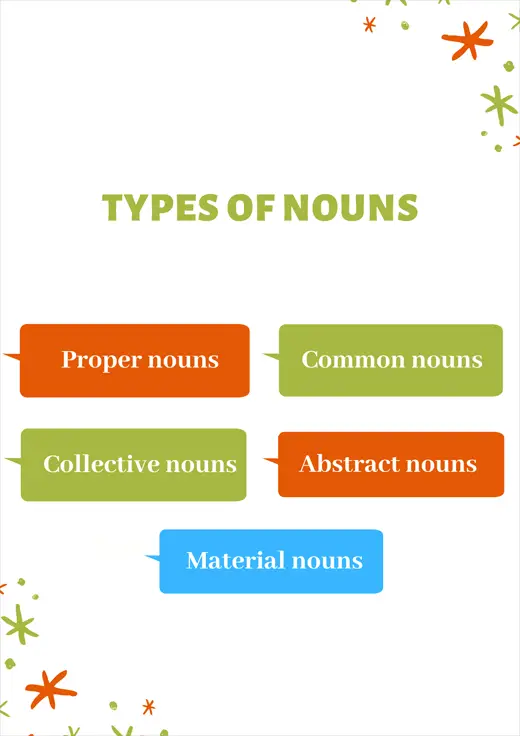
Nouns are classified into several categories in English grammar. Today, we will discuss the five types of nouns. They are:
- Proper nouns
- Common nouns
- Collective nouns
- Abstract nouns
- Material nouns
1. Proper Nouns
A proper noun is the name of any particular person, animal, place, thing, etc. Proper nouns always start with a capital letter.
Let’s see some examples of proper nouns: Jack, Jennifer, Nathan, Dubai, United Kingdom, Willy, etc. Proper nouns are marked in bold for easy identification:
- Jack is my favorite friend.
- Risa is traveling to Cape Town.
- Nathan is going to buy some books.
- He has been living in Dubai for five years.
- The United Kingdom is a beautiful country.
- I saw a tiger named Willy in the zoo.
- The Mona Lisa is my favorite painting.
- She will buy an iPhone very soon.
- Asia is the largest continent.
- Google is a popular search engine.
2. Common Nouns
Common nouns describe common people, animals, places, things, etc. This noun does not define any particular type of person, place, or thing.
Let us see some examples of common nouns: country, city, man, King, Queen, boy, girl, etc. Common nouns are marked in bold for easy identification:
- The name of my country is Bangladesh.
- New York is a fantastic city.
- The boy is good at English.
- The teacher explained the lesson.
- He talks as if he were a king.
- I love this beautiful Queen.
- The girl is going to meet her friends.
- Cricket is a gentleman’s game.
- He cannot swim in the river.
- The school is closed today.
3. Collective Nouns
A collective noun is a name that denotes a group of people or things.
In American English, collective nouns are treated as singular, taking singular verbs and pronouns (e.g., the team plays very well on its home ground).
British English is more flexible: collective nouns can be singular or plural depending on whether the group acts as one unit or as individuals (the team play very well on their home ground).
Examples of collective nouns are: family, crowd, team, group, class, troop, cattle, committee, etc. Collective nouns are marked in bold for easy identification:
- I belong to a middle-class family.
- They watched an exciting cricket match, and the stadium was full of crowds.
- The cricket team of this country is developing day by day.
- A group of people has been working on the humanitarian crisis.
- Troops constantly battle against their enemies to protect their nation.
- The herd of cattle is eating grass in the field.
- The managing committee will take the final decision.
- The committee has made a final decision.
- The audience clapped loudly in the auditorium.
4. Abstract Nouns
An abstract noun is a noun that represents a thing, such as a concept, idea, or quality, and that cannot be seen physically. For example, friendship, relationship, neighborhood, childhood, beauty, love, peace, honesty, bravery, etc. Abstract nouns are marked in bold for easy identification:
- We have a good friendship.
- Please do not break our relationship over a misconception.
- I see a great neighborhood among them.
- Childhood is one of the best periods of human life.
- You can not explain her beauty with a single word.
- The love between mother and son is always tremendous.
- We should sustain this peace in our country for a long time.
- Honesty is a great virtue for humans.
- Never lose your bravery.
5. Material Nouns
A material noun is a type of noun that describes a material or substance from which the thing is made. For example, gold, iron, silver, water, wood, etc. Material nouns are marked in bold for easy identification:
- Gold is useful for making rings.
- Iron helps produce many products.
- The bed is made of wood.
- Silver is a necessary material for us.
- Would you please give me a glass of water?
Summary Table: Types of Nouns
| Type of Noun | Definition |
|---|---|
| Proper Noun | Names specific people, places, or things |
| Common Noun | Names general people, places, or things |
| Collective Noun | A word for a group of things or people |
| Abstract Noun | An idea, quality, or emotion |
| Material Noun | A material or substance from which things are made |
Final Thoughts
Nouns are crucial parts of our English grammar learning journey. By understanding the different types of nouns discussed above, we can improve our English grammar, communication, and writing skills.
Whether it’s a common noun naming something ordinary or an abstract noun capturing an idea you can’t touch, each type does its own job in making the language rich and precise.
Frequently Asked Questions
What are nouns?
Nouns are the naming words that describe persons, places, things, or objects.
What are the 5 types of nouns?
Nouns are of 5 types. They are proper nouns, common nouns, collective nouns, abstract nouns, and material nouns.
What is the difference between common and proper nouns?
Common nouns refer to general items, while proper nouns name specific, unique entities and always start with capital letters.
What is a collective noun?
A collective noun names a group of people or things treated as one unit, such as team, family, or committee.
What is an abstract noun?
An abstract noun names something you can’t see or touch, like an idea, quality, or feeling — for example, honesty, love, or freedom.
What is a material noun?
A material noun names the substance something is made from, such as gold, iron, wood, or water.
Noun Exercises

Nouns Quiz
Related Articles

- Bandwagon Fallacy: Meaning, Examples and Origin - October 8, 2026
- Straw Man Fallacy: Meaning, Examples and How to Respond - October 8, 2026
- Ad Hominem: Meaning, Types and Examples of the Fallacy - October 7, 2026