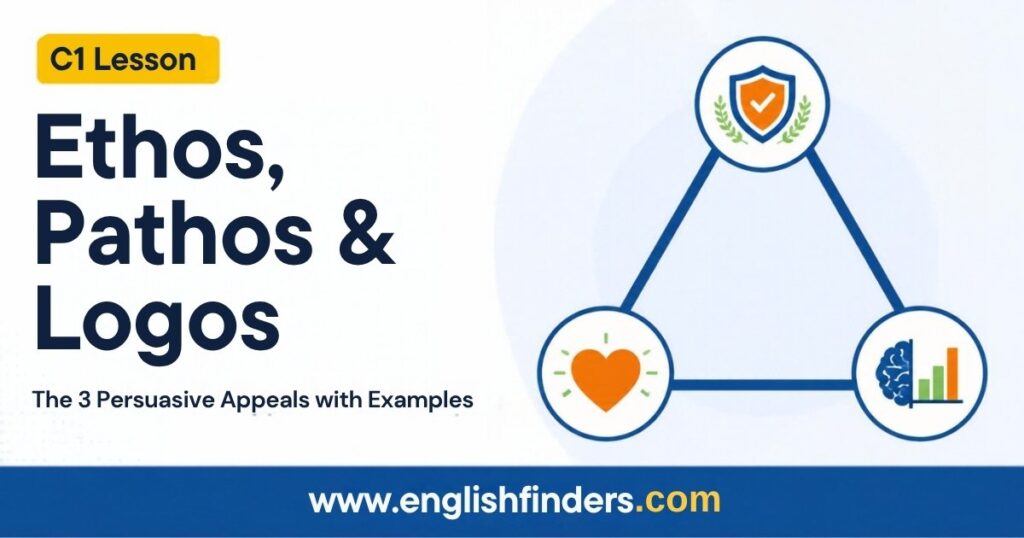
Ethos, pathos and logos are the three main ways to persuade an audience. Ethos builds trust in the speaker, pathos appeals to the audience’s emotions, and logos uses facts and logic.
The Greek philosopher Aristotle described them in his Rhetoric more than 2,300 years ago. A good charity appeal still uses all three: a trusted name, a moving story and a clear number.
We’ll take each appeal in turn, then show how to balance all three in a persuasive essay.
- Ethos = credibility. “Trust me, I’m an expert.”
- Pathos = emotion. “Imagine how you would feel.”
- Logos = logic. “Here are the facts and the reasons.”
- What ethos, pathos and logos mean and how to pronounce them
- How each appeal works, with examples from ads, speeches and daily life
- How to spot the appeals in a text you are reading
- How to use all three in your own essays and presentations
- How the appeals can be misused, with a short practice quiz
The Rhetorical Triangle
Quick Navigation
Teachers often show the three appeals as a triangle. Each corner links to one part of communication: the speaker, the audience and the message.
Pronunciation and Original Meaning
| Term | Sounds like | IPA | Greek meaning | Appeals to |
|---|---|---|---|---|
| Ethos | EE-thoss | /ˈiː.θɒs/ | Character | Trust and credibility |
| Pathos | PAY-thoss | /ˈpeɪ.θɒs/ | Suffering, feeling | Emotion |
| Logos | LOH-goss | /ˈləʊ.ɡɒs/ (UK), /ˈloʊ.ɡoʊs/ (US) | Word, reason | Logic and evidence |
Many students search for “ethos pathos logos” as one phrase, but each word names a different appeal. From these Greek words, English gets ethical, sympathy, empathy and logical. Linking them helps you remember each appeal.
What Is Ethos?
Ethos is an appeal to credibility. The audience believes the message because they trust the person giving it.
A speaker builds ethos by showing knowledge, experience, honesty and good intentions. Ethos can also come from fairness: admitting the other side has a point often makes people trust you more.
Examples of ethos:
- A doctor says, “In my 20 years of treating heart patients, I have seen this diet help hundreds of people.”
- A toothpaste ad says the product is “recommended by dentists.”
- A student essay quotes a respected scientist or a government report.
- A speaker says, “I grew up in this neighborhood, so I know these problems well.”
Words and phrases that build ethos: as a qualified…, in my experience…, according to (expert source)…, research from (university) shows…, to be fair…
What Is Pathos?
Pathos is an appeal to emotion. It makes the audience feel something, such as sympathy, fear, hope, anger, pride or joy, so that they care about the message.
Pathos often uses stories, vivid images, personal examples and emotional words. It is powerful because people make many decisions with their feelings.
Examples of pathos:
- A charity ad shows a hungry child and says, “Your gift tonight can give her a meal tomorrow.”
- An insurance ad shows a family at home and asks, “Are the people you love protected?”
- A speech at a sports final says, “Tonight we play for every fan who never stopped believing in us.”
- A friend says, “Please come to my party. It won’t feel the same without you.”
Words and phrases that build pathos: imagine…, picture this…, think of your children…, heartbreaking, devastating, proud, together…
What Is Logos?
Logos is an appeal to logic. It persuades with facts, statistics, examples, cause and effect, and clear step-by-step reasoning.
Logos is the backbone of academic writing. Even an emotional speech usually needs some logic, or the audience may feel manipulated.
Examples of logos:
- “Cycling to work saves about 20 minutes a day in heavy traffic, and it costs nothing.”
- “Sales rose 30% after we reduced the price. So a further price cut should increase sales again.”
- An ad says a phone battery lasts “up to 48 hours” and shows a test result.
- An essay explains, “If schools start later, students sleep longer. Longer sleep improves concentration. Therefore, a later start may improve results.”
Words and phrases that build logos: the evidence shows…, statistics suggest…, as a result…, therefore…, for this reason…, it follows that…
Ethos vs Pathos vs Logos: Comparison Table
| Ethos | Pathos | Logos | |
|---|---|---|---|
| Main question | Can I trust the speaker? | How does this make me feel? | Does this make sense? |
| Focus | The speaker | The audience | The message |
| Typical tools | Expertise, experience, reputation, fairness | Stories, images, emotional words | Facts, data, examples, reasoning |
| Example | “As a nurse, I…” | “Imagine losing your home.” | “Prices rose by 12% this year.” |
| Risk if overused or faked | Fake authority, name-dropping | Manipulation, fear-mongering | Cold tone, misleading numbers |
Check your answer
Kairos: The Fourth Appeal
Many teachers add a fourth idea, kairos (KY-ross), which means “the right moment.” A message about saving water persuades more people during a drought than in a rainy month. When you write or speak, ask yourself: Why should my audience listen now?
How to Spot the Appeals in a Text
When you read an ad, speech or opinion article, ask three short questions.
- Who is speaking, and why should I believe them? If the text points to experience, titles or trusted sources, that is ethos.
- How is the text trying to make me feel? Look for stories, strong adjectives and images. That is pathos.
- What reasons and evidence are given? Numbers, examples and “because… therefore” chains show logos.
Most real texts mix the appeals. Your job in a rhetorical analysis is to explain which appeal is used, how it works and why it suits the audience.
How to Use Ethos, Pathos and Logos in Your Own Writing
Here is a simple plan for a persuasive essay or presentation.
- Open with ethos. Show why you are worth listening to: your experience, your research, or a fair summary of both sides.
- Build the body with logos. Give each main point a clear reason and at least one piece of evidence.
- Add pathos with care. Use one short, real example that helps readers feel the human side of the issue.
- Answer the other side. Mention an opposing view and respond to it calmly. This strengthens your ethos.
- Close with pathos and a call to action. End with an image or question that stays with the reader.
For more practice with persuasive structure, see our C1 lesson on building a persuasive argument and the C2 lesson on the anatomy of a strong argument.
When the Appeals Go Wrong
Each appeal can be misused. When that happens, the argument becomes a logical fallacy.
| Appeal | Misuse | Example |
|---|---|---|
| Ethos | Appeal to false authority | “A famous actor says this medicine works, so it must.” |
| Ethos | Attacking the person (ad hominem) | “Don’t listen to her plan; she failed math in school.” |
| Pathos | Fear-mongering | “If you don’t buy this alarm, your family will be in danger tonight.” |
| Pathos | Bandwagon | “Everyone is buying it, so you should too.” |
| Logos | Cherry-picking data | Quoting one good month and hiding a bad year |
| Logos | Slippery slope | “If we allow phones in class, students will never study again.” |
A good persuader uses emotion honestly, chooses reliable sources and presents numbers fairly.
Practice: Test Your Understanding
Part A. Which appeal does each sentence mainly use: ethos, pathos or logos?
- “As a firefighter with 15 years of service, I can tell you smoke alarms save lives.”
- “Homes with working smoke alarms have far fewer fire deaths than homes without them.”
- “Imagine waking up to the smell of smoke with your children asleep upstairs.”
- “Nine out of ten dentists we asked recommend this toothpaste.”
- “Don’t let your dog spend another cold night alone. Adopt today.”
- “Because the bridge is closed, traffic will move to Main Street, so journeys will take longer.”
Show answers for Part A
- Ethos – the speaker’s experience builds trust.
- Logos – a comparison based on evidence.
- Pathos – a frightening image that creates emotion.
- Ethos and logos – expert approval plus a number.
- Pathos – sympathy for the animal.
- Logos – a cause-and-effect chain.
Part B. Rewrite this weak sentence three times, once with each appeal: “You should drink more water.”
Show sample answers for Part B
- Ethos: “As a sports nutritionist, I recommend that most adults drink more water every day.”
- Pathos: “Imagine feeling fresher, clearer and more awake every afternoon.”
- Logos: “Even mild dehydration can make it harder to concentrate, so drinking more water may help you work better.”
Part C (writing). Write a 100-word paragraph persuading your city to build more bike lanes. Use all three appeals and label each one. Then get feedback with our AI Writing Feedback tool.
Key Takeaways
- Ethos = trust in the speaker. Pathos = emotion. Logos = logic and evidence.
- Aristotle described them in his “Rhetoric” in the 4th century BC.
- Strong arguments balance all three, and kairos reminds you to choose the right moment.
- When you analyze a text, explain which appeal is used, how it works and why it suits the audience.
- Misused appeals turn into fallacies, so keep emotions honest and evidence accurate.
Next, see how writers use contrast to persuade in our lesson on juxtaposition, or practice the language of argument with rhetorical questions and emphasis techniques.
Frequently Asked Questions
What are ethos, pathos and logos in simple words?
They are three ways to persuade people. Ethos makes the audience trust the speaker. Pathos makes the audience feel something. Logos gives the audience facts and reasons. Strong arguments usually use all three.
Who created ethos, pathos and logos?
The Greek philosopher Aristotle described them in his book “Rhetoric” in the 4th century BC. He called them the three modes of persuasion, and teachers still use his model today.
What is an example of pathos?
A charity ad that shows a hungry child and says, “Your gift tonight can give her a meal tomorrow,” uses pathos. It moves the audience through sympathy rather than statistics.
What is kairos?
Kairos is a fourth idea often taught with the other three. It means choosing the right moment and the right context for your message. The same argument can fail at the wrong time and succeed at the right one.
How do I use ethos, pathos and logos in an essay?
Show you are informed and fair (ethos), support each point with evidence and clear reasoning (logos), and add a short, relevant example that makes readers care (pathos). Keep emotion honest and evidence accurate.
Related Articles

- Logical Fallacies: 15 Common Types with Examples - October 6, 2026
- Ethos, Pathos and Logos: The 3 Persuasive Appeals with Examples - October 6, 2026
- Paradox: Meaning, Types and Examples in Literature and Life - October 5, 2026