
Assonance: Meaning, Examples and How to Hear It
Assonance is the repetition of vowel sounds in nearby words. Learn how to hear it when spelling misleads you, examples from poems and how it differs from rhyme.
C2 Proficiency English: near-native, expert-level linguistic and academic content for mastery-level learners, aligned with the CEFR C2 level.
Assonance is the repetition of vowel sounds in nearby words. Learn how to hear it when spelling misleads you, examples from poems and how it differs from rhyme.

Zeugma uses one word in two senses at once, as in “He caught a cold and the last train.” Learn its meaning, famous examples and when it becomes a mistake.
Zeugma: Meaning, Examples and the Verbs That Make It Work Read More »

Synecdoche uses a part to mean the whole, or the whole to mean a part. Learn how to say it, its types, everyday examples and how it differs from metonymy.
Metonymy names something by a closely linked thing, like “the White House” for the US president’s team. Learn its types, examples and how to read it in news.
Metonymy: Meaning, Types and Examples in the News Read More »
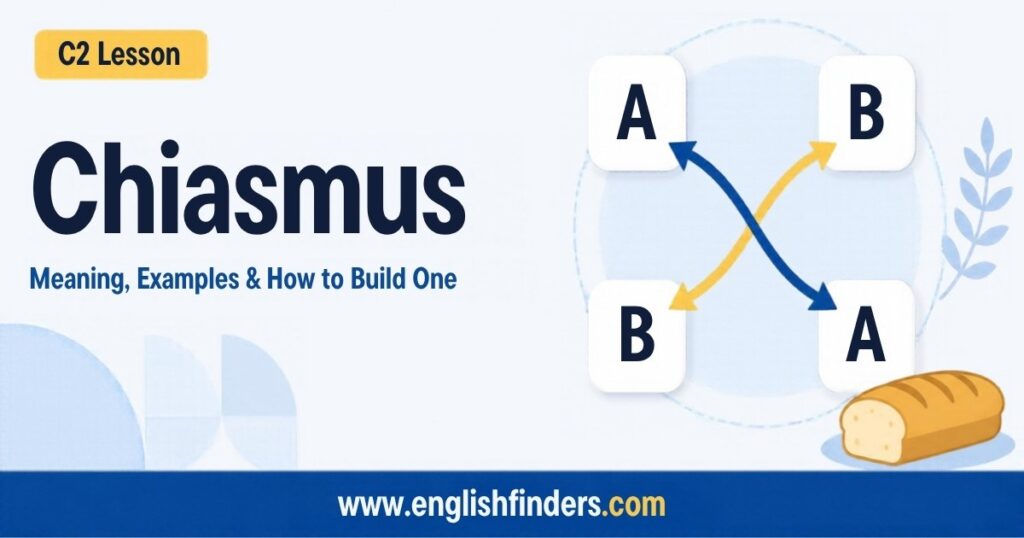
Chiasmus reverses the order of words or ideas in two matching halves (A B, B A). Learn how to say it, famous examples and how it differs from antimetabole.
Chiasmus: Meaning, Examples and How to Build One Read More »
Antithesis sets opposite ideas in balanced sentences. Learn its meaning, pronunciation, real examples and grammar patterns, then practice with answers.
Antithesis: Meaning, Examples and the Grammar of Balance Read More »