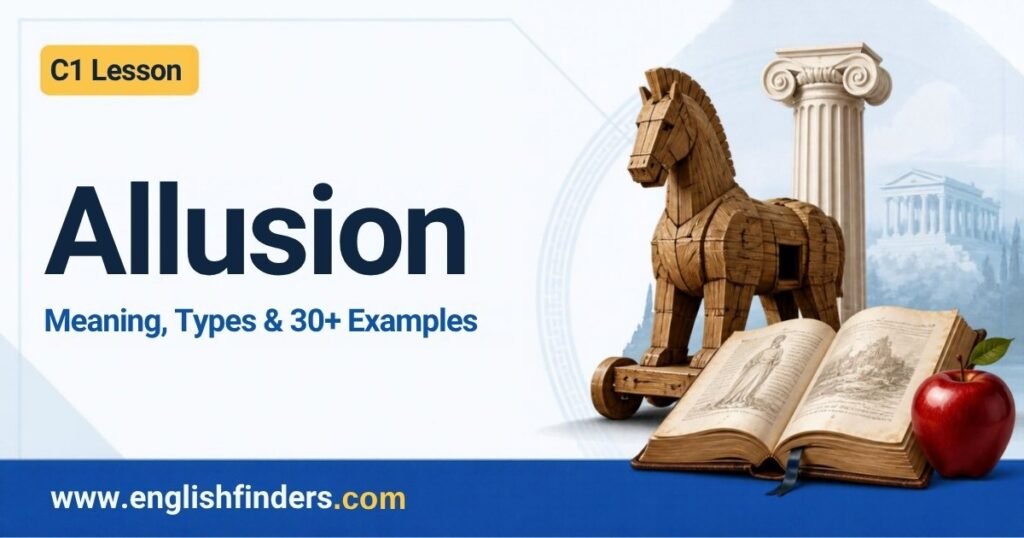
An allusion is a brief, indirect reference to a famous person, place, story, event or work of art.
The writer does not explain the reference because they expect the reader to recognize it. When someone calls a hard job a “Herculean task,” they are making an allusion to the Greek hero Hercules.
Read on for the most common allusions in English, where they come from, and how to use them without confusing your reader.
Quick answer
Allusion (noun): a short reference to something well known, used without explanation.
Example: “Our new manager has the Midas touch.” This alludes to King Midas, who turned everything he touched into gold. It means she makes everything successful.
What you will learn
- What an allusion is and how to pronounce it
- How to use allusion and the verb allude to correctly
- The five main types of allusion
- 30+ common allusions in everyday English, with their meanings and sources
- How to use allusions in your own writing, with a practice quiz
What Is an Allusion?
Quick Navigation
An allusion works like a shortcut. In one or two words, it brings a whole story into the reader’s mind. The reader then connects the story to the new situation.
For example, if a news report says a small company is fighting “a David and Goliath battle” against a huge one, readers who know the Bible story understand at once: the small side is weak but brave, and it might still win.
This is also why allusions can be hard for English learners. If you do not know the original story, the meaning is hidden. The examples below will help you build that background knowledge.
Teacher’s tip
When you see a name in an unexpected place, such as “a real Romeo” or “a Herculean task,” it is often an allusion. Look it up, and you learn a story as well as a word.
Pronunciation and Word Forms
| Word | Sounds like | IPA | Example |
|---|---|---|---|
| Allusion (noun) | uh-LOO-zhun | /əˈluː.ʒən/ | The title is an allusion to a Shakespeare play. |
| Allude to (verb) | uh-LOOD | /əˈluːd/ | She alluded to her problems but didn’t explain them. |
| Allusive (adjective) | uh-LOO-siv | /əˈluː.sɪv/ | His poems are highly allusive. |
Grammar note: we make an allusion to something, and we allude to something. Do not say “allude something” without to.
Useful collocations: a clear / obvious allusion, a passing allusion (a quick mention), a veiled allusion (a hidden one), a biblical / literary / historical allusion.
Allusion vs illusion
These two words sound almost the same, but their meanings are very different.
| Word | Meaning | Example |
|---|---|---|
| Allusion | A reference to something famous | The film is full of allusions to classic westerns. |
| Illusion | Something that seems real but is not | The mirror creates the illusion of a bigger room. |
The 5 Main Types of Allusion
| Type | Source | Example | Meaning |
|---|---|---|---|
| Historical | Real events and people | “He crossed the Rubicon.” | He made a decision he cannot reverse. |
| Mythological | Greek and Roman myths | “It opened a Pandora’s box.” | It caused many unexpected problems. |
| Religious | The Bible and other holy texts | “She was a Good Samaritan.” | She helped a stranger in need. |
| Literary | Novels, plays and poems | “He’s a real Romeo.” | He is a romantic man who loves to flirt. |
| Pop culture | Films, TV, music, games | “Use the Force.” | Trust your instincts (from Star Wars). |
✋ Quick check: What type of allusion is “He finally met his Waterloo”?
Check your answer
Historical. It refers to Napoleon’s final defeat at the Battle of Waterloo in 1815.
30+ Common Allusions in Everyday English
None of these needs a literature degree. A business report might call a weak product “the company’s Achilles’ heel” and expect every reader to follow.
From Greek and Roman myths
| Allusion | Origin | Meaning today |
|---|---|---|
| Achilles’ heel | The hero Achilles could only be hurt on his heel. | A person’s one weak point |
| Pandora’s box | Pandora opened a box that released all the world’s troubles. | Something that causes many new problems |
| Trojan horse | Greek soldiers hid inside a wooden horse to enter Troy. | A hidden trick or danger; also a type of computer virus |
| The Midas touch | King Midas turned everything he touched into gold. | The ability to make anything successful |
| A Herculean task | Hercules completed twelve almost impossible jobs. | A very difficult task |
| An odyssey | Odysseus took ten years to travel home. | A long, eventful journey |
| A nemesis | Nemesis was the goddess of punishment. | A long-standing rival who is very hard to beat |
| Between Scylla and Charybdis | Two sea monsters guarded a narrow passage. | Stuck between two dangers |
From the Bible
| Allusion | Origin | Meaning today |
|---|---|---|
| A Good Samaritan | A stranger helps an injured traveler in a parable. | A kind person who helps others |
| David and Goliath | A young shepherd defeats a giant. | A small side against a much bigger one |
| Forbidden fruit | Adam and Eve eat fruit they were told not to touch. | Something tempting because it is not allowed |
| The prodigal son | A son wastes his money and then returns home. | Someone who comes back after mistakes |
| The writing on the wall | A hand writes a warning on a palace wall. | Clear signs that something bad will happen |
| Turn the other cheek | Jesus tells people not to hit back. | Not respond to an attack with violence |
From history
| Allusion | Origin | Meaning today |
|---|---|---|
| Cross the Rubicon | Julius Caesar crossed this river with his army in 49 BC. | Make a decision you cannot undo |
| Meet your Waterloo | Napoleon was defeated at Waterloo in 1815. | Suffer a final, decisive defeat |
| A Pyrrhic victory | King Pyrrhus won battles but lost too many soldiers. | A win that costs too much |
| Fiddling while Rome burns | Emperor Nero is said to have played music during a fire. | Ignoring a serious crisis |
From literature
| Allusion | Origin | Meaning today |
|---|---|---|
| A Scrooge | Ebenezer Scrooge in A Christmas Carol by Charles Dickens | A person who hates spending money |
| A Romeo | Romeo in Shakespeare’s Romeo and Juliet | A romantic man |
| Jekyll and Hyde | Strange Case of Dr Jekyll and Mr Hyde by R. L. Stevenson | A person with two very different sides |
| Big Brother | The all-seeing leader in George Orwell’s 1984 | A government or company that watches people |
| A catch-22 | Joseph Heller’s novel Catch-22 | A problem with no way out |
| A Cinderella story | The fairy tale Cinderella | An unexpected rise to success |
| A Peter Pan | The boy who never grows up, by J. M. Barrie | An adult who acts like a child |
| A Sherlock | The detective Sherlock Holmes by Arthur Conan Doyle | Someone who notices clues (often said as a joke) |
From modern pop culture
| Allusion | Origin | Meaning today |
|---|---|---|
| Houston, we have a problem | The Apollo 13 space mission (1970) and the 1995 film | Something has gone wrong |
| A Kodak moment | An advertising slogan | A moment worth taking a photo of |
| “I’ll be back” | Arnold Schwarzenegger in The Terminator | A playful promise to return |
Allusions in Literature
Writers often hide allusions in titles and key lines.
- **Aldous Huxley’s Brave New World** takes its title from Shakespeare’s The Tempest: “O brave new world, that has such people in’t!”
- **William Faulkner’s The Sound and the Fury** alludes to Macbeth’s speech that life is “a tale told by an idiot, full of sound and fury.”
- **John Steinbeck’s East of Eden** alludes to the Bible story of Cain and Abel.
- Martin Luther King Jr. opened his 1963 “I Have a Dream” speech with “Five score years ago,” an allusion to Abraham Lincoln’s Gettysburg Address, which begins “Four score and seven years ago.”
Allusion vs Similar Devices
| Device | What it does | Example |
|---|---|---|
| Allusion | Hints at a famous source without explaining it | “He has the Midas touch.” |
| Quotation | Repeats exact words and usually names the source | As Lincoln said, “A house divided against itself cannot stand.” |
| Metaphor | Says one thing is another | “Time is money.” |
| Reference | Mentions a source directly and openly | “According to Hamlet…” |
An allusion can also be a metaphor. “He’s a Romeo” is both: it compares the man to Romeo (metaphor) and points to Shakespeare’s play (allusion). To learn more about comparisons, see our C2 lesson on metaphor and simile.
Why Do Writers Use Allusions?
- To save words. One phrase replaces a long explanation.
- To add depth. The original story brings extra feeling and meaning.
- To build a connection. Readers who catch the reference feel part of a shared group.
- To persuade. Speakers allude to respected texts to borrow their authority. This links to ethos in our lesson on ethos, pathos and logos.
- To add humor. A playful allusion, like calling a messy room “a Pandora’s box,” makes readers smile.
How to Use Allusions in Your Own Writing
- Know your audience. Use allusions your readers are likely to know. A Bible or Shakespeare allusion works well for many English readers; a niche video game may not.
- Keep it short. An allusion should be a hint, not a lesson.
- Make sure it fits. The original story must match your situation. “A Herculean task” suits a huge job, not a small chore.
- Use one at a time. Too many allusions make your writing hard to follow.
- In formal essays, explain briefly if needed. If the allusion is less common, add a short clause: “…a Pyrrhic victory, a win that cost more than it gained.”
Sentence frames
- “This could open a Pandora’s box of…”
- “It was a David and Goliath contest between… and…”
- “For many students, math is their Achilles’ heel.”
- “The new law gives the government a Big Brother role in…”
Common Mistakes Learners Make
- **Confusing allusion and illusion.** Check the meaning: reference or false image?
- Forgetting the preposition. Say allude to something, not “allude something.”
- Using allusions incorrectly. “Achilles’ heel” is a weakness, not a strength.
- Missing the apostrophe. Write Achilles’ heel and Pandora’s box.
- Choosing allusions your reader won’t know. If your reader misses the reference, your point is lost.
Practice: Test Your Understanding
Part A. What does each allusion mean? Choose a, b or c.
- “Public speaking is my Achilles’ heel.” – a) my favorite activity b) my weak point c) my job
- “The new tax opened a Pandora’s box.” – a) solved a problem b) caused many new problems c) saved money
- “Our uncle is a real Scrooge.” – a) generous b) funny c) mean with money
- “Moving abroad was crossing the Rubicon for me.” – a) a decision I couldn’t undo b) a short holiday c) a mistake
- “It was a Pyrrhic victory.” – a) an easy win b) a win that cost too much c) a draw
Show answers for Part A
- b – my weak point
- b – caused many new problems
- c – mean with money
- a – a decision I couldn’t undo
- b – a win that cost too much
Part B. Allusion or illusion? Choose the correct word.
- The magician created the (allusion / illusion) of a floating table.
- The poem makes an (allusion / illusion) to Greek mythology.
- She is under the (allusion / illusion) that the exam will be easy.
Show answers for Part B
- Illusion
- Allusion
- Illusion
Part C (writing). Describe a challenge in your life in two sentences. Use one allusion from this lesson, such as a Herculean task or my Achilles’ heel. Check your sentences with our AI Writing Feedback tool, or build more vocabulary with the Vocabulary Quiz.
Key Takeaways
Remember
- An allusion is a short, unexplained reference to something famous.
- Say it uh-LOO-zhun. The verb is allude to.
- Main types: historical, mythological, religious, literary and pop culture.
- Learn common ones like Achilles’ heel, Pandora’s box and a Scrooge; they are common outside literature too.
- Use allusions your reader will know, keep them short, and make sure they fit.
Keep going with our lessons on paradox and juxtaposition, or browse more advanced lessons on the C1 Advanced English hub.
Frequently Asked Questions
What is an allusion in simple words?
An allusion is a short, indirect reference to something famous, such as a story, a person, a historical event or a film. The writer does not explain it, because they expect the reader to recognize it.
What is an example of an allusion?
“Don’t be such a Scrooge” is an allusion to Ebenezer Scrooge in Charles Dickens’s A Christmas Carol. It means “don’t be so mean with money” without needing to say so directly.
What is the difference between allusion and illusion?
An allusion is a reference to something famous. An illusion is something that looks real but is not, like a magic trick. They sound similar: allusion is /əˈluːʒən/ and illusion is /ɪˈluːʒən/.
What are the main types of allusion?
The main types are historical, mythological, religious, literary and pop culture allusions. Each one refers to a different source, from Greek myths and the Bible to Shakespeare, history and modern films.
How is an allusion different from a quotation?
A quotation repeats someone’s exact words and usually names the source. An allusion only hints at the source in a few words and leaves the reader to make the connection.
Why do writers use allusions?
Allusions save words, add layers of meaning and create a connection with readers who share the same knowledge. One word like “Herculean” brings a whole story to the reader’s mind.
Related Articles

- Allusion: Meaning, Types and 30+ Examples You Need to Know - October 5, 2026
- Oxymoron: Meaning, 40+ Examples and How to Use Them - October 4, 2026
- Juxtaposition: Meaning, Examples and How to Use It - October 4, 2026