
Flatmates
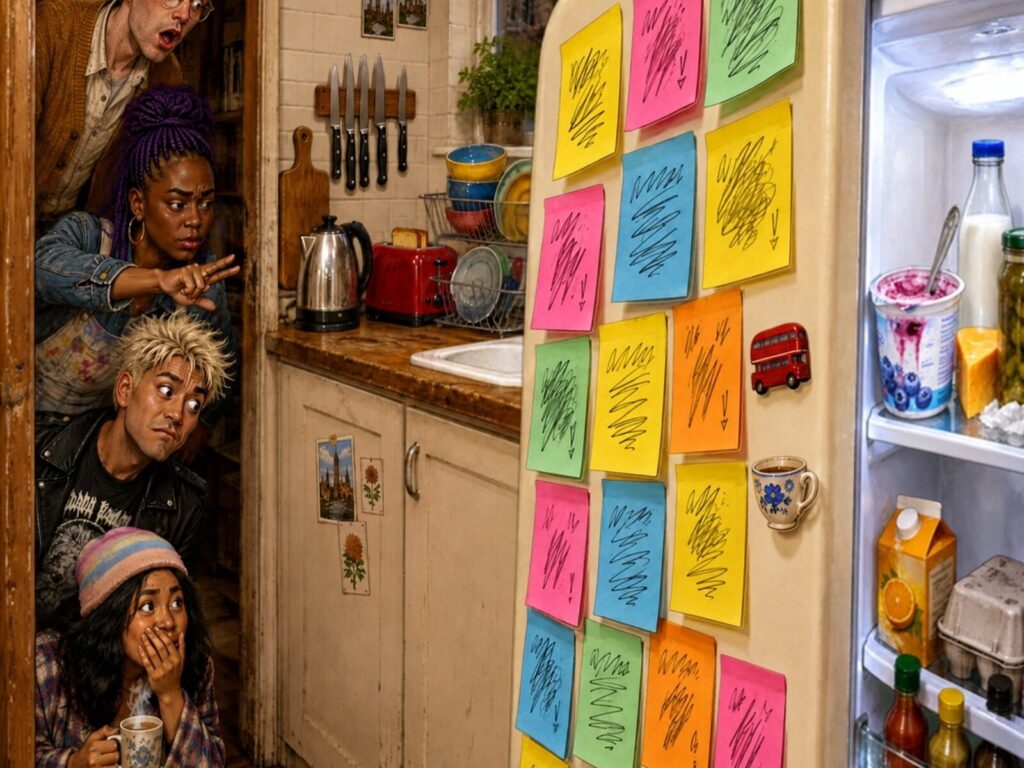
The first note appeared on the on a Tuesday in October. It was written in neat capital letters on a yellow sticky note: “WHOEVER IS EATING MY YOGHURT — PLEASE STOP. — G.”
Nobody admitted anything, of course. The four people who shared the flat on Albert Road had moved in within a week of each other and barely knew each other’s names. There was Grace, a law student who left for the library at seven every morning. There was Ollie, a chef who came home at two in the morning smelling of garlic. There was Hana, a nurse who worked night shifts and slept during the day. And there was Marcus, who said he was “between jobs” and seemed to spend most of his time playing video games.
By Friday, there was a second note, in green ink this time: “I haven’t touched your yoghurt. But someone has been using my expensive olive oil. — O.”
Then a third, in pencil: “Could whoever is playing music at 3 a.m. please consider that some of us work nights and sleep during the day? Thanks so much. — H.”
The “thanks so much” was clearly not meant kindly. The war of the fridge notes had begun.
Over the next month, the notes multiplied. They were polite on the surface and furious underneath. Grace complained about dishes left in the sink. Ollie someone of moving his knives. Hana pointed out that the bathroom had not been cleaned “since the Stone Age”. Marcus, who rarely wrote anything, finally added a single note: “Is there a reason you all hate me?”
Soon the fridge door was so covered in yellow, green and pink squares that you could barely see it. Nobody actually spoke to anyone. When two of them met in the kitchen, they would nod politely, say “Morning,” and leave as quickly as possible.
It was Hana who broke the pattern. One evening in December, after a particularly difficult night at the hospital, she came home to find a new note on the fridge — not a complaint this time, but a question, in Ollie’s green ink: “Does anyone know how to fix a broken heart? Asking for a friend.”
Hana stood in the kitchen for a long time looking at it. Then she took a pen and wrote underneath: “Chocolate. Bad films. Time. And talking to someone. I’m home tonight if your friend wants to talk. — H.”
That night, for the first time, two of the sat in the living room together. Ollie had just been dumped by his girlfriend of four years. Hana made tea and listened. At some point Grace came home, heard them talking and, after hesitating in the doorway, sat down too. She had failed an important exam that week and hadn’t told anyone. Marcus appeared at midnight with a pizza. He had been “between jobs”, it turned out, because his company had closed, and he was too embarrassed to tell anyone that he was running out of money.
They talked until four in the morning. Ollie admitted that he had eaten Grace’s yoghurt — twice. Grace confessed that she had moved his knives because she was afraid of them. Marcus for the music; he played games at night because he couldn’t sleep. Everyone agreed that the bathroom situation was .
The next day, a new kind of note appeared on the fridge: a cleaning , drawn in four different colours. It was a , carefully : Ollie would cook on Sundays if the others did his share of the cleaning. Marcus would wear headphones after midnight. Grace would stop hiding the knives.
The notes didn’t disappear completely. But they changed. “Made too much curry, help yourselves. — O.” “Good luck in your exam today!! — M.” “Whoever bought me flowers after my night shift: thank you. I cried a bit. — H.”
Two years later, the four of them still meet once a month for dinner, even though they no longer live together. Grace, now a lawyer, keeps one yellow sticky note framed on her office wall. It says: “WHOEVER IS EATING MY YOGHURT — PLEASE STOP.” Underneath, in green ink, someone has added: “Never.”
Words from the Story
- flatmate
- a person you share a flat with
- fridge noun A2
- a cold cupboard in the kitchen that keeps food fresh
- negotiate verb B1
- to discuss something until everyone agrees
- rota
- a list that shows whose turn it is to do a job, and when
- accuse
- to say that someone has done something wrong
- apologise
- to say sorry
- compromise noun B1
- an agreement where each person gives up a little of what they want
- ridiculous adjective B1
- very silly or unreasonable
Check Your Understanding
- How did the flatmates communicate at first?
- What does the phrase "polite on the surface and furious underneath" suggest about the notes?
- Which note changed the situation?
- Why was Marcus "between jobs"?
- What does the final note on Grace's wall show?