
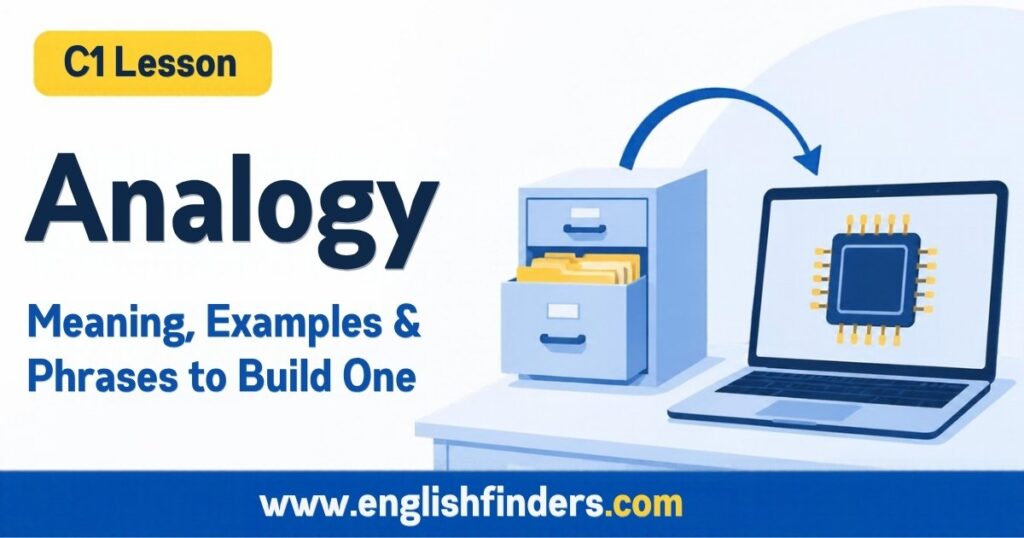
An analogy is a comparison that explains something unfamiliar by showing how it works like something familiar. It points to a shared relationship, not just a surface likeness, so it is a tool for teaching and arguing as much as for decoration.
Imagine computer memory as a desk and storage as a filing cabinet. The desk holds what you are working on now; the cabinet keeps everything else. The picture isn’t exact, but it explains memory better than a list of numbers.
Analogies can also be practiced with set phrases, and those phrases are what turn a vague comparison into a clear one.
- What an analogy is and how its two parts work
- How to say analogy and analogous (the g changes)
- Analogy vs simile, metaphor and allegory
- Phrases for building analogies in speech and essays
- How to spot a weak analogy in an argument
What Is an Analogy?
Quick Navigation
Every analogy has two sides. The source is the thing your listener already knows, such as a desk. The target is the new idea you want to explain. The analogy carries a relationship from the source to the target.
In the opening example, the relationship is “small and fast for current work versus large and slow for long-term keeping.” If that relationship is true for both sides, the analogy works. If it isn’t, the analogy misleads.
How to Pronounce Analogy and Its Family
| Word | Sounds like | IPA | Part of speech |
|---|---|---|---|
| Analogy | uh-NAL-uh-jee | /əˈnæl.ə.dʒi/ | Noun |
| Analogous | uh-NAL-uh-gus | /əˈnæl.ə.ɡəs/ | Adjective |
| Analogical | an-uh-LOJ-ih-kul | /ˌæn.əˈlɑː.dʒɪ.kəl/ | Adjective |
| Analog (US) / analogue (UK) | AN-uh-log | /ˈæn.ə.lɑːɡ/ | Noun, adjective |
Useful patterns: draw an analogy between X and Y, a useful analogy, a weak analogy, the analogy breaks down, by analogy, X is analogous to Y. See the analogy and analogous dictionary pages.
Analogy vs Simile, Metaphor and Allegory
| Device | What it does | Example |
|---|---|---|
| Simile | Compares with like or as to create an image | “Her voice was like warm honey.” |
| Metaphor | Says one thing is another | “The office was a pressure cooker.” |
| Analogy | Explains or argues through a shared relationship | “A good editor is to a writer what a coach is to an athlete.” |
| Allegory | A whole story in which characters stand for ideas | A fable where animals represent political groups |
The lines between them are not sharp. Many analogies use a simile or a metaphor as their first step and then explain the connection.
The difference is mostly purpose: a simile paints a picture, while an analogy is trying to make you understand or agree. For the first two devices, see our C2 lesson on metaphor and simile.
Analogy Examples
| Field | Analogy | What it explains |
|---|---|---|
| Science | The heart works like a pump. | How blood moves through the body |
| Biology | DNA is a recipe book for the body. | How genes carry instructions |
| Work | A manager is like a coach: they don’t play, but they make the team better. | The role of a leader |
| Learning | Cramming the night before a test is like filling a bucket with a hole in it. | Why last-minute study is soon forgotten |
| Health | Sleep is to the brain what charging is to a phone. | Why rest restores energy |
Analogy in Literature
In Romeo and Juliet, Juliet argues that Romeo’s family name should not matter: “That which we call a rose / By any other name would smell as sweet.”
A rose stays a rose whatever we call it, she reasons, so Romeo would be the same person without the name Montague. The analogy is her whole argument.
The Language of Analogy
These phrases let you introduce an analogy clearly. They are especially useful in presentations and essays.
| Phrase | Example | Grammar note |
|---|---|---|
| X is like Y in that… | “Memory is like a desk in that it holds what you’re using now.” | In that introduces the shared feature |
| Just as X, (so) Y | “Just as muscles grow with exercise, so does your vocabulary.” | After so, inversion is common: so does + subject |
| In the same way that X, Y | “In the same way that a map simplifies a city, a model simplifies the economy.” | More formal; good for essays |
| X is to Y what A is to B | “Sleep is to the brain what charging is to a phone.” | The two pairs share one relationship |
| Think of X as Y | “Think of your budget as a pie that everyone wants a slice of.” | Friendly; good for explaining |
| X is analogous to Y | “The process is analogous to sorting mail.” | Formal; usually followed by to |
| To draw an analogy, … | “To draw an analogy, a firewall is a security guard at the door.” | Signals that a comparison is coming |
For more ways to compare ideas smoothly, try our C1 fluent comparison task.
Check your answer
Word Analogies (A : B :: C : D)
Many tests and puzzles use short word analogies. “Bird : flock :: fish : school” is read “bird is to flock as fish is to school.” First name the relationship in the first pair, then find the pair with the same relationship.
| Analogy | Relationship |
|---|---|
| Page : book :: brick : wall | Part to whole |
| Chef : kitchen :: pilot : cockpit | Worker to workplace |
| Brush : painter :: scalpel : surgeon | Tool to user |
| Warm : hot :: cool : freezing | Degree (weaker to stronger) |
| Generous : selfish :: brave : cowardly | Opposites |
Weak and False Analogies
An analogy shows that two things are alike in one way. It doesn’t prove they are alike in every way. A weak analogy pushes the comparison into an area where the two things differ.
“Watching the film is just like reading the book, so there’s no reason to read it.” The two share a story, but they differ in detail, inner thoughts and pace, and the conclusion ignores exactly that.
Our guide to logical fallacies covers this and other reasoning errors.
To challenge an analogy politely, use: “That analogy only goes so far,” “The comparison breaks down when…” or “The two situations differ in one important way.”
How to Build a Strong Analogy
- Pick a familiar source: your listener must already understand it well. Kitchens, sports and journeys work for most audiences.
- Check the relationship: ask whether the key feature is really the same on both sides.
- Say where it stops: “Like any analogy, this one has limits…” makes you sound careful, not weak.
- Keep it short: one or two sentences usually work better than a long comparison.
Common Mistakes Learners Make
- Pronunciation: soft g in analogy, hard g in analogous.
- Prepositions: an analogy between X and Y; analogous to (analogous with is rare).
- Calling every simile an analogy: “as tall as a tree” describes; it doesn’t explain a relationship.
- Stretching it too far: if you need five sentences to explain the comparison, choose a simpler one.
Practice: Test Your Understanding
Part A. Name the relationship in each word analogy.
- Leaf : tree :: feather : bird
- Teacher : classroom :: farmer : field
- Whisper : shout :: drizzle : downpour
- Key : lock :: password : account
Show answers for Part A
- Part to whole
- Worker to workplace
- Degree (gentle to strong)
- Tool to what it opens
Part B. Rewrite each idea as an analogy using the phrase in brackets.
- Roots keep a tree steady in a storm. Close friends keep you steady in hard times. (Just as…, so…)
- A conductor guides an orchestra. A director guides a film crew. (X is to Y what A is to B)
- Our new app sorts your emails automatically, like a mail sorter. (analogous to)
Show answers for Part B
- “Just as roots keep a tree steady in a storm, so close friends keep you steady in hard times.” (Also possible: “…so do close friends keep you steady…”)
- “A conductor is to an orchestra what a director is to a film crew.”
- “Our new app is analogous to a mail sorter: it sorts your emails automatically.”
Part C (writing). Explain a topic from your job or studies to a 12-year-old in 60–80 words, using one analogy. Then add one sentence saying where the analogy stops working. Get feedback with our AI Writing Feedback tool.
Quiz: Test Yourself
- What is an analogy?
- How do you pronounce analogous?
- In an analogy, what is the “source”?
- Which sentence is correct?
- Complete: “Just as muscles grow with exercise, so ___ your vocabulary.”
- “Page : book :: brick : wall.” What is the relationship?
- What is the main difference between a simile and an analogy?
- What is a weak analogy?
- How does Juliet use the rose in Romeo and Juliet?
- Which phrase politely challenges an analogy?
Key Takeaways
- An analogy explains a new idea through a shared relationship with a familiar one.
- Soft g in analogy, hard g in analogous and analog.
- Useful frames: just as…, so…, X is to Y what A is to B, think of X as Y, analogous to.
- Similes paint pictures; analogies explain or argue.
- Check where the comparison breaks down, or it becomes a weak analogy.
Analogies often lean on figures of speech; see how they fit together in our overview of figures of speech. To test the reasoning behind comparisons, explore logical fallacies.
Frequently Asked Questions
What is an analogy in simple words?
An analogy is a comparison that explains one thing by showing how it works like another, more familiar thing. “The heart is like a pump” helps you understand the heart by thinking about a machine you already know.
What is the difference between an analogy and a metaphor?
A metaphor says one thing is another to create an image: “Time is a thief.” An analogy explains or argues by showing a shared relationship, often over several sentences. Many analogies use metaphors or similes as their building blocks.
What is an example of an analogy?
“Just as a coach doesn’t play the game but makes the team better, a good manager doesn’t do every task but helps others do theirs well.” The familiar idea, a coach, explains the less familiar one, a manager’s role.
How do you pronounce analogy and analogous?
Analogy is uh-NAL-uh-jee, with a soft g: /əˈnæl.ə.dʒi/. Analogous is uh-NAL-uh-gus, with a hard g: /əˈnæl.ə.ɡəs/. The stress stays on NAL in both words.
What is a false analogy?
A false or weak analogy compares two things that are not alike in the way that matters, then draws a conclusion from the comparison. It is a common logical fallacy in arguments and ads.
What does “A is to B as C is to D” mean?
It is the classic form of a word analogy. “Bird is to flock as fish is to school” means a bird belongs to a flock in the same way a fish belongs to a school. Tests use this format to check vocabulary and reasoning.
Related Articles

- Alliteration: Meaning, Examples and Sound Tricks - October 26, 2026
- Analogy: Meaning, Examples and Phrases to Build One - October 26, 2026
- Hyperbole: Meaning, Pronunciation and Everyday Examples - October 25, 2026