
Last updated on November 22nd, 2026 at 02:40 pm
“If I had more time, I’d learn the guitar.” The speaker doesn’t have more time, and that is the whole point. The sentence imagines a different present.
This is the second conditional. We use it for situations that are not true now, or that probably won’t happen in the future.
Below you will find the form, the rules that cause the most mistakes, and 50 example sentences grouped by how people use them.
- The form of the second conditional, with short forms and questions
- When to use was and when to use were
- Where the comma goes
- 50 example sentences, grouped by use
- How to choose between the first and second conditional
How to Form the Second Conditional
Quick Navigation
A second conditional sentence has two parts. The if part describes the imaginary situation. The other part gives the result.
| Part | Verb form | Example |
|---|---|---|
| If clause (the situation) | Past simple | If I had a car, |
| Main clause (the result) | Would + base verb | I would drive to work. |
The past simple here does not talk about the past. “If I had a car” means “I don’t have a car now.”
Short Forms
In speech and informal writing, would usually becomes ’d, and would not becomes wouldn’t.
- If I had a car, I’d drive to work.
- If she knew, she’d tell you.
- If it were cheaper, we wouldn’t need a loan.
Questions
To make a question, put would before the subject in the main clause.
- What would you do if you lost your job?
- Would you help me if I asked?
Was or Were?
With I, he, she and it, both was and were are possible in the if clause.
- If I was rich, I’d buy a boat. (Common in everyday speech)
- If I were rich, I’d buy a boat. (More formal, safer in exams)
The phrase for advice is different. Always say “If I were you.” “If I was you” sounds wrong to many speakers, and it is marked wrong in most tests.
Where Does the Comma Go?
When the if clause comes first, put a comma after it. When the result comes first, you don’t need a comma.
- If I had more money, I would travel.
- I would travel if I had more money.
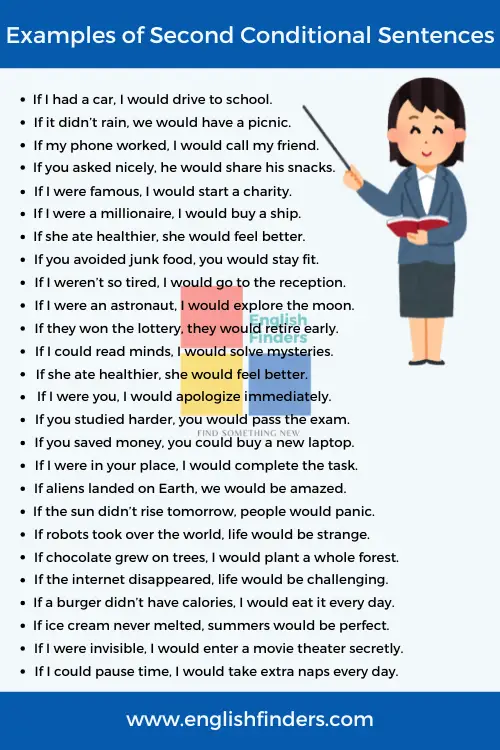
50 Second Conditional Examples
Imaginary Situations Now
- If I had more time, I would learn the guitar.
- If she lived closer, we would see her every week.
- If I knew his number, I would call him.
- If we had a car, we would drive to the coast.
- If my phone worked, I would send you the photos.
- If he spoke English, he would get the job.
- If they weren’t so busy, they would come to the party.
- If I didn’t have homework, I would watch a movie.
- If you lived in Canada, you would need a warm coat.
- If our apartment were bigger, we would get a dog.
Unlikely Future Events
- If I won the lottery, I would buy a house by the sea.
- If it snowed in July, people would be very surprised.
- If the bus drivers went on strike, I would walk to work.
- If you lost your passport abroad, you would need to visit the embassy.
- If my boss offered me a raise, I would say yes immediately.
- If aliens landed tomorrow, the news would talk about nothing else.
- If the internet stopped working for a week, many businesses would close.
- If I met a famous actor, I wouldn’t know what to say.
Giving Advice
- If I were you, I would apologize.
- If I were you, I would see a doctor.
- If I were you, I wouldn’t buy that phone.
- If I were you, I would ask for help.
- If I were in your position, I would take the job.
- If I were you, I would save some money every month.
- If I were you, I wouldn’t worry about it.
Result First
- I would travel more if I had the money.
- She would be happier if she changed jobs.
- We would go for a walk if it weren’t so cold.
- I would help you if I could.
- They would win more games if they trained harder.
- He wouldn’t be so tired if he went to bed earlier.
- You would understand if you read the whole letter.
With Could and Might
Could means “would be able to.” Might means “would perhaps.” Both can replace would in the result.
- If I had a bike, I could cycle to school.
- If you practiced every day, you could join the school band.
- If we left now, we might catch the early train.
- If she studied medicine, she could become a doctor.
- If it were cheaper, more people might buy it.
- If I spoke Spanish, I could talk to my neighbors.
- If you asked him nicely, he might say yes.
- If we had more money, we could fix the roof.
Questions
- What would you do if you won a million dollars?
- Where would you live if you could live anywhere?
- If you could meet anyone, who would it be?
- Would you take the job if they offered it to you?
- What would you change if you were the president?
- If you had a free day tomorrow, how would you spend it?
- Would you be angry if I borrowed your car?
- If you could speak any language, which one would you choose?
- What would happen if everyone stopped using plastic bags?
- Would you move abroad if you had the chance?
First or Second Conditional?
Both can talk about the future. The difference is how likely the speaker thinks the situation is.
| First conditional (real and possible) | Second conditional (imaginary or unlikely) |
|---|---|
| If I get the job, I’ll move to Chicago. (I have a good chance.) | If I got the job, I’d move to Chicago. (I probably won’t get it.) |
| If it rains tomorrow, we’ll stay at home. | If it snowed in the desert, people would take photos. |
| If I save enough, I’ll buy a laptop in May. | If I had a lot of money, I’d buy a new laptop every year. |
| If I see Anna, I’ll tell her. | If I saw the president, I’d ask for a photo. |
The first conditional uses the present simple and will. The second uses the past simple and would. Don’t mix the two in one sentence: “If I have money, I would buy it” is wrong.
Check your answer
Practice With Answers
Part A: Complete the Sentences
- If I ___ (have) a garden, I would grow tomatoes.
- If she ___ (not / work) so late, she would sleep better.
- If we lived near the sea, we ___ (go) swimming every day.
- If I were you, I ___ (not / sign) that contract.
- What ___ you ___ (do) if you saw a ghost?
- If he ___ (know) the answer, he would tell us.
Show answers
- Had
- Didn’t work
- Would go
- Wouldn’t sign
- Would … do
- Knew
Part B: First or Second Conditional?
- If the train is late, I ___ (call) you.
- If I ___ (be) a bird, I would fly over the mountains.
- If you ___ (study) tonight, you will pass tomorrow.
- If people ___ (live) on Mars, they would need special suits.
Show answers
- Will call (first: a real possibility)
- Were (second: imaginary)
- Study (first: a real possibility)
- Lived (second: imaginary)
Part C: Correct the Mistake
- If I would have more money, I would buy a car.
- If I was you, I would say sorry.
- If she has a car, she would drive us.
- I would call him, if I knew his number.
Show answers
- If I had more money, I would buy a car.
- If I were you, I would say sorry.
- If she had a car, she would drive us.
- I would call him if I knew his number. (No comma when the result comes first.)
Quiz: Test Yourself
- Which sentence is a correct second conditional?
- “If I ___ you, I would take the train.”
- What does “If I had a dog, I would walk it every day” tell you?
- Choose the correct form: “She ___ happier if she had more free time.”
- Where does the comma go?
- Which sentence talks about something likely?
- “If we left now, we ___ catch the early bus.” Which word means “would perhaps”?
- Which question is correct?
- What is the short form of “I would go”?
- Which sentence has a mistake?
Key Takeaways
- The second conditional imagines situations that are not true now or are unlikely in the future.
- Form: If + past simple, would + base verb.
- Say “If I were you” for advice; was is fine in casual speech elsewhere.
- Put a comma after the if clause only when it comes first.
- Never use would in the if clause.
Frequently Asked Questions
What is the second conditional?
It is a sentence pattern for imaginary or unlikely situations and their results. The form is if + past simple, would + base verb: “If I had a car, I would drive to work.”
Should I say “if I was” or “if I were”?
Both are used. Were is more formal and safer in exams, and was is common in everyday speech. For advice, always say “If I were you.”
Does a second conditional sentence need a comma?
Only when the if clause comes first: “If it rained, we would stay inside.” When the result comes first, leave the comma out: “We would stay inside if it rained.”
What is the difference between the first and second conditional?
The first conditional is for real possibilities: “If I get the job, I’ll move.” The second is for imaginary or unlikely ones: “If I got the job, I’d move.”
Can I use would in the if clause?
No. Would belongs only in the result. Say “If I knew, I would tell you,” not “If I would know, I would tell you.”
Can I use could or might instead of would?
Yes. Could means “would be able to,” and might means “would perhaps”: “If I had a bike, I could cycle to school.”
Related Articles

- Lay vs Lie: The Difference, Verb Forms and Examples - November 24, 2026
- Farther vs Further: Distance, Degree and Useful Phrases - November 24, 2026
- Compliment vs Complement: Meaning, Spelling and Examples - November 24, 2026