
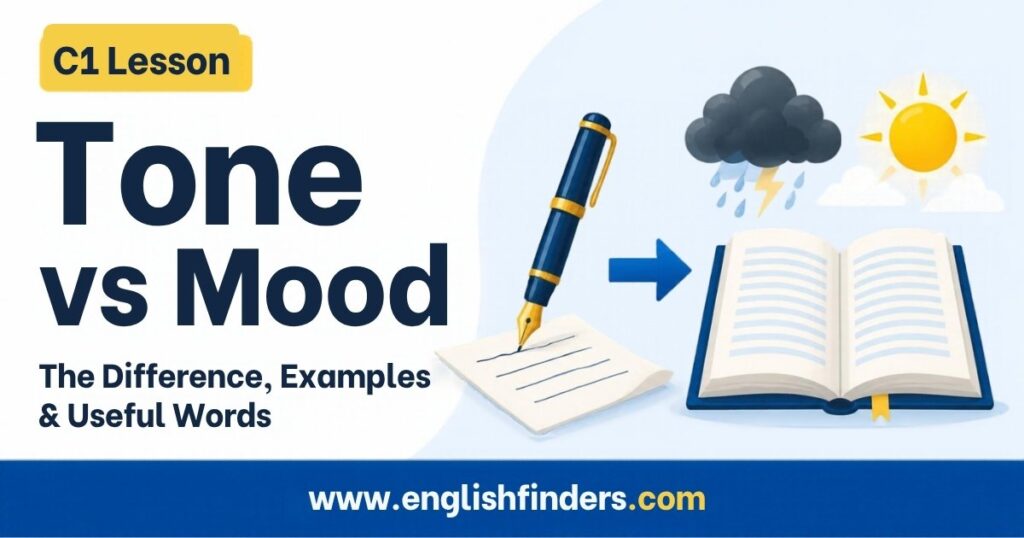
Comparing tone vs mood comes down to one question: whose feeling are you describing? Tone is the attitude of the writer or speaker. Mood is the feeling or atmosphere the reader experiences.
A TV weather presenter smiles and says, “Good news for umbrella sellers! A huge storm arrives tonight, so stay indoors.” Her tone is cheerful and joking. The mood for viewers watching from a small seaside town is probably anxious.
Most of the confusion between the two words disappears once you have the right adjectives, so a large part of this lesson is vocabulary.
- The difference between tone and mood, with a quick test
- How writers create tone and how they create mood
- Real examples from literature
- Adjectives to describe tone and mood precisely
- Phrases for writing about tone and mood in an essay
What Is the Difference Between Tone and Mood?
Quick Navigation
Think of a film. The director’s choices (the music, the lighting, the camera angles) shape how the audience feels. In writing, the author’s attitude shows in the tone, and the result in the reader is the mood.
The two are linked, but they are not the same thing. A writer controls the tone directly. The mood depends on the text, and partly on the reader too.
| Feature | Tone | Mood |
|---|---|---|
| Whose feeling? | The writer’s or narrator’s | The reader’s |
| Question to ask | “How does the writer feel about this?” | “How does this make me feel?” |
| Created by | Word choice, formality, irony, punctuation | Setting, imagery, sound, pace |
| Typical adjectives | Sarcastic, admiring, critical | Tense, peaceful, eerie |
Pronunciation and Other Meanings
| Word | Sounds like | IPA |
|---|---|---|
| Tone | tohn | /toʊn/ |
| Mood | mood | /muːd/ |
| Atmosphere | AT-mus-feer | /ˈæt.məs.fɪr/ |
Both words have other meanings. Tone of voice is how someone sounds when they speak. In grammar, mood also names verb forms such as the subjunctive.
In everyday English, “I’m in a good mood” is about your own feelings. See the tone and mood dictionary pages for all the senses.
How Writers Create Tone
Tone lives in the writer’s choices. Compare these two descriptions of the same meeting:
- “The meeting ran for three hours and reached several useful decisions.” (Neutral, positive tone)
- “Three hours later, we had bravely agreed to meet again next week.” (Sarcastic, frustrated tone)
The facts barely change. The word bravely, used ironically, shows the writer’s attitude. Formality, exclamation marks, short sentences and what the writer chooses to mention all work the same way.
How Writers Create Mood
Mood comes mostly from what the reader sees and hears in the text:
- Setting: an empty parking garage at midnight, a sunny market on a Saturday morning.
- Imagery and sound: dripping water, flickering lights, laughter from the next room.
- Pace: short, broken sentences feel tense; long, flowing ones feel calm.
- Weather and light: fog and dim light suggest mystery, while an open sky suggests freedom.
Tone and Mood in Literature
| Text | Tone | Mood | How |
|---|---|---|---|
| Pride and Prejudice, Jane Austen (1813) | Ironic, amused | Light, playful | “It is a truth universally acknowledged…” pretends to state a universal law about marriage |
| “The Raven,” Edgar Allan Poe (1845) | Grieving, obsessive | Gloomy, eerie | A midnight setting, a dying fire, a bird that repeats one word |
| Bleak House, Charles Dickens (1853) | Critical, weary | Heavy, confused | The novel opens with fog spreading over London, a picture of a slow legal system |
| A Christmas Carol, Charles Dickens (1843) | Warm, humorous | Cozy, hopeful (at the end) | A cheerful narrator who jokes with the reader |
Austen’s first sentence does not mean what it says. The tone is gently mocking, readers enjoy the joke, and the mood stays light. Irony is a common way to create tone; it is pushed further in our lesson on satire.
Words to Describe Tone
Precise adjectives earn marks in essays. “Positive” and “negative” are too vague.
| Tone | Meaning | Example situation |
|---|---|---|
| Sarcastic | Saying the opposite of what you mean, to mock | “Oh, great. Another form to fill out.” |
| Nostalgic | Fondly remembering the past | A writer remembering their grandmother’s kitchen |
| Detached | Cool, without emotion | A news report describing an accident in plain facts |
| Earnest | Serious and sincere | A volunteer explaining why the work matters |
| Condescending | Speaking as if the reader is less intelligent | “Let me explain this very slowly for you.” |
| Wistful | Sad longing for something lost | “If only we had stayed one more summer.” |
| Urgent | Pushing for fast action | “We must act before the river floods again.” |
Words to Describe Mood
| Mood | Meaning | Example situation |
|---|---|---|
| Eerie | Strange and frightening | An empty playground with one swing moving |
| Tense | Nervous, as if something will happen | Waiting outside the exam room |
| Serene | Calm and peaceful | A still lake at sunrise |
| Melancholy | Gently sad | Rain on the window on a Sunday evening |
| Festive | Happy and celebratory | Music and lights at a street party |
| Ominous | Suggesting something bad is coming | Dark clouds gathering over a wedding |
| Claustrophobic | Closed in, hard to breathe | A crowded elevator that has stopped |
Tone or mood? (tap to check)
SarcasticTap to reveal
EerieTap to reveal
NostalgicTap to reveal
SuspensefulTap to reveal
DetachedTap to reveal
How to Write About Tone and Mood
These collocations sound natural in essays and exam answers:
| For tone | For mood |
|---|---|
| The writer adopts a … tone | The passage creates a … mood |
| The tone is mocking / respectful | The setting establishes a … atmosphere |
| She strikes a hopeful tone | The imagery evokes a sense of … |
| The tone shifts from … to … | The mood darkens / lightens when … |
| Written in a formal tone | Builds a mood of suspense |
Example answer: “Austen adopts an ironic tone in the opening sentence, which creates a light, playful mood. The mood darkens slightly when…”
Note the prepositions: in a … tone (“written in a calm tone”), but create a … mood. For practice changing tone and register, try the C1 register and tone shifting worksheet.
Check your answer
Common Mistakes Learners Make
- Mixing up whose feeling it is: writers have a tone; readers feel a mood.
- Vague adjectives: “The tone is good” says nothing. Use admiring, grateful or enthusiastic.
- Forgetting the evidence: always quote the words that create the tone or mood.
- Preposition errors: the usual pattern is “written in a sarcastic tone,” and we say “a mood of suspense,” not “a mood for suspense.”
Practice: Test Your Understanding
Part A. Is each description about tone or mood?
- The writer mocks the new policy with exaggerated praise.
- The reader feels uneasy as the footsteps get closer.
- The narrator speaks of her childhood with affection.
- The forest at dusk feels silent and threatening.
- The article criticizes the company in a cold, factual way.
Show answers for Part A
- Tone – sarcastic or mocking.
- Mood – tense or suspenseful.
- Tone – nostalgic or affectionate.
- Mood – ominous or eerie.
- Tone – detached and critical.
Part B. Choose the more precise adjective.
- A narrator who remembers her school days fondly: (nostalgic / nice) tone.
- A scene in a dark basement with a dripping pipe: (bad / eerie) mood.
- A letter demanding immediate repairs: (urgent / strong) tone.
Show answers for Part B
- Nostalgic
- Eerie
- Urgent
Part C (writing). Write two 40-word paragraphs about the same bus journey, one cheerful in tone and one bitter. Add one sentence on how each tone changes the mood. Check your work with our AI Writing Feedback tool.
Quiz: Test Yourself
- What is tone?
- Which question helps you find the mood?
- “An empty playground at dusk, one swing creaking in the wind.” Which word best describes the mood?
- Which word describes tone, not mood?
- Can a text have a calm tone and a disturbing mood?
- Which sentence is correct?
- Which collocation is natural?
- In grammar, what else can mood mean?
- “Oh, great. Another form to fill out.” What is the tone?
- What mainly creates mood in a story?
Key Takeaways
- Tone is the writer’s attitude; mood is the reader’s feeling.
- Ask “How does the writer feel?” for tone and “How do I feel?” for mood.
- Tone comes from word choice and formality; mood comes from setting, imagery and pace.
- Use precise adjectives: sarcastic, nostalgic, eerie, ominous.
- Collocations: adopt a tone, create a mood, in a … tone.
When the tone turns mocking and the target is society, you have satire; read the satire lesson next. For stories where the reader knows more than the characters, continue with dramatic irony.
Frequently Asked Questions
What is the difference between tone and mood?
Tone is the writer’s or speaker’s attitude toward the subject, such as sarcastic or respectful. Mood is the feeling or atmosphere the reader experiences, such as tense or peaceful. Tone belongs to the writer; mood belongs to the reader.
How do you find the tone of a text?
Ask, “How does the writer feel about this subject?” Look at word choice, formality, punctuation and what the writer praises or mocks. Describe the answer with an adjective such as admiring, bitter or amused.
How do you find the mood of a text?
Ask, “How does this passage make me feel?” Look at the setting, imagery, sounds and the pace of the sentences. Then name the feeling with an adjective such as eerie, hopeful or tense.
Can tone and mood be different in the same text?
Yes. A narrator can describe something frightening in a calm, matter-of-fact tone, and that calmness can make the mood even more disturbing for the reader.
What are some words to describe tone?
Common tone words include formal, informal, serious, humorous, sarcastic, ironic, nostalgic, critical, admiring, detached, urgent and sympathetic. Choose the one that matches the writer’s attitude most precisely.
What are some words to describe mood?
Common mood words include tense, eerie, gloomy, peaceful, joyful, hopeful, melancholy, suspenseful, romantic, chaotic and calm. They describe the atmosphere the reader feels.
Related Articles

- Zeugma: Meaning, Examples and the Verbs That Make It Work - October 24, 2026
- Dramatic Irony: Meaning, Examples and the Language Behind It - October 24, 2026
- Satire: Meaning, Types, Examples and How to Spot It - October 24, 2026