
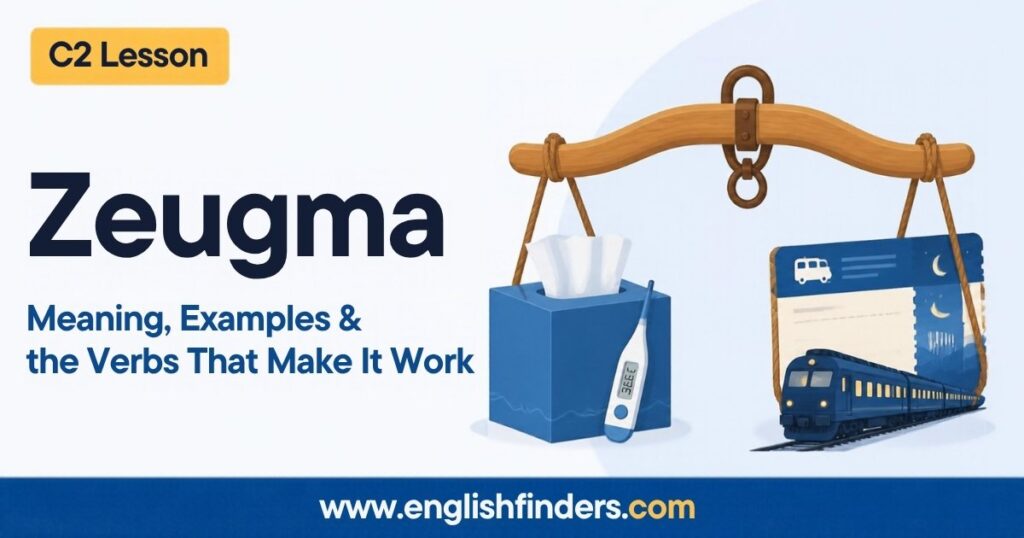
Zeugma is a figure of speech in which one word, usually a verb, is linked to two or more other words, but its meaning changes with each one. The sentence stays short, and the second meaning arrives as a small surprise.
“He caught a cold and the last train home.” The verb caught does two different jobs. With a cold, it means he became ill; with the last train, it means he got on it just in time. One verb carries both.
Because zeugma depends on verbs with several meanings, it is also a good test of how well you know the busiest verbs in English.
- What zeugma is and where the word comes from
- How to say zeugma, its plural and the related term syllepsis
- Famous and everyday examples
- The multi-meaning verbs that make zeugma possible
- When zeugma is wordplay and when it is a mistake
What Is Zeugma?
Quick Navigation
The Greek word means “a yoking together.” A yoke is the wooden bar that joins two animals so they pull one cart. In zeugma, one word pulls two partners, and each partner takes a different meaning from it.
Most zeugmas combine a literal meaning with a figurative one: lose your keys (literal) and your temper (figurative). The contrast between the concrete and the abstract is what makes them funny or sharp.
How to Pronounce Zeugma
| Word | Sounds like | IPA |
|---|---|---|
| Zeugma | ZOOG-muh | /ˈzuːɡ.mə/ |
| Zeugmata (plural) | ZOOG-muh-tuh | /ˈzuːɡ.mə.tə/ |
| Syllepsis | sih-LEP-sis | /sɪˈlep.sɪs/ |
Useful patterns: a clever zeugma, an example of zeugma, the line turns on a zeugma, zeugmatic (adjective). In everyday writing, zeugmas is a perfectly good plural. See the zeugma dictionary page.
Two Kinds of Zeugma
| Type | What happens | Example |
|---|---|---|
| Meaning shift | One word fits both partners, but in different senses | “She opened the window and her heart.” |
| Grammar mismatch | One word fits only one partner grammatically | “The kids were laughing and the baby asleep.” (were doesn’t fit the baby) |
The first type is the one you will meet in literature and jokes. The second is more often a slip in careless writing, which is why it matters for learners.
Zeugma Examples
In Literature
| Text | Line | The two meanings |
|---|---|---|
| The Rape of the Lock, Alexander Pope (1714) | “Or stain her honour, or her new brocade” | Stain a fabric; damage a reputation |
| The Pickwick Papers, Charles Dickens (1837) | Miss Bolo “went straight home, in a flood of tears and a sedan-chair” | Emotion; a means of transport |
Pope’s poem mocks a society that treats a lost lock of hair as a disaster. Putting honour and brocade (an expensive fabric) side by side suggests that, to these people, both matter equally. The zeugma is the joke and the criticism at once.
In Everyday English
| Sentence | Verb | Meaning 1 | Meaning 2 |
|---|---|---|---|
| “I lost my umbrella and my patience on the same rainy morning.” | Lost | Could not find | Became angry |
| “She broke the record and her ankle in the same race.” | Broke | Did better than | Injured |
| “He held the door and his tongue.” | Held | Kept open | Stayed silent |
| “They took a taxi and a huge risk.” | Took | Traveled in | Accepted danger |
| “She runs marathons and a small bakery.” | Runs | Completes a race | Manages |
The Verbs That Make Zeugma Work
Zeugma needs a word with several common meanings. The most useful ones are short, everyday verbs. Each has a literal sense and several figurative collocations, and knowing those collocations is a sign of advanced English.
| Verb | Literal | Figurative or other collocations |
|---|---|---|
| Catch | A ball | A cold, a train, someone’s eye, a glimpse |
| Lose | Your keys | Your temper, weight, track of time, face |
| Break | A glass | A promise, the news, a record, the silence |
| Raise | Your hand | Children, prices, a question, eyebrows |
| Hold | A cup | A meeting, your breath, your tongue, a grudge |
| Take | A photo | A break, a risk, your time, offense |
| Run | A marathon | A business, late, a risk, out of time |
| Draw | A picture | A conclusion, a crowd, the line, attention |
To build a zeugma, pick a verb, choose one concrete partner and one abstract partner, and join them with and. For more work on these word partnerships, see our C2 lesson on advanced collocations.
Check your answer
When Zeugma Is a Mistake
An accidental zeugma happens when you drop a verb to save words, but the remaining verb does not fit both partners. Readers may laugh at the wrong moment.
| Accidental zeugma | Problem | Better |
|---|---|---|
| “She ate a sandwich and a cup of coffee.” | You don’t eat coffee | “She ate a sandwich and drank a cup of coffee.” |
| “The kids were laughing and the baby asleep.” | Were doesn’t agree with the baby | “The kids were laughing, and the baby was asleep.” |
| “He has always and will always support the team.” | Has … support is not correct | “He has always supported, and will always support, the team.” |
Leaving out a repeated word is often fine; this is called ellipsis. It only fails when the shared word would be wrong for one of its partners. Our C1 lesson on ellipsis explains when you can safely omit words.
Zeugma vs Similar Devices
| Device | How it works | Example |
|---|---|---|
| Zeugma | One word, two partners, two senses | “She lost her keys and her temper.” |
| Pun | One word or sound with two meanings | “I used to be a banker, but I lost interest.” |
| Chiasmus | Repeats words in reverse order | “Work to live; don’t live to work.” |
| Antithesis | Places opposite ideas in balance | “Easy to start, hard to finish.” |
Zeugma is close to the pun, because both play on double meanings. Our C2 lesson on puns and wordplay covers more of these tricks.
Common Mistakes Learners Make
- Pronunciation: it is ZOOG-muh, not “zeg-ma” or “zee-ug-ma.”
- Any list counts as zeugma: “I bought apples and bread” is not zeugma, because bought means the same thing with both.
- Accidental zeugma in essays: check that a shared verb fits every partner, in meaning and in grammar.
- Overuse: one zeugma in a speech is witty; three in a paragraph feel forced.
Practice: Test Your Understanding
Part A. Write the two meanings of the verb in each zeugma.
- He paid the bill and the price for his mistake.
- She caught the bus and the attention of everyone on it.
- The storm knocked out the power and our plans for the weekend.
- I kept my receipt and my promise.
Show answers for Part A
- Paid – gave money / suffered the result.
- Caught – got on in time / attracted.
- Knocked out – stopped (the electricity) / ruined.
- Kept – did not throw away / did what I said I would.
Part B. Correct the accidental zeugma.
- We ate pizza and lemonade at the party.
- The windows were open and the door locked.
- She can and has finished the report.
Show answers for Part B
- “We ate pizza and drank lemonade at the party.”
- “The windows were open, and the door was locked.”
- “She can finish, and has finished, the report.” (or “She has finished the report.”)
Part C (writing). Choose two verbs from the table, such as break and raise, and write one deliberate zeugma with each. Then add a sentence explaining both meanings. Get feedback with our AI Writing Feedback tool.
Quiz: Test Yourself
- What is zeugma?
- How do you pronounce zeugma?
- In “She lost her keys and her temper,” what does lost mean with temper?
- What does the Greek word behind zeugma mean?
- Which sentence is NOT a zeugma?
- In Pope’s line, what does stain combine?
- Fix the accidental zeugma: “She ate a sandwich and a cup of coffee.”
- Which collocation with raise is figurative?
- How is zeugma related to a pun?
- What is the usual plural of zeugma in everyday writing?
Key Takeaways
- Zeugma links one word to two partners in two different senses.
- Say ZOOG-muh; the plural is zeugmas or zeugmata.
- It usually mixes a literal and a figurative meaning: “lost her keys and her temper.”
- Multi-meaning verbs like catch, lose, break, raise and hold make it possible.
- An accidental zeugma is a grammar or meaning error: give each partner the right verb.
Zeugma plays with meaning; its cousin chiasmus plays with word order. For balanced opposites, see antithesis.
Frequently Asked Questions
What is zeugma in simple words?
Zeugma is when one word, usually a verb, connects to two other words but means something different with each. In “She lost her keys and her temper,” lost is literal with keys and figurative with temper.
How do you pronounce zeugma?
Say ZOOG-muh, with the stress on the first syllable: /ˈzuːɡ.mə/. The plural is zeugmas or, more formally, zeugmata (ZOOG-muh-tuh). The word comes from Greek and means “a yoking together.”
What is the difference between zeugma and syllepsis?
Writers on rhetoric don’t agree. Some use the terms as synonyms. Others use syllepsis for the meaning-shift type and zeugma for a word that fits only one partner grammatically. Most dictionaries accept zeugma for both.
What is a famous example of zeugma?
In Alexander Pope’s The Rape of the Lock (1714), a woman might “stain her honour, or her new brocade.” The verb stain works literally with the fabric and figuratively with her reputation, which makes the line comic.
Is zeugma a grammar mistake?
It can be. A deliberate zeugma is wordplay. An accidental one, such as “She ate a sandwich and a cup of coffee,” is a mistake, because you drink coffee. Fix it by adding the right verb.
Why do writers use zeugma?
It is short, witty and surprising. The reader expects one meaning, meets a second one, and has to rethink the sentence. Writers use it for humor, irony or to link a small event with a big one.
Related Articles

- Zeugma: Meaning, Examples and the Verbs That Make It Work - October 24, 2026
- Dramatic Irony: Meaning, Examples and the Language Behind It - October 24, 2026
- Satire: Meaning, Types, Examples and How to Spot It - October 24, 2026