Last updated on September 4th, 2026 at 02:47 pm
A declarative sentence is a type of sentence that asserts or declares a fact, opinion, or statement. It ends with a period and does not contain a question mark. Examples of declarative sentences include:
- The sky is blue.
- I am taking the online course.
- She enjoys gardening.
- My sister is the best cook.
These sentences all make a statement, which is what makes them declarative sentences.
Declarative sentences can be positive or negative — “I am not taking the online course” is still declarative because it makes a statement.
Declarative sentences are important for conveying information and expressing opinions clearly. They are an essential part of communication, and understanding how to use them correctly is important.
Structure of a Declarative Sentence (Formula)
Quick Navigation
| Sentence Type | Structure | Example |
|---|---|---|
| Affirmative | Subject + verb + object/complement | She enjoys gardening. |
| Negative | Subject + auxiliary + not + verb + object/complement | She does not enjoy gardening. |
When to Use Declarative Sentences
- To state a fact — “The sun rises in the east.”
- To share an opinion — “I think this book is interesting.”
- To describe a person, place, or thing — “My sister is the best cook.”
- To explain or report something — “He has been working on his project all day.”
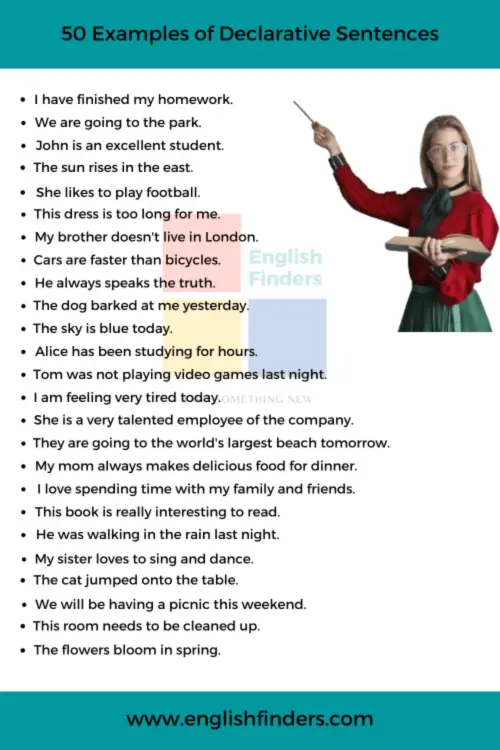
50 Examples of Declarative Sentences
Let’s see the 50 useful examples of Declarative Sentences:
- I have finished my homework.
- We are going to the park.
- He has been watching a movie for a long time.
- John is an excellent student.
- The sun rises in the east.
- She likes to play football.
- This dress is too long for me.
- My brother doesn’t live in London.
- Cars are faster than bicycles.
- He always speaks the truth.
- The dog barked at me yesterday.
- The sky is blue today.
- Alice has been studying for hours.
- Tom was not playing video games last night.
- I am feeling very tired today.
- She is a very talented employee of the company.
- They are going to the world’s largest beach tomorrow.
- My mom always makes delicious food for dinner.
- I love spending time with my family and friends.
- This book is really interesting to read.
- He was walking in the rain last night.
- My sister loves to sing and dance.
- The cat jumped onto the table.
- We will be having a picnic this weekend.
- This room needs to be cleaned up.
- The flowers bloom in spring.
- John has been working on his project all day.
- The city looks beautiful at night.
- School starts at 8:00 am every day.
- My dad likes to watch sports on TV.
- I often go running in the morning.
- She always wears bright colors when she goes out.
- We should listen more carefully to each other’s opinions.
- The sky was filled with stars last night.
- My sister loves animals and wants to be a vet when she grows up.
- It’s important to care for our environment by recycling and reducing waste whenever possible.
- Tomatoes are good for your health and can be used in many dishes like salads, sauces, and soups.
- Ice cream tastes great on hot summer days.
- Life can be unpredictable, and you never know what’s around the corner.
- There are so many different types of music out there that you can find something for everyone.
- I think it’s important to take time out of your day and relax.
- I’m surprised to see you after a long time.
- He is not happy to miss the flight.
- Jimmy feels sad for his sister.
- We know you can achieve the prize.
- I’m confident in solving the math.
- She is singing a melodious song for me.
- We need to be united till our last breath.
- They are launching a new project for artificial intelligence.
- He didn’t reach his destination last night.
A declarative sentence depicts a fact, opinion, or statement, and it plays a significant role in everyday life — in academic writing as much as daily conversation.
That’s why it’s worth learning to use them properly, and the 50 examples above are a good place to practice.
Common Mistakes to Avoid
- Forgetting subject-verb agreement. “She enjoy gardening” should be “She enjoys gardening” — the verb must agree with a third-person singular subject.
- Turning a declarative sentence into a question by mistake. A declarative sentence ends with a period, not a question mark, even when it reports something someone asked.
- Overusing run-on sentences. Long declarative sentences that string together too many ideas without proper punctuation become hard to follow — break them up or use conjunctions correctly.
Frequently Asked Questions
What is a declarative sentence?
A declarative sentence is a sentence that states a fact, opinion, or statement and ends with a period.
Can a declarative sentence be negative?
Yes. A declarative sentence can be positive or negative — “I am not taking the online course” is still declarative because it makes a statement.
What is the difference between a declarative and an interrogative sentence?
A declarative sentence makes a statement and ends with a period. An interrogative sentence asks a question and ends with a question mark.
Continue Learning

- 50 Words Ending in Less | Meanings, Examples, and Worksheet - July 26, 2026
- 5 Letter Words with 3 Vowels: 200+ Words with Meanings and Examples - July 11, 2026
- 100 Words Ending in Ful: Meanings, Example Sentences, and Worksheet - May 29, 2026