
Last updated on November 21st, 2026 at 07:00 pm
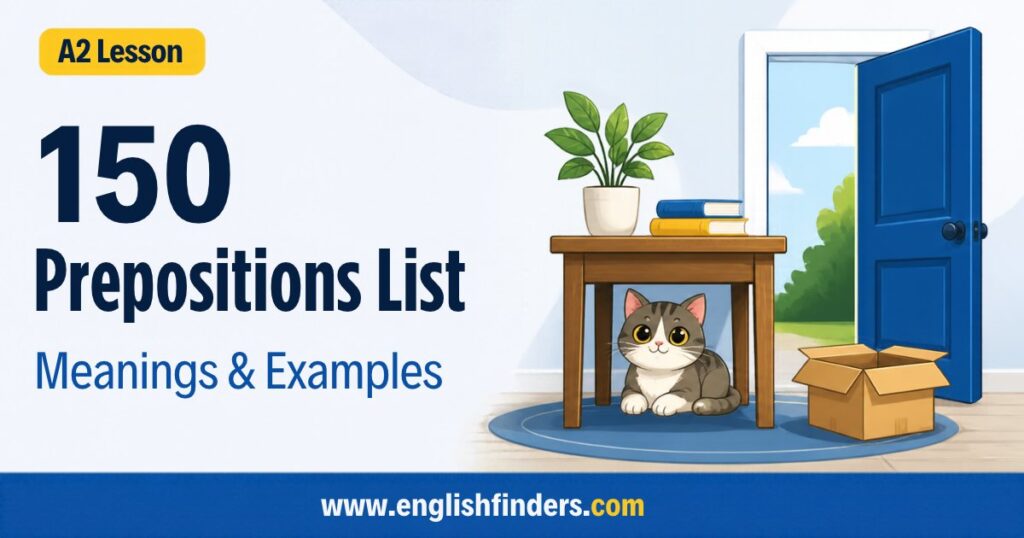
Look at this sentence: The cat is under the table, next to the door.
The words under and next to tell us where the cat is. They are prepositions. A preposition is a small word or a group of words. It shows how a noun or pronoun connects to the rest of the sentence.
This page lists 150 English prepositions with short meanings and examples. It starts with the 10 most common ones. Then it groups them by use and ends with a quiz.
- What a preposition is
- How many prepositions there are in English
- The 10 most common prepositions
- A list of 150 prepositions with meanings and examples
- Prepositions of time, place and direction, and common word + preposition pairs
What Is a Preposition?
Quick Navigation
A preposition usually comes before a noun or a pronoun. Together they make a prepositional phrase, such as in the morning or with my friends.
- The keys are on the table.
- We met after lunch.
- She walked into the room.
- This gift is for you.
- I stayed home because of the rain.
The word preposition comes from Latin. Pre means “before,” and a preposition is “placed before” a noun.
How Many Prepositions Are There in English?
There is no final list. Some words work as prepositions in one sentence and as adverbs or conjunctions in another. Most grammar lists include about 100 to 150 prepositions.
The list on this page has 150: 80 one-word prepositions and 70 complex prepositions of two or more words. About 30 of them do most of the work in everyday English.
The 10 Most Common Prepositions
These ten appear again and again in English. Learn them first.
| Preposition | Example |
|---|---|
| Of | A cup of tea, please. |
| In | My sister lives in Canada. |
| To | We walked to school. |
| For | This letter is for you. |
| With | I live with my parents. |
| On | Your phone is on the bed. |
| At | Let’s meet at 6 p.m. |
| From | He comes from Brazil. |
| By | The book was written by my teacher. |
| About | Tell me about your trip. |
List of 150 Prepositions in English
The list has three parts: one-word prepositions, two-word prepositions, and prepositions of three or more words.
One-Word Prepositions (A–D)
| Preposition | Meaning | Example |
|---|---|---|
| Aboard | On a ship, plane, bus or train | We went aboard the ship. |
| About | On the subject of | This book is about animals. |
| Above | Higher than | A bird flew above the house. |
| Across | From one side to the other | We swam across the river. |
| After | Later than | Let’s go out after dinner. |
| Against | Touching, or opposing | The bike is against the wall. |
| Along | Following the length of | We walked along the beach. |
| Alongside | Next to, or together with | Our car stopped alongside a bus. |
| Amid | In the middle of (formal) | The town stayed calm amid the storm. |
| Among | In a group of more than two | She sat among her friends. |
| Around | In a circle, or about | We walked around the lake. |
| As | In the role of | She works as a nurse. |
| Astride | With one leg on each side | The boy sat astride the horse. |
| At | At a point in place or time | I am at home. |
| Atop | On the top of (formal) | A flag flew atop the tower. |
| Barring | Unless something happens | Barring delays, we will arrive at noon. |
| Before | Earlier than | Wash your hands before lunch. |
| Behind | At the back of | The garden is behind the house. |
| Below | Lower than | The temperature fell below zero. |
| Beneath | Under (formal) | The coins were beneath the sand. |
| Beside | Next to | Come and sit beside me. |
| Besides | In addition to | Besides English, she speaks French. |
| Between | In the space between two things | The bank is between the café and the shop. |
| Beyond | On the far side of | The village is beyond the hills. |
| But | Except | Everyone but Tom came to the party. |
| By | Near, or done by | I sat by the window. |
| Circa | Around a date (formal) | The castle was built circa 1200. |
| Concerning | About (formal) | I have a question concerning my bill. |
| Considering | When you think about | He played well, considering his injury. |
| Despite | Even though there is | We went out despite the rain. |
| Down | From higher to lower | She ran down the stairs. |
| During | All through a period of time | Please turn off your phone during the film. |
One-Word Prepositions (E–O)
| Preposition | Meaning | Example |
|---|---|---|
| Except | Not including | I like all fruit except bananas. |
| Excluding | Not counting | The price is $20, excluding tax. |
| Following | After (formal) | Following the meeting, we had lunch. |
| For | Meant for, or a period of time | I waited for an hour. |
| From | Starting point | The train goes from Dhaka to Chattogram. |
| Given | When you think about | Given the traffic, we should leave now. |
| In | Inside, or within a period | The milk is in the fridge. |
| Including | Counting as part of a group | Ten people came, including my cousin. |
| Inside | Within something | Leave your shoes inside the door. |
| Into | Moving to the inside of | She jumped into the pool. |
| Like | Similar to | He sings like a bird. |
| Minus | Less, without | Ten minus three is seven. |
| Near | Not far from | Our school is near the park. |
| Notwithstanding | In spite of (very formal) | Notwithstanding the cost, they bought the house. |
| Of | Belonging to, or part of | The color of the car is red. |
| Off | Away from a surface | The cat jumped off the sofa. |
| On | Touching the surface of | The picture is on the wall. |
| Onto | Moving to a surface | He climbed onto the roof. |
| Opposite | Facing, on the other side | The bank is opposite the post office. |
| Out | Through and away (informal) | She looked out the window. |
| Outside | Not inside | The children are playing outside the house. |
| Over | Above, or across | A plane flew over the city. |
One-Word Prepositions (P–W)
| Preposition | Meaning | Example |
|---|---|---|
| Past | Beyond, or later than | It is ten past five. |
| Pending | While waiting for | The match is stopped pending a decision. |
| Per | For each | The tickets cost $10 per person. |
| Plus | Added to | Two plus two is four. |
| Regarding | About (formal) | I am writing regarding your order. |
| Round | Around (mainly British) | We drove round the town. |
| Save | Except (formal) | All the guests left save one. |
| Since | From a time in the past until now | I have lived here since 2019. |
| Than | Used to compare | She is taller than her brother. |
| Through | From one end to the other | The train went through a tunnel. |
| Throughout | In every part, or all the time | It rained throughout the day. |
| Till | Until (informal) | The shop is open till nine. |
| To | Toward a place or person | Give the book to Sara. |
| Toward (towards) | In the direction of | The dog ran toward me. |
| Under | Below | The ball is under the chair. |
| Underneath | Directly under | I found my keys underneath the bed. |
| Unlike | Different from | Unlike her sister, she loves sports. |
| Until | Up to a time | I will wait until Friday. |
| Up | From lower to higher | We walked up the hill. |
| Upon | On (formal) | The king sat upon his throne. |
| Versus | Against (in a game or case) | It is Brazil versus Spain tonight. |
| Via | Through, by way of | We flew to London via Dubai. |
| With | Together with, or using | I cut the bread with a knife. |
| Within | Inside a limit | Please reply within two days. |
| Without | Not having | I can’t see without my glasses. |
| Worth | Having a value of | This old coin is worth $100. |
Two-Word Prepositions
| Preposition | Meaning | Example |
|---|---|---|
| According to | As said by | According to the news, it will snow. |
| Ahead of | In front of, or before | She finished ahead of the others. |
| Along with | Together with | I bought a pen along with a notebook. |
| Apart from | Except for, or as well as | Apart from Sam, everyone was there. |
| As for | Talking about | As for me, I prefer tea. |
| As of | Starting from a time | As of Monday, the shop opens at 8. |
| As per | According to (formal) | We sent the files as per your request. |
| As to | About (formal) | There is no news as to the cause. |
| Aside from | Except for | Aside from the rain, the trip was great. |
| Away from | Not near | Keep the medicine away from children. |
| Based on | Using something as a starting point | The film is based on a true story. |
| Because of | For the reason of | The game stopped because of the rain. |
| But for | Without (formal) | But for your help, I would have failed. |
| Close to | Near | Our house is close to the station. |
| Contrary to | Opposite to | Contrary to the forecast, it was sunny. |
| Depending on | Changing with | Depending on the weather, we will go swimming. |
| Due to | Caused by | The flight was late due to fog. |
| Except for | Not including | The room was empty except for a chair. |
| Far from | A long way from | The hotel is far from the beach. |
| Inside of | Inside (informal) | Put your bag inside of the locker. |
| Instead of | In place of | I had tea instead of coffee. |
| Irrespective of | Not affected by (formal) | Everyone pays the same, irrespective of age. |
| Near to | Close to | The shop is near to my office. |
| Next to | Beside | Sit next to me. |
| Opposite to | Facing, or very different from | My view is opposite to yours. |
| Other than | Except | I have no plans other than sleeping. |
| Out of | From inside to outside | She took a book out of her bag. |
| Outside of | Outside (informal) | There is a café outside of the station. |
| Owing to | Because of (formal) | Owing to the strike, there are no trains. |
| Prior to | Before (formal) | Please arrive prior to the meeting. |
| Pursuant to | Following a rule (legal) | The money was paid pursuant to the contract. |
| Rather than | Instead of | I’ll walk rather than wait for the bus. |
| Regardless of | Without caring about | We will play, regardless of the weather. |
| Short of | Without enough of | We are short of money this month. |
| Subsequent to | After (formal) | Subsequent to the test, we got our results. |
| Such as | For example | I like fruit such as apples and mangoes. |
| Thanks to | Because of (good result) | Thanks to your help, we finished early. |
| Together with | With | He came together with his wife. |
| Up to | As far as, or as many as | The bus holds up to 50 people. |
| Up until | Until | I lived in Sylhet up until last year. |
Prepositions of Three or More Words
| Preposition | Meaning | Example |
|---|---|---|
| As far as | To a place or degree | We walked as far as the bridge. |
| As opposed to | Rather than | I prefer tea, as opposed to coffee. |
| As well as | And also | She speaks Hindi as well as English. |
| By means of | Using | They crossed the river by means of a rope. |
| By virtue of | Because of (formal) | She won by virtue of her hard work. |
| By way of | Through, or as a form of | We came by way of the old road. |
| For the sake of | To help or benefit | He quit smoking for the sake of his health. |
| In accordance with | Following a rule | Do it in accordance with the instructions. |
| In addition to | As well as | In addition to math, he teaches science. |
| In case of | If something happens | In case of fire, use the stairs. |
| In charge of | Responsible for | She is in charge of the team. |
| In comparison with | Compared to | This phone is cheap in comparison with others. |
| In exchange for | Giving one thing for another | I helped him in exchange for a lesson. |
| In favor of | Supporting | Most students are in favor of the plan. |
| In front of | Facing, before | The bus stops in front of the school. |
| In lieu of | Instead of (formal) | We got a voucher in lieu of a refund. |
| In light of | Because of, considering | In light of the news, the trip is canceled. |
| In place of | Instead of | Use honey in place of sugar. |
| In relation to | About, connected with | I have a question in relation to the test. |
| In response to | As an answer to | In response to your email, here is the file. |
| In search of | Looking for | They traveled in search of work. |
| In spite of | Despite | We went out in spite of the rain. |
| In terms of | Talking about | In terms of price, this phone is the best. |
| In view of | Because of | In view of the weather, the match was moved. |
| On account of | Because of | The school closed on account of the flood. |
| On behalf of | For, in the place of | I am writing on behalf of my manager. |
| On top of | On the highest part of, or as well as | The cat is on top of the fridge. |
| With regard to | About (formal) | With regard to your question, the answer is yes. |
| With respect to | About (formal) | With respect to cost, both options are similar. |
| With the exception of | Except | Everyone passed, with the exception of two students. |
Prepositions of Time, Place and Direction
Many learners study prepositions by use. Here are the most useful ones in each group.
| Use | Prepositions | Examples |
|---|---|---|
| Time | At, on, in, before, after, during, since, for, until, by | At 7 p.m., on Monday, in July, since 2020 |
| Place | In, on, at, under, above, between, among, behind, in front of, next to, opposite | In the box, on the wall, at the door |
| Direction | To, into, onto, toward, through, across, along, up, down, out of, past | Into the room, across the road, up the hill |
| Other | With, without, by, about, like, for, of, despite | With a pen, about music, like a star |
30 Common Word + Preposition Pairs
Some words always take the same preposition. You have to learn these pairs together.
| Pair | Example |
|---|---|
| Afraid of | My little brother is afraid of dogs. |
| Angry with (a person) | She was angry with me for being late. |
| Interested in | I am interested in history. |
| Good at | He is good at math. |
| Bad at | I am bad at drawing. |
| Proud of | We are proud of you. |
| Tired of | I am tired of waiting. |
| Famous for | Paris is famous for its food. |
| Responsible for | She is responsible for the budget. |
| Different from | My answer is different from yours. |
| Similar to | Your bag is similar to mine. |
| Married to | He is married to a doctor. |
| Worried about | They are worried about the exam. |
| Excited about | The kids are excited about the trip. |
| Keen on | She is keen on tennis. |
| Aware of | Are you aware of the new rule? |
| Full of | The box is full of books. |
| Capable of | He is capable of doing the job. |
| Depend on | Children depend on their parents. |
| Belong to | This phone belongs to Sara. |
| Listen to | Please listen to the teacher. |
| Wait for | We are waiting for the bus. |
| Look for | I am looking for my keys. |
| Apply for | She applied for a new job. |
| Believe in | I believe in you. |
| Succeed in | He succeeded in passing the test. |
| Agree with | I agree with you. |
| Laugh at | Everyone laughed at the joke. |
| Think about | I often think about my old school. |
| Apologize for | He apologized for the mistake. |
For more practice, see these 50 examples of prepositional phrases.
Check your answer
Quiz: Test Yourself
- “The book is ___ the table.”
- “I was born ___ 2005.”
- Which one is a complex preposition?
- “She is good ___ math.”
- “We have lived here ___ 2019.”
- Which word is not a preposition?
- “He walked ___ the room and sat down.”
- “I am interested ___ history.”
- “The meeting is ___ Monday.”
- Choose the correct sentence.
Key Takeaways
- A preposition comes before a noun or pronoun and shows place, time, direction or another relation.
- English has about 150 common prepositions, including complex ones like in front of.
- The 10 most common are of, in, to, for, with, on, at, from, by and about.
- Use at for times, on for days and in for months and years.
- Some words always take the same preposition, like afraid of and good at.
Frequently Asked Questions
What are prepositions?
Prepositions are words like in, on, at, with and because of. They come before a noun or pronoun and show place, time, direction or another relation: on the table, at 5 p.m.
How many prepositions are there in English?
There is no final list, because some words can also be adverbs or conjunctions. Most lists have about 100 to 150. This page lists 150: 80 one-word and 70 complex prepositions.
What are the 10 most common prepositions?
The 10 most common prepositions in English are of, in, to, for, with, on, at, from, by and about. Learn these first.
What is a complex preposition?
A complex preposition has two or more words that work together as one preposition, such as because of, next to, in front of and in spite of.
Can a sentence end with a preposition?
Yes. In everyday English it is natural: Who are you talking to? What are you looking at? Very formal writing sometimes avoids it.
What is the difference between a preposition and a conjunction?
A preposition comes before a noun: before lunch. A conjunction joins a full clause: before we ate lunch. Some words, like before and after, can be both.
Related Articles

- Lay vs Lie: The Difference, Verb Forms and Examples - November 24, 2026
- Farther vs Further: Distance, Degree and Useful Phrases - November 24, 2026
- Compliment vs Complement: Meaning, Spelling and Examples - November 24, 2026
is there a prepositional phrase in the sentence, “The vet asked questions concerning the cat’s health.” Please respawn ASAP. Thank you!!!
No! We don’t find any prepositional phrases in the sentence.