
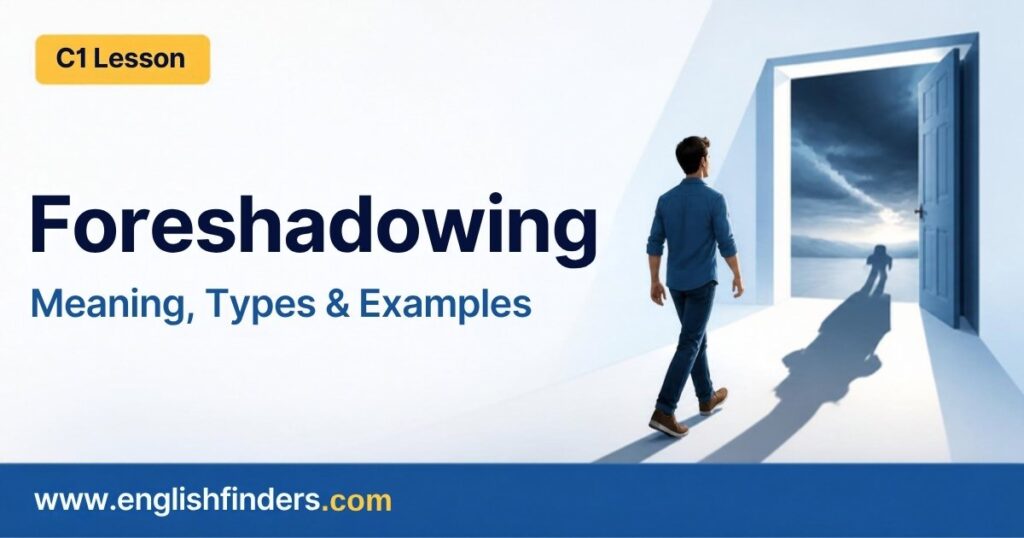
Foreshadowing is a hint or clue early in a story about something that will happen later. A dark cloud, a strange comment or a small object can quietly prepare the reader for an important event.
Readers often notice it only on a second reading. Then the clues seem obvious: the loose step on the stairs, the door left open, the friend who says “Nothing ever happens here.”
You’ll see how direct and indirect foreshadowing differ, then practice the grammar writers use to plant a hint.
- What foreshadowing means and how to pronounce it
- Direct and indirect foreshadowing
- Famous examples from literature
- Useful grammar for foreshadowing, such as would and little did she know
- How to use foreshadowing in your own stories, with a practice quiz
What Is Foreshadowing?
Quick Navigation
The word comes from fore (before) and shadow. Think of a shadow that arrives before the person does. You see it first, and then the person appears. Foreshadowing works the same way: the hint appears first, and the event comes later.
Good foreshadowing is easy to miss on a first reading. On a second reading, the clue seems obvious, and readers enjoy noticing how carefully the story was planned.
How to pronounce foreshadowing
| Word | Sounds like | IPA | Part of speech |
|---|---|---|---|
| Foreshadowing | for-SHAD-oh-ing | /fɔːˈʃæd.əʊ.ɪŋ/ | Noun |
| Foreshadow | for-SHAD-oh | /fɔːˈʃæd.əʊ/ | Verb |
Useful patterns: X foreshadows Y, Y is foreshadowed by X, an early hint of…, an ominous sign. See more on our foreshadow dictionary page.
Direct vs Indirect Foreshadowing
| Type | How it works | Example |
|---|---|---|
| Direct | The text openly tells the reader that something will happen. | “It was the last time she would see her brother.” |
| Indirect | Small clues hint at the future without saying it. | A character keeps checking a weak lock on the back door. |
Direct foreshadowing creates suspense: we know something will happen, but not how. Indirect foreshadowing creates surprise: the clue only makes sense when the event arrives.
Common Ways Writers Foreshadow
- Dialogue: a character says something that turns out to be important. “Nothing bad ever happens in this town.”
- Setting and weather: a storm before a fight, or dark clouds before bad news.
- Objects: an item that appears early and matters later.
- Prophecies and warnings: a fortune teller, a dream or a stranger’s warning.
- Titles and prologues: the title or opening tells us how the story might end.
- Character actions: a nervous habit or small lie that grows into a bigger problem.
Famous Foreshadowing Examples in Literature
Spoiler note: some examples below mention how stories end.
| Work | Foreshadowing | What it points to |
|---|---|---|
| Romeo and Juliet, William Shakespeare | The prologue calls them “star-cross’d lovers” who “take their life.” | The tragic deaths of the two lovers |
| Macbeth, William Shakespeare | The witches predict that Macbeth will become king. | Macbeth’s rise to power and his fall |
| Of Mice and Men, John Steinbeck | Candy’s old dog is shot because it is no longer useful. | George’s painful decision about Lennie at the end |
In Romeo and Juliet, the foreshadowing is direct: we know the ending from the start. The tension comes from watching how it happens.
Grammar for Foreshadowing
These structures help you hint at the future while telling a story in the past. They are very useful at C1 level.
| Structure | Example | Effect |
|---|---|---|
| Would (future in the past) | She smiled and waved. She would never see him again. | Tells the reader about a future event |
| Was to + verb | It was to be the most important day of his life. | Formal, dramatic hint |
| Little did + subject + know | Little did she know that the letter would change everything. | Creates suspense |
| If only + past perfect | If only he had listened to the warning. | Suggests regret and danger |
| Didn’t know it yet, but… | I didn’t know it yet, but that phone call would change my life. | Friendly, natural style |
Little did she know uses inversion (the verb comes before the subject). You can learn more in our C1 lesson on negative adverbial inversion.
Check your answer
Foreshadowing vs Flashback vs Red Herring
| Device | Direction | What it does |
|---|---|---|
| Foreshadowing | Forward | Hints at what will happen later |
| Flashback | Backward | Shows what happened earlier |
| Red herring | Misleading | A false clue that sends readers the wrong way |
Mystery writers use both foreshadowing and red herrings. The real clues are foreshadowing; the fake ones are red herrings.
How to Use Foreshadowing in Your Own Writing
- Know your ending first. You cannot plant clues for an event you have not planned.
- Choose one or two clues. An object, a warning, a change in weather.
- Hide them in normal moments. A clue in the middle of ordinary action feels natural.
- Make the payoff clear. When the event happens, readers should be able to look back and see the clue.
- Do not overdo it. Too many hints make the ending predictable.
- “At the time, it seemed like a small thing.”
- “Nobody paid attention to…”
- “I didn’t know it yet, but…”
- “It would be years before she understood…”
- “Little did they know…”
Common Mistakes Learners Make
- Spelling: it is foreshadowing (fore + shadow), not “forshadowing.”
- Giving away too much. “Later, he would die in the war” removes all suspense unless that is your goal.
- Planting clues that go nowhere. If you foreshadow something, it must happen.
- Confusing it with a flashback. Foreshadowing points forward; a flashback goes back.
Practice: Test Your Understanding
Part A. Direct foreshadowing, indirect foreshadowing or neither?
- “It was the last summer we would spend together.”
- The detective noticed a muddy boot print by the window but said nothing.
- They ate dinner and watched a film.
- A fortune teller warned him never to cross the river at night.
- Little did she know that her new neighbor was a famous spy.
Show answers for Part A
- Direct – it tells us something will change.
- Indirect – a small clue that will matter later.
- Neither – just everyday action.
- Direct – a warning or prophecy.
- Direct – the narrator openly hints at a secret.
Part B. Complete each sentence to foreshadow an event.
- She locked the door and left. She would…
- Little did he know that…
- At the time, the broken window seemed…
Show sample answers for Part B
- She would never live in that house again.
- Little did he know that the stranger on the train was his future boss.
- At the time, the broken window seemed unimportant.
Part C (writing). Write the first three sentences of a short story. Include one clue that hints at a surprise later. Check your writing with our AI Writing Feedback tool, or practice sentence structure in the Sentence Builder.
Quiz: Test Yourself
- What is foreshadowing?
- “It was the last summer we would spend together.” What kind of foreshadowing is this?
- A character keeps checking a weak lock on the back door. What kind of foreshadowing is this?
- “______ she know that the letter would change everything.”
- “She waved goodbye. She ______ never see him again.”
- What is Chekhov’s gun?
- How is foreshadowing different from a flashback?
- In a mystery story, what is a red herring?
- Which spelling is correct?
- What is a common mistake when using foreshadowing?
Key Takeaways
- Foreshadowing is an early hint about a later event.
- Direct foreshadowing tells openly; indirect foreshadowing uses small clues.
- Writers foreshadow through dialogue, setting, objects, prophecies and titles.
- Useful grammar: would, was to, little did… know, didn’t know it yet, but…
- Every clue you plant should matter later (Chekhov’s gun).
Next, learn how stories move back in time in our lesson on flashback, or see how one object can carry deeper meaning in our lesson on symbolism.
Frequently Asked Questions
What is foreshadowing in simple words?
Foreshadowing is a hint or clue early in a story about something that will happen later. It prepares the reader, builds suspense and makes the ending feel planned rather than random.
What is an example of foreshadowing?
In the prologue of Romeo and Juliet, Shakespeare calls the lovers “star-cross’d” and says they “take their life.” Before the play even starts, the audience knows the story will end in tragedy.
What are the two main types of foreshadowing?
Direct foreshadowing tells the reader openly that something will happen, for example through a prophecy. Indirect foreshadowing uses small clues, such as an object, the weather or a line of dialogue, that only make sense later.
What is the difference between foreshadowing and flashback?
Foreshadowing looks forward: it hints at future events. A flashback looks back: it shows events that happened before the main story. Both change how readers experience time in a story.
What is Chekhov’s gun?
Chekhov’s gun is a writing principle named after the Russian writer Anton Chekhov. If a story shows an important detail, such as a gun on the wall, that detail should matter later. Otherwise, it should be removed.
How do you use foreshadowing in your own writing?
Plant a small clue early, such as an object, a warning or a change in the weather. Keep it subtle, then make it matter later. Phrases like “She didn’t know it yet, but…” create direct foreshadowing.
Related Articles

- Foreshadowing: Meaning, Types and Examples in Stories - October 12, 2026
- Symbolism: Meaning, Common Symbols and Examples in Literature - October 11, 2026
- Imagery: Meaning, 7 Types and Examples in Writing - October 10, 2026