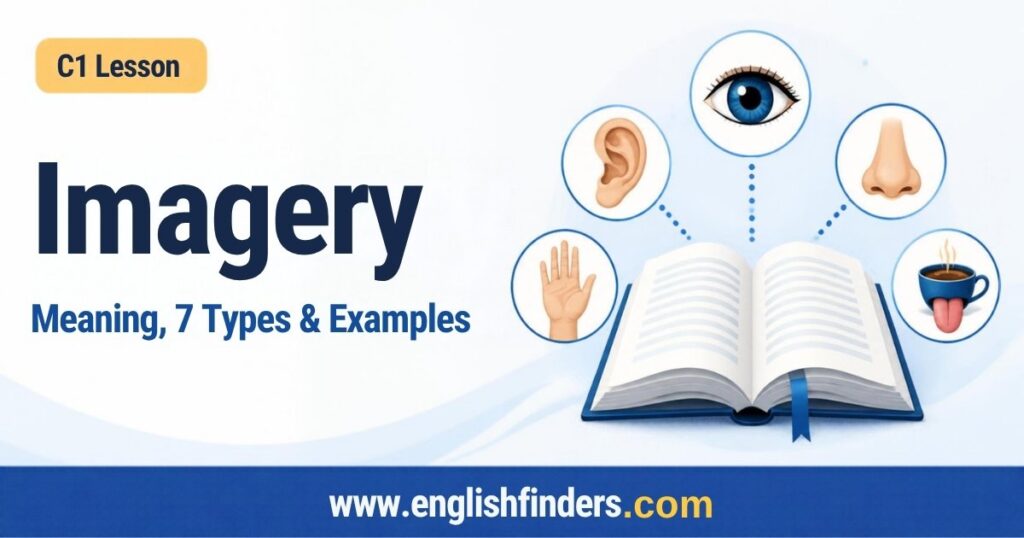
Imagery is descriptive language that appeals to the reader’s five senses: sight, sound, smell, taste and touch. It helps readers picture a scene, feel a mood and experience a story instead of just reading about it.
Compare “The room was quiet” with “The only sound was the slow tick of the kitchen clock.” Both sentences say the same thing, but only the second one lets you hear it.
The seven types of imagery follow, each with useful words and a quick rewrite to try.
- What imagery means and how to pronounce it
- The seven types of imagery, with examples
- A bank of sensory words for each sense
- Famous examples of imagery in literature
- How to turn plain sentences into vivid ones, with a practice quiz
What Is Imagery?
Quick Navigation
When writers use imagery, they do not just tell you something. They let you sense it. Compare these two sentences:
- Plain: The beach was nice.
- With imagery: Warm sand squeaked under my feet, and the air tasted of salt.
The second sentence uses touch, sound and taste. You can almost stand on that beach. That is the power of imagery.
How to pronounce imagery
| Word | Sounds like | IPA |
|---|---|---|
| Imagery | IM-ij-ree | /ˈɪm.ɪ.dʒər.i/ |
| Image | IM-ij | /ˈɪm.ɪdʒ/ |
The stress is on the first syllable: IM-ij-ree. You can listen to it on our imagery dictionary page.
The 7 Types of Imagery
Most guides list five senses, but writers usually talk about seven types of imagery. The last two describe movement and feelings inside the body.
| Type | Sense | Example |
|---|---|---|
| Visual | Sight | The sky turned pink, then deep purple. |
| Auditory | Sound | Rain drummed on the tin roof. |
| Olfactory | Smell | The room smelled of old books and coffee. |
| Gustatory | Taste | The lemon was so sour it made my eyes water. |
| Tactile | Touch | The blanket was soft and heavy on my shoulders. |
| Kinesthetic | Movement | The boat rocked gently from side to side. |
| Organic | Inner feelings | My stomach tightened as the doors opened. |
Sensory Words: A Word Bank for Each Sense
Learners often know beautiful, loud and delicious, but strong imagery needs more precise words. Here are useful options for each sense.
| Sense | Useful words |
|---|---|
| Sight | Glittering, faded, shadowy, gleaming, misty, dazzling, dim |
| Sound | Crackling, rustling, booming, hushed, murmuring, shrill, thud |
| Smell | Smoky, musty, fragrant, earthy, sharp, sweet, damp |
| Taste | Bitter, tangy, salty, creamy, spicy, bland, zesty |
| Touch | Rough, silky, sticky, icy, prickly, damp, smooth |
| Movement | Drifting, stumbling, darting, swaying, crawling, rushing |
| Feelings | Aching, dizzy, restless, breathless, hollow, numb |
You can look up any of these words in our English Dictionary Search to hear them and see more examples.
Imagery Examples in Literature
William Wordsworth, “I Wandered Lonely as a Cloud”
“A host, of golden daffodils; / Beside the lake, beneath the trees, / Fluttering and dancing in the breeze.”
The poem gives us visual imagery (golden, lake, trees) and kinesthetic imagery (fluttering and dancing). We see the flowers and feel them move.
John Keats, “To Autumn”
“Season of mists and mellow fruitfulness”
In one line, Keats appeals to sight (mists), touch and taste (mellow, meaning soft and ripe). The whole poem is full of ripe fruit, warm sun and soft sounds.
William Shakespeare, Romeo and Juliet
“But soft, what light through yonder window breaks? / It is the east, and Juliet is the sun.”
Here imagery and metaphor work together. Romeo describes light breaking through a window, then compares Juliet to the sun. The image shows how bright and important she is to him.
Literal vs Figurative Imagery
Imagery can be literal or figurative.
| Type | What it does | Example |
|---|---|---|
| Literal imagery | Describes things exactly as they are | The kettle whistled and steam filled the kitchen. |
| Figurative imagery | Uses comparisons such as similes and metaphors | Her voice was as smooth as honey. |
Both types are useful. Literal imagery feels clear and real. Figurative imagery adds emotion and surprise. To learn more about comparisons, see our C2 lesson on metaphor and simile.
Check your answer
Why Do Writers Use Imagery?
- To make scenes real. Readers believe a world they can see and hear.
- To create mood. “Grey clouds pressed down on the empty street” feels very different from “Sunlight danced on the busy street.”
- To show feelings without naming them. “Her hands shook and her mouth went dry” shows fear without saying afraid.
- To make writing memorable. Readers remember pictures more easily than general statements.
How to Add Imagery to Your Own Writing
Here is a simple four-step method you can use in stories, descriptions and even emails.
- Choose one moment. Do not try to describe everything. Pick a single scene.
- Ask the five senses. What can you see, hear, smell, taste and feel there?
- Replace general words with specific ones. Change nice to warm, noise to crackle, food to spicy noodles.
- Choose two or three senses, not five. Too many details slow the reader down.
- Before: The market was busy.
- After: Sellers shouted prices over the clatter of carts, and the air smelled of fresh mint and fried onions.
- Before: I was tired after the exam.
- After: My eyes burned, and my legs felt heavy as I walked out into the cold evening.
Common Mistakes Learners Make
- Using only sight. Many learners describe only what things look like. Add sound, smell or touch.
- Piling up adjectives. “The big, beautiful, amazing, colorful garden” is weak. One precise word beats four general ones.
- Mixing up imagery and imagination. Imagery is the language on the page; imagination is the ability to create ideas in your mind.
- Using too much in formal writing. In academic essays, one short concrete image is enough.
Practice: Test Your Understanding
Part A. Name the main type of imagery in each sentence.
- The coffee was bitter and burned my tongue.
- A dog barked somewhere in the dark.
- The field was covered in white frost.
- The smell of fresh paint filled the hallway.
- The swing moved slowly back and forth.
- A sudden wave of homesickness made my chest ache.
Show answers for Part A
- Gustatory (bitter) and tactile (burned)
- Auditory
- Visual
- Olfactory
- Kinesthetic
- Organic
Part B. Rewrite each plain sentence with imagery. Use at least two senses.
- The restaurant was good.
- It was a cold morning.
Show sample answers for Part B
- The restaurant glowed with candlelight, and every table smelled of garlic and fresh bread.
- Frost sparkled on the cars, and my breath hung in the air like smoke.
Part C (writing). Describe your favorite place in three sentences using at least three senses. Check it with our AI Writing Feedback tool, or test your vocabulary with the Vocabulary Quiz.
Quiz: Test Yourself
- What is imagery?
- Where is the stress in imagery?
- “Rain drummed on the tin roof.” Which type of imagery is this?
- Which type of imagery is about smell?
- “The boat rocked gently from side to side.” Which type of imagery is this?
- “My stomach tightened as the doors opened.” Which type of imagery is this?
- Which word is the best choice for a sound?
- “Her voice was as smooth as honey.” What kind of imagery is this?
- Which sentence shows fear without naming it?
- How many senses should you usually use when you describe one scene?
Key Takeaways
- Imagery is language that appeals to the senses.
- The seven types: visual, auditory, olfactory, gustatory, tactile, kinesthetic and organic.
- Imagery can be literal or figurative (similes and metaphors).
- Use specific sensory words and choose two or three senses per scene.
- Imagery shows feelings and mood without stating them directly.
Next, see how one image can carry a bigger meaning in our lesson on symbolism, or explore the full list in our guide to literary devices.
Frequently Asked Questions
What is imagery in simple words?
Imagery is descriptive language that helps readers see, hear, smell, taste or feel what a writer is describing. Instead of saying “the soup was good,” a writer might say “the soup was thick, hot and smelled of garlic.”
What are the 7 types of imagery?
The seven types are visual (sight), auditory (sound), olfactory (smell), gustatory (taste), tactile (touch), kinesthetic (movement) and organic (inner feelings such as hunger, tiredness or fear).
What is an example of imagery?
“The cold rain stung my face as thunder rolled over the hills” is imagery. It uses touch (cold, stung) and sound (thunder rolled) to put the reader inside the scene.
Is imagery the same as a metaphor?
No. Imagery is any language that appeals to the senses. A metaphor is one tool that can create imagery by comparing two things, such as “Juliet is the sun.” Plain, literal description can also be imagery.
Why do writers use imagery?
Writers use imagery to make scenes feel real, to create a mood, to show emotions without stating them, and to help readers remember a moment. Good imagery lets readers experience the story rather than just read it.
How can I use imagery in an essay?
Use one or two short, concrete details in your introduction or examples, for example the sound of traffic in a city essay. Keep it brief in academic writing and make sure every detail supports your point.
Related Articles

- Imagery: Meaning, 7 Types and Examples in Writing - October 10, 2026
- Literary Devices: 30 Common Devices with Meanings and Examples - October 9, 2026
- Bandwagon Fallacy: Meaning, Examples and Origin - October 8, 2026