
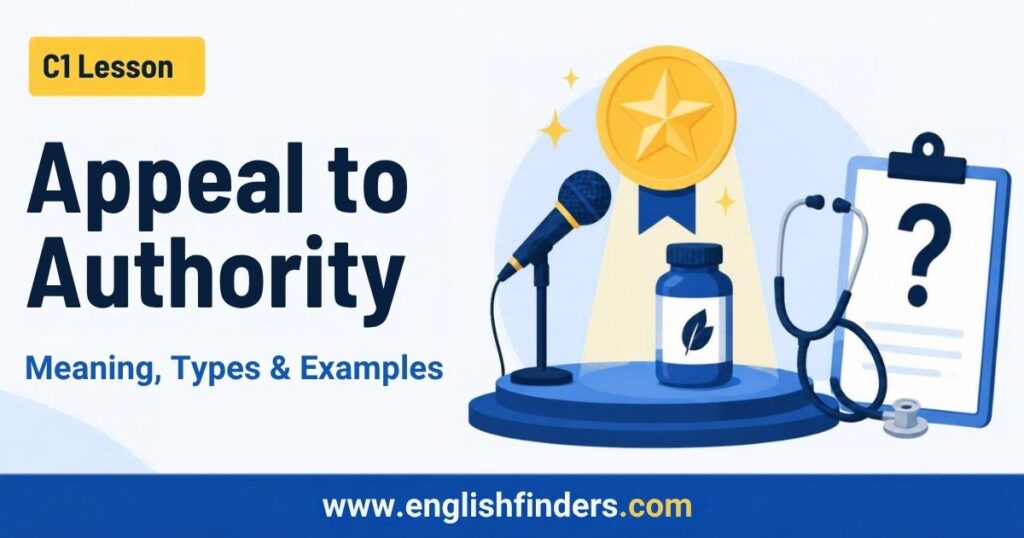
An appeal to authority is an argument that says a claim must be true because an expert, leader or famous person said it. It becomes a fallacy when that person is not a real expert on the topic.
This one is tricky, because quoting experts is usually a good thing. A dentist talking about teeth is worth hearing; a footballer selling vitamins is not. The skill is telling the two apart.
That skill, along with how to cite sources properly in an essay, is what the rest of this lesson is about.
- What the appeal to authority fallacy is and its Latin name
- Four common types of false authority
- A checklist for when quoting an expert is fair
- Language for citing sources properly in essays
- How to respond politely, with a practice quiz
What Is the Appeal to Authority Fallacy?
Quick Navigation
We rely on experts all the time. We trust doctors about health and pilots about flying. That is sensible, because they have training and experience in those areas.
The fallacy happens when the authority is not relevant, not reliable or not named, or when “an expert said so” is treated as the end of the discussion.
Pronunciation and other names
| Phrase | Sounds like | IPA |
|---|---|---|
| Authority | aw-THOR-ih-tee | /ɔːˈθɒr.ə.ti/ |
| Argumentum ad verecundiam | ar-gyoo-MEN-tum ad ver-uh-KUN-dee-am | /ˌɑː.ɡjuˈmen.təm æd ˌver.ɪˈkʌn.di.æm/ |
Other names: appeal to false authority, argument from authority, argumentum ad verecundiam (“argument from respect”). See our authority dictionary page.
4 Types of Appeal to Authority
| Type | What happens | Example |
|---|---|---|
| Wrong field | The person is an expert, but not on this topic | “A Nobel Prize-winning physicist says this diet is the healthiest.” |
| Celebrity or no expertise | The person is famous, not expert | “My favorite singer says vaccines are dangerous.” |
| Anonymous authority | The source is vague and cannot be checked | “Experts say this is the best school in the country.” |
| Biased authority | The expert has a strong reason to say it | “A scientist paid by a sugar company says sugar is harmless.” |
Another form is the lone dissenter: quoting one expert who disagrees with almost every other expert in the field, and presenting that one opinion as the truth.
When Is Citing an Authority Fair?
Use this checklist. The more “yes” answers, the stronger the appeal.
- Is the person a real expert in this exact field?
- Do most experts in the field agree?
- Is the source named, so we can check it?
- Is the expert free from obvious bias or payment?
- Is the evidence available, not just the opinion?
A fair appeal might sound like this: “According to the World Health Organization, adults should do at least 150 minutes of moderate exercise a week.” The source is named, relevant and based on research.
Check your answer
Appeal to Authority Examples in Everyday Life
| Context | Example | Problem |
|---|---|---|
| Advertising | “Recommended by a famous tennis player.” | Sports fame is not product expertise |
| Online | “A doctor on social media says this tea cures anxiety.” | Unknown qualifications and no evidence |
| School | “The teacher said it, so it can’t be wrong.” | Teachers can make mistakes too |
| Family | “Grandma always said cold weather gives you a cold.” | Tradition, not medical evidence |
| News | “Sources say the company will close.” | Anonymous source |
How to Cite Sources Well in Your Writing
At C1 level, a strong argument names its sources clearly. This turns a possible fallacy into fair support.
| Weak (vague) | Strong (specific) |
|---|---|
| “Experts say sleep is important.” | “According to the US National Sleep Foundation, adults need seven to nine hours of sleep.” |
| “Studies show that reading helps.” | “The OECD’s PISA 2018 report found that students who enjoy reading tend to score higher in reading tests.” |
| “Scientists say the climate is changing.” | “The Intergovernmental Panel on Climate Change reports that global temperatures have risen since the 1800s.” |
Useful reporting verbs: argue, claim, report, find, suggest, point out, warn, conclude. For more practice, see our advanced reporting verbs worksheet.
Appeal to Authority vs Related Fallacies
| Fallacy | What it does | Example |
|---|---|---|
| Appeal to authority | Accepts a claim because of who says it | “A famous chef says this vitamin works.” |
| Ad hominem | Rejects a claim because of who says it | “Don’t listen to him; he never went to university.” |
| Bandwagon fallacy | Accepts a claim because many people believe it | “Everyone takes this vitamin.” |
Appeals to authority are a misuse of ethos, the appeal to credibility. Learn more in our lesson on ethos, pathos and logos.
How to Respond Politely
- “What is her background in this area?”
- “Which experts? Do you know where that study was published?”
- “Do most experts in the field agree with that?”
- “That’s interesting. Is there any evidence behind it?”
Common Mistakes Learners Make
- Thinking all quotes from experts are fallacies. Quoting a relevant, named expert is good practice.
- Writing “studies show” without details. Always name the study, organization or researcher.
- Using “authority” to mean any famous person. In this fallacy, the key question is expertise in the topic.
- Confusing it with ad hominem. One accepts because of the person; the other rejects because of the person.
Practice: Test Your Understanding
Part A. Fair appeal or fallacy?
- “A famous rapper says this phone has the best camera.”
- “The national weather service says a storm will arrive tonight.”
- “Experts say this is the best way to learn a language.”
- “My lawyer says the contract is legally binding.”
- “A scientist hired by an oil company says pollution isn’t a problem.”
Show answers for Part A
- Fallacy – celebrity, not a camera expert.
- Fair – a named, relevant authority.
- Fallacy – anonymous authority.
- Fair – legal expert on a legal question.
- Fallacy – biased authority.
Part B. Rewrite each vague claim with a named source, using according to or a reporting verb. Use a real source you can check.
- “Studies show that exercise improves mood.”
- “Experts say children need more sleep.”
Show sample answers for Part B
- “According to the World Health Organization, regular physical activity can reduce symptoms of depression and anxiety.”
- “The American Academy of Sleep Medicine recommends that teenagers aged 13 to 18 sleep eight to ten hours a night.”
Part C (writing). Write a short paragraph (60–80 words) supporting an opinion. Include one properly cited source using according to or a reporting verb. Check it with our AI Writing Feedback tool.
Quiz: Test Yourself
- When does an appeal to authority become a fallacy?
- “A famous tennis player recommends this vitamin.” What is the problem?
- “A Nobel Prize-winning physicist says this diet is the healthiest.” Which type is this?
- “Experts say this is the best school in the country.” Which type is this?
- “A scientist paid by a sugar company says sugar is harmless.” Which type is this?
- Which sentence cites a source well?
- What is the Latin name for this fallacy?
- How is an appeal to authority different from ad hominem?
- Which reporting verb is useful for citing an expert?
- Which question helps you decide if an appeal to authority is fair?
Key Takeaways
- An appeal to authority accepts a claim because of who says it, not because of the evidence.
- Common types: wrong field, celebrity, anonymous source, biased expert and the lone dissenter.
- Citing an expert is fair when the person is qualified, named, unbiased and in line with most experts.
- In essays, avoid vague phrases like studies show; say who found what, and where.
- It is the mirror image of ad hominem.
Explore the full guide to logical fallacies, or see how popularity misleads us with the bandwagon fallacy.
Frequently Asked Questions
What is an appeal to authority in simple words?
An appeal to authority is when someone says a claim must be true just because an expert, leader or famous person said it, without giving the evidence. It becomes a fallacy when the person is not a real expert on the topic.
What is an example of the appeal to authority fallacy?
“A famous footballer says this vitamin cures colds, so it must work.” The footballer is an expert in football, not medicine, so his opinion is not good evidence.
Is it always wrong to quote an expert?
No. Quoting a real expert in the right field, especially when most experts agree, is a reasonable way to support an argument. The fallacy happens when the authority is unqualified, biased, anonymous or treated as final proof.
What is the Latin name for appeal to authority?
The Latin name is argumentum ad verecundiam, often translated as “argument from respect” or “argument from modesty,” because it relies on our respect for important people.
What is an appeal to anonymous authority?
It is a claim supported by vague sources such as “experts say” or “studies show,” without naming who the experts are or which studies were done. Without details, we cannot check the evidence.
How is appeal to authority different from ad hominem?
They are mirror images. Appeal to authority accepts a claim because of who said it. Ad hominem rejects a claim because of who said it. Both judge the person instead of the evidence.
Related Articles

- Hasty Generalization: Meaning, Examples and How to Avoid It - October 13, 2026
- Appeal to Authority: Meaning, Types and Examples - October 13, 2026
- Foreshadowing: Meaning, Types and Examples in Stories - October 12, 2026