
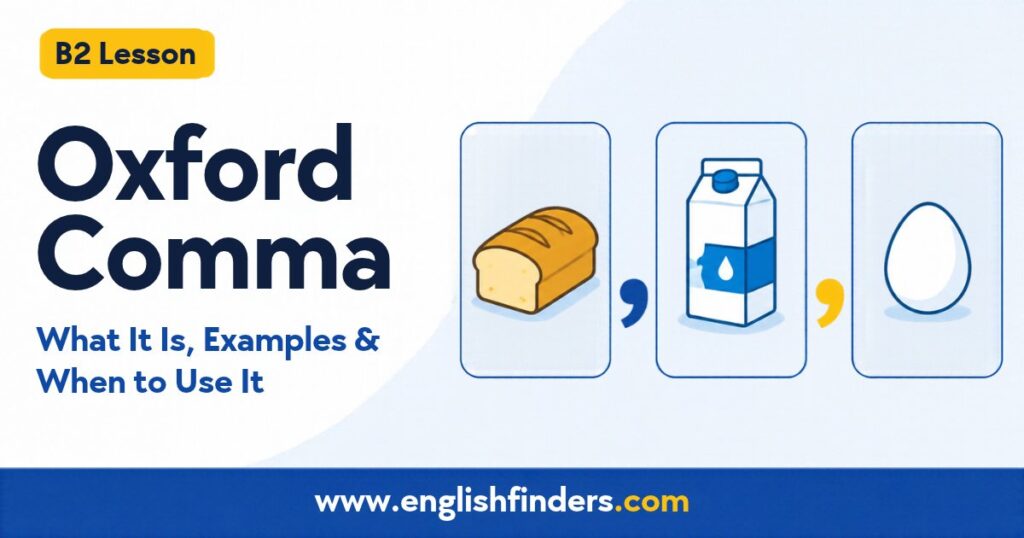
The Oxford comma is the comma that comes before and or or at the end of a list of three or more items, as in “bread, milk, and eggs.” Few punctuation marks start as many arguments, mostly because it is optional.
A wedding thank-you note reads: “Special thanks to my brothers, Sam and Leo.” Are Sam and Leo the brothers, or two more people? With one more comma (“my brothers, Sam, and Leo”), the second meaning becomes clear.
The short version: neither choice is wrong, but some lists are clearer with the comma, and you should be consistent.
- What the Oxford comma is and where it goes
- Who uses it and who doesn’t
- How it can prevent, and sometimes cause, confusion
- A real court case about a missing comma
- The basic rules for punctuating lists in English
What Is the Oxford Comma?
Quick Navigation
In a list of three or more items, English puts commas between the items. The question is only about the last comma, the one just before and or or. With it, the list has the Oxford comma; without it, it doesn’t.
“I need paper, pens, and envelopes” uses the Oxford comma. “I need paper, pens and envelopes” does not. In this simple sentence, both are clear and both are correct.
Other names: the serial comma (common in the US) and the Harvard comma. The Oxford name comes from Oxford University Press, whose editors traditionally used it. For a review of all the main punctuation marks, see our guide to punctuation marks in English.
Who Uses It?
| Style guide or publisher | Oxford comma? |
|---|---|
| Chicago Manual of Style (books, many US publishers) | Yes |
| APA style (psychology and social science papers) | Yes |
| MLA style (literature and humanities papers) | Yes |
| Oxford University Press | Yes, traditionally |
| AP Stylebook (US news) | No, except when needed for clarity |
| Many British newspapers | Usually no |
If your teacher, university or employer has a style guide, follow it. If not, choose one style and use it through the whole document.
When the Oxford Comma Prevents Confusion
The comma matters most when a list item could be read as a description of the item before it.
| Without the Oxford comma | Possible misreading | With the Oxford comma |
|---|---|---|
| “I called my parents, the doctor and the nurse.” | My parents are the doctor and the nurse | “I called my parents, the doctor, and the nurse.” |
| “Breakfast is cereal, toast and butter and jam.” | Unclear which items go together | “Breakfast is cereal, toast and butter, and jam.” |
In the first row, “the doctor and the nurse” could be an appositive, a phrase that renames the noun before it. The Oxford comma makes it clear they are separate items.
Non-defining relative clauses use the same kind of “extra information” commas; see our B1 lesson on non-defining relative clauses.
When It Can Cause Confusion
The comma is not a magic fix. Sometimes it creates the problem it usually solves.
“I thanked my sister, a nurse, and the doctor.” Is “a nurse” describing your sister, or is it a third person? Here the comma makes things less clear.
The best solution is often to reorder the list: “I thanked the doctor, a nurse, and my sister.” Or rewrite: “I thanked my sister, who is a nurse, and the doctor.”
Check your answer
A Real Case: The Maine Dairy Lawsuit
In 2017, a US federal appeals court ruled in a case that delivery drivers brought against Oakhurst Dairy in Maine. A state law listed jobs without overtime pay, ending with “packing for shipment or distribution.” The court found this phrase ambiguous.
Was “distribution” a separate activity, which would cover the drivers, or part of “packing for”? With no comma before or, the court read the law in the drivers’ favor. The dairy later settled for a reported five million dollars, and Maine rewrote the law.
Rules for Lists in English
| Rule | Example |
|---|---|
| Two items: no comma | “Salt and pepper” |
| Three or more items: commas between them | “Salt, pepper(,) and oil” |
| Use or for choices, and for all | “Tea, coffee, or juice” |
| Items that already contain commas: use semicolons | “Paris, France; Rome, Italy; and Madrid, Spain” |
| Keep list items parallel | “To read, to write, and to speak,” not “to read, writing, and speak” |
| No comma before an ampersand (&) | “Smith, Jones & Brown” |
The semicolon rule is useful in reports: when items are long or contain their own commas, semicolons separate them clearly.
Common Mistakes Learners Make
- A comma with only two items: “bread, and butter” is wrong; write “bread and butter.”
- Mixing styles: using the Oxford comma in one list and not in the next.
- A comma before the first item: “I bought, apples, pears, and plums” is wrong.
- Unparallel lists: “She likes hiking, to swim, and reads” should be “hiking, swimming, and reading.”
Practice: Test Your Understanding
Part A. Does each sentence use the Oxford comma? Answer yes or no.
- We need flour, sugar, and eggs.
- The flag is red, white and blue.
- You can pay by card, cash, or bank transfer.
- I invited Leila and Omar.
Show answers for Part A
- Yes – comma before and.
- No – no comma before and.
- Yes – comma before or.
- No – only two items, so no comma is needed.
Part B. Punctuate each list using the Oxford comma. Use semicolons where needed.
- The menu has soup pasta and salad.
- We have offices in Austin Texas Denver Colorado and Boston Massachusetts.
- I want to thank my parents my coach and my teammates.
Show answers for Part B
- “The menu has soup, pasta, and salad.”
- “We have offices in Austin, Texas; Denver, Colorado; and Boston, Massachusetts.”
- “I want to thank my parents, my coach, and my teammates.”
Part C (writing). Write 50–70 words about what you pack for a weekend trip. Include two lists of three or more items with the Oxford comma, and one list with semicolons. Get feedback with our AI Writing Feedback tool.
Quiz: Test Yourself
- Where does the Oxford comma go?
- What is another name for the Oxford comma?
- Which sentence uses the Oxford comma?
- Is leaving out the Oxford comma a grammar mistake?
- Which style guide generally leaves it out?
- Which sentence clearly lists four people?
- How many commas should “salt and pepper” have?
- When should you use semicolons in a list?
- In the Maine dairy case, what was missing from the law?
- Which list is parallel?
Key Takeaways
- The Oxford comma comes before the final and or or in a list of three or more.
- It is optional: Chicago, APA and MLA use it; AP usually doesn’t.
- It can prevent confusion, especially when an item could describe the one before it.
- No comma with two items; semicolons for items that contain commas.
- Whatever you choose, be consistent.
Punctuation and small linking words often work together; see how for example and that is are shortened in i.e. vs e.g., or explore the formal linker albeit.
Frequently Asked Questions
What is the Oxford comma?
The Oxford comma is the comma placed before and or or at the end of a list of three or more items: “tea, coffee, and juice.” It is also called the serial comma or the Harvard comma.
Is the Oxford comma correct or wrong?
Both styles are correct. Some style guides ask for it, and others leave it out unless it is needed for clarity. The important rule is to choose one style and use it consistently in the same piece of writing.
Why is it called the Oxford comma?
It takes its name from Oxford University Press, whose editors traditionally used it. American writers often call it the serial comma, and it is sometimes called the Harvard comma after Harvard University Press.
Does AP style use the Oxford comma?
Generally no. The Associated Press Stylebook, used by many American newspapers, leaves it out in simple lists but allows it when a list would be confusing without it. Chicago and APA style use it.
Do you need a comma before and with only two items?
No. With two items, there is no comma: “salt and pepper.” The Oxford comma only appears in lists of three or more items.
Can the Oxford comma change the meaning of a sentence?
Yes. “I called my parents, the doctor and the nurse” can suggest your parents are the doctor and the nurse. “I called my parents, the doctor, and the nurse” clearly lists four people.
Related Articles

- Oxford Comma: What It Is, Examples and When to Use It - November 21, 2026
- Affect vs Effect: The Difference, Examples and Collocations - November 21, 2026
- Albeit: Meaning, Pronunciation, and How to Use It - November 21, 2026