
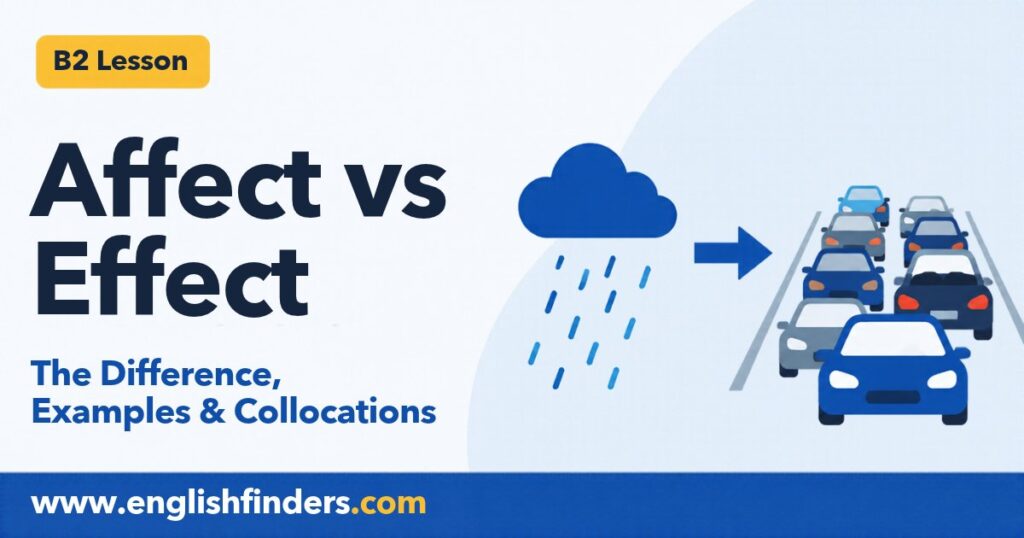
Affect is usually a verb that means “to influence,” and effect is usually a noun that means “a result.” So the choice is mostly about grammar: once you know which job the word does in your sentence, it is easy.
A café owner posts a notice online: “Our new opening hours will effect all customers from Monday.” Within minutes, two regulars reply, each correcting the spelling. The owner meant that the change will influence customers, so the verb should be affect.
The rule above works most of the time, but there are a few traps, and they are mostly about the words that go with each one.
- The basic rule and a quick test for each sentence
- The rare exceptions: effect as a verb and affect as a noun
- How to pronounce both words
- The prepositions and collocations that go with each word
- The word family: effective, affected, affection and more
The Basic Rule
Quick Navigation
When something affects something else, it acts on it. When there is an effect, you are naming the result. The cause affects; the result is the effect.
“Screens affect children’s sleep” uses the verb. “Screens have an effect on children’s sleep” uses the noun. Both sentences say the same thing with different grammar.
Two Quick Tests
| Test | How it works | Example |
|---|---|---|
| Try the | If the, an or a big fits before the word, use effect | “The ___ was surprising.” → effect |
| Try influence | If influence or change (as verbs) fits, use affect | “The news will ___ prices.” → affect |
| Look for on | If on follows, you almost always need effect | “It had no ___ on me.” → effect |
How to Pronounce Affect and Effect
| Word | Sounds like | IPA | Part of speech |
|---|---|---|---|
| Affect | uh-FEKT | /əˈfekt/ | Verb |
| Effect | ih-FEKT | /ɪˈfekt/ | Noun (verb: rare) |
| Affect | AF-ekt | /ˈæf.ekt/ | Noun (psychology) |
In fast, everyday speech, the verb affect and the noun effect often sound the same. That is why the confusion is mainly a spelling problem. See the affect and effect dictionary pages to hear both.
Affect vs Effect in Context
| Situation | With affect (verb) | With effect (noun) |
|---|---|---|
| Health | “Caffeine affects how well you sleep.” | “Caffeine has a strong effect on sleep.” |
| Money | “Higher rents affect young workers most.” | “The effect of higher rents is clear.” |
| School | “Missing class affected her grades.” | “Missing class had a bad effect on her grades.” |
| Weather | “The storm affected flights across the region.” | “The effects of the storm lasted for days.” |
| Medicine | “The medicine may affect your appetite.” | “Loss of appetite is a common side effect.” |
The Exceptions
Two less common uses swap the usual roles. Formal reports and psychology texts use them, so it helps to recognize them.
| Word | Meaning | Example | How common? |
|---|---|---|---|
| Effect (verb) | To make something happen | “Protesters effected real change in the law.” | Rare, formal |
| Affect (noun) | The emotion a person shows | “He spoke with a flat affect.” | Psychology only |
| Affect (verb) | To pretend, to put on | “She affected a bored expression.” | Rare, literary |
Notice the difference in meaning: to affect change is to influence it, but to effect change is to cause it. Most writers only need effect change in formal contexts such as reports and speeches.
Check your answer
Collocations: The Words That Go With Each
This is where the real difference shows. Learning these chunks will help you choose correctly without stopping to think about grammar.
| With effect (noun) | With affect (verb) |
|---|---|
| Have an effect on something | Badly / seriously affect something |
| A side effect, a ripple effect | Directly / indirectly affect someone |
| Take effect, come into effect | Be affected by something |
| In effect (= in reality) | Deeply affected (= emotionally moved) |
| Special effects (in films) | The areas affected (= the places that suffered) |
| Personal effects (= belongings) | Affect the outcome / the result |
Personal effects is a surprising one: it means a person’s small belongings, as in “The hospital returned his personal effects.”
The Word Family
| Word | Meaning | Example |
|---|---|---|
| Effective (adj.) | Works well | “An effective treatment” |
| Effectively (adv.) | In a way that works; in reality | “The decision was effectively final.” |
| Affected (adj.) | 1) Influenced; 2) not natural, put on | “The affected areas”; “an affected accent” |
| Affection (noun) | A feeling of liking or love | “She spoke of her teacher with affection.” |
| Unaffected (adj.) | Not changed by something | “The east of the city was unaffected.” |
Affection looks like a cousin of affect, but its meaning is quite different. For more on building nouns from verbs, see our C1 lesson on turning verbs into nouns.
Common Mistakes Learners Make
- **Adding on after affect:** say “It affected my plans,” not “It affected on my plans.”
- **Using affect as a noun by accident:** “the affect of social media” should be “the effect of social media.”
- **Writing effect change when you mean influence:** use affect unless you mean “cause” or “bring about.”
- **Confusing effective and efficient:** effective means it works; efficient means it works without wasting time or money.
Practice: Test Your Understanding
Part A. Choose affect or effect.
- The noise didn’t ______ the baby at all.
- What ______ will the new tax have on small shops?
- Too much sugar can ______ your teeth.
- The medicine has one side ______: it makes you sleepy.
- The new rules take ______ on Monday.
Show answers for Part A
- Affect – a verb after didn’t.
- Effect – a noun after what, followed by on.
- Affect – a verb after can.
- Effect – side effect is a fixed noun phrase.
- Effect – take effect is a fixed phrase.
Part B. Rewrite each sentence using the word in brackets.
- The heat had a bad effect on the crops. (affected)
- The news affected her deeply. (effect)
- The new road has changed local businesses. (affected)
Show answers for Part B
- “The heat badly affected the crops.”
- “The news had a deep effect on her.”
- “Local businesses have been affected by the new road.”
Part C (writing). Write 60–80 words about a change in your town or workplace. Use affect twice and effect twice, including one collocation from the table. Check it with our AI Writing Feedback tool, then try the vocabulary quiz.
Quiz: Test Yourself
- In most sentences, what part of speech is affect?
- Which sentence is correct?
- Which sentence is correct?
- “The new manager effected several changes.” What does effected mean?
- Complete: “The law comes into ______ in January.”
- What are personal effects?
- In psychology, what does the noun affect mean?
- Which test helps you choose effect?
- What does effective mean?
- “She was deeply ______ by the film.”
Key Takeaways
- Affect is usually a verb (to influence); effect is usually a noun (a result).
- Say “have an effect on,” but “affect something” with no preposition.
- Fixed phrases with effect: side effect, take effect, come into effect, in effect.
- Rare uses: effect = make happen; affect (noun) = visible emotion.
- If the fits before the word, you probably need effect.
Another pair that confuses even fluent writers is empathy vs sympathy. For two tiny abbreviations with very different jobs, see i.e. vs e.g.
Frequently Asked Questions
What is the difference between affect and effect?
In most sentences, affect is a verb that means “to influence,” and effect is a noun that means “a result.” Example: “Lack of sleep affects your memory. It has a big effect on your memory.”
Is it “affect on” or “effect on”?
Use effect on: “The rain had an effect on the game.” Affect never takes on, because it is a verb with a direct object: “The rain affected the game.”
Can effect be a verb?
Yes, but it is rare and formal. To effect something means to make it happen: “The new manager effected several changes.” Compare: “The new manager affected several changes” means she influenced changes that were already happening.
Can affect be a noun?
Yes, in psychology. Affect (stressed AF-ekt) means the emotion a person shows on their face and in their voice, as in “The patient had a flat affect.” Outside that field, you rarely need it.
How can I remember affect vs effect?
Many learners use RAVEN: Remember, Affect is a Verb, Effect is a Noun. Another test is to put the before the word. If “the” fits, you probably need effect.
Do affect and effect sound the same?
Almost. In careful speech, affect starts with uh- (/əˈfekt/) and effect with ih- (/ɪˈfekt/), but in fast speech they often sound identical. That is one reason even native speakers mix them up in writing.
Related Articles

- Oxford Comma: What It Is, Examples and When to Use It - November 21, 2026
- Affect vs Effect: The Difference, Examples and Collocations - November 21, 2026
- Albeit: Meaning, Pronunciation, and How to Use It - November 21, 2026