B1 English (Intermediate)

B1 Intermediate English: present and past perfect tenses, first and second conditionals, idioms, phrasal verbs and richer vocabulary for independent learners, aligned with the CEFR B1 level.

Exercises on Conditional Sentences

20 Exercises on Conditional Sentences

This exercise on conditional sentences focuses on understanding and applying the concept of conditional sentences in English grammar. It covers various aspects, including the definition, types (zero, first, second, third, and mixed conditionals), and their appropriate usage. The questions test your ability to identify conditional sentence types, use correct structures, and differentiate between real and […]
20 Exercises on Conditional Sentences Read More »

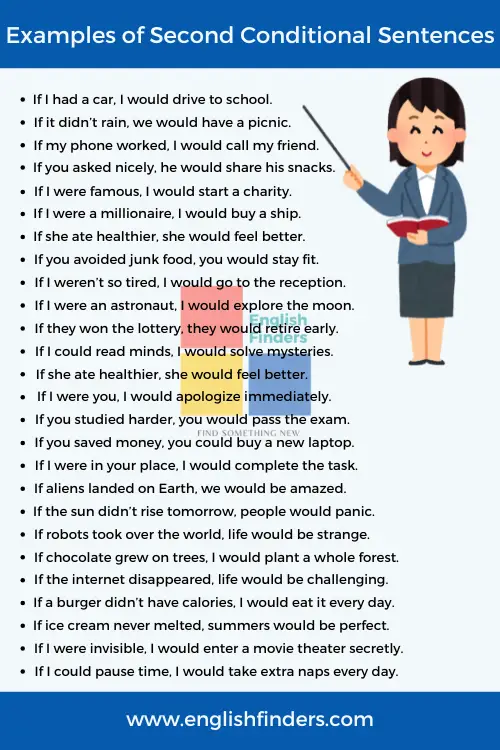
Examples of Second Conditional Sentences

Second Conditional Sentences: 50 Example Sentences

The second conditional sentences are all about hypothetical or unreal situations in the present or future. For example, you might say, “If I had a magic wand, I would make all my homework disappear!” Sounds fun, right? In this lesson, we’ll dive into 50 examples of second conditional sentences that will not only help you

Second Conditional Sentences: 50 Example Sentences Read More »

Examples of First Conditional Sentences

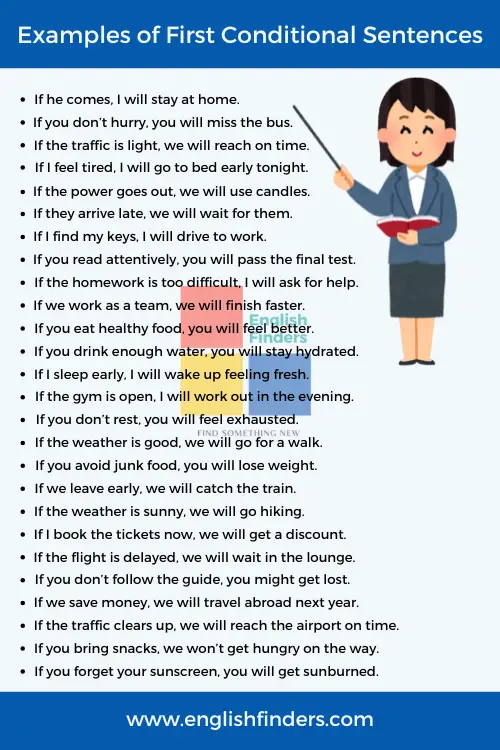
First Conditional Sentences: 50 Example Sentences

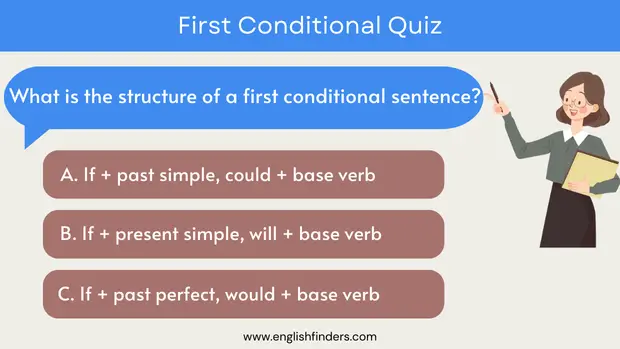
Conditional sentences are essential parts of the English language. They help us to talk about possibilities, and plans and even give advice. Among the four types of conditional sentences, the first conditional sentence is the most useful because it describes real and possible situations in the future. So, what is the first conditional? In short,

First Conditional Sentences: 50 Example Sentences Read More »

100 Examples of Subordinating Conjunctions

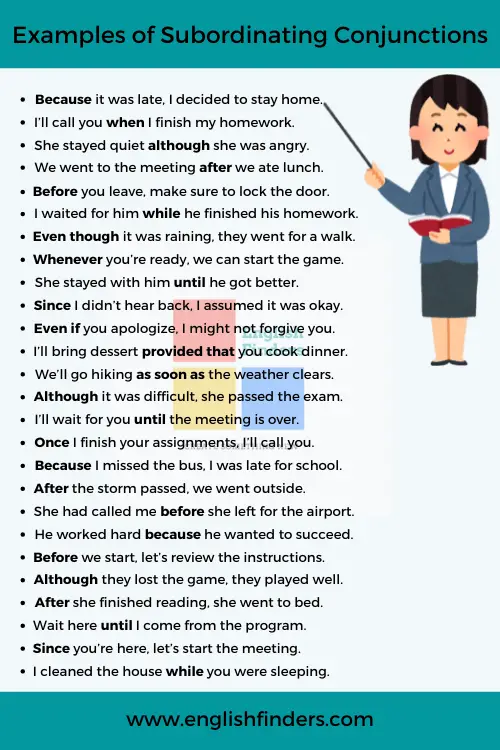
100 Examples of Subordinating Conjunctions

Subordinating conjunctions are important for making your sentences more interesting and meaningful. These little words help connect ideas, showing the relationship between two clauses in a sentence. If you’ve ever used words like because, although, or since, you’ve already used subordinating conjunctions. These are the most common examples of subordinating conjunctions. In this lesson, we’ll

100 Examples of Subordinating Conjunctions Read More »

Scroll to Top