
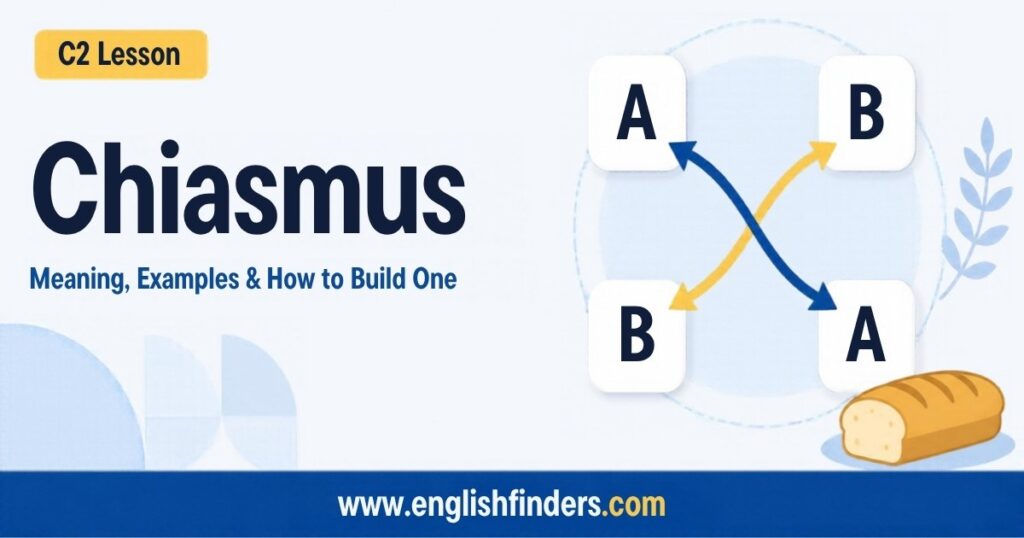
Chiasmus is a figure of speech in which the second half of a sentence repeats the key parts of the first half in reverse order. If the first half goes A then B, the second goes B then A.
A small bakery has a sign by the register: “We don’t bake to sell; we sell so we can bake.” Customers read it twice. The same two verbs come back, but swapped, and the swap tells you what the owners really care about.
Learners who already know antithesis will find this one easier, because the two devices are close relatives.
- What chiasmus is and why it is named after an X
- How to pronounce chiasmus, its plural and its adjective
- The difference between chiasmus and antimetabole
- Famous and everyday examples
- The grammar that makes a reversal work, and how to build your own
What Is Chiasmus?
Quick Navigation
The name comes from the Greek letter chi, which looks like an X. Write the two halves of a chiasmus one above the other, draw lines between the matching parts, and the lines cross.
Reversal makes the listener do a small piece of work. They hear a familiar pair of words, notice that the order has changed, and look for the reason. That moment of checking is why chiastic lines stay in the memory.
How to Pronounce Chiasmus
| Word | Sounds like | IPA | Part of speech |
|---|---|---|---|
| Chiasmus | ky-AZ-mus | /kaɪˈæz.məs/ | Noun |
| Chiasmi | ky-AZ-my | /kaɪˈæz.maɪ/ | Noun (plural) |
| Chiastic | ky-AS-tik | /kaɪˈæs.tɪk/ | Adjective |
| Antimetabole | an-tee-muh-TAB-uh-lee | /ˌæn.ti.məˈtæb.əl.i/ | Noun |
Useful patterns: a chiastic structure, a famous chiasmus, built as a chiasmus. The plural chiasmuses is also correct and more common in everyday writing. Listen to the word on the chiasmus dictionary page.
Chiasmus and Antimetabole
Some writers use two names for two slightly different devices. In everyday teaching, chiasmus is often used for both.
| Device | What is reversed | Example |
|---|---|---|
| Antimetabole | The same words, in reverse order | “Work to live, don’t live to work.” |
| Chiasmus (strict sense) | The grammar or the ideas, with different words | “Her eyes were laughing; serious was her mouth.” |
In the second example, the words change but the order flips: noun then description, then description then noun. Strict chiasmus is subtler and more common in poetry. Antimetabole is louder and suits slogans and speeches.
Chiasmus Examples
| Source | Line | What swaps |
|---|---|---|
| Macbeth, William Shakespeare | “Fair is foul, and foul is fair” | Fair / foul |
| Mark 2:27, King James Bible | “The sabbath was made for man, and not man for the sabbath.” | Sabbath / man |
| John F. Kennedy, inaugural address (1961) | “Ask not what your country can do for you; ask what you can do for your country.” | Your country / you |
| Proverb | “When the going gets tough, the tough get going.” | Going / tough |
| Kitchen advice | “Clean as you cook, and you won’t cook in a mess.” | Clean / cook (idea reversed) |
| Office saying (made up) | “Don’t bring me problems without plans; bring me plans for the problems.” | Problems / plans |
Kennedy’s line works because of what it asks. The first half describes what most citizens expect; the second half turns the same words into a duty. Without the reversal, it would be an ordinary request.
The witches’ line in Macbeth is a reversal and a paradox at once. Fair and foul trade places, which suggests a world where good and bad cannot be told apart. That idea runs through the whole play.
The Grammar of Reversal
A chiasmus only works if the reversed words can still do their new jobs in the sentence. These are the patterns English uses most.
| Pattern | Example | Grammar note |
|---|---|---|
| Subject ↔ object | “You don’t own the house; the house owns you.” | Nouns swap roles around the verb |
| To + verb ↔ to + verb | “Eat to live; don’t live to eat.” | Both halves keep verb + to + verb |
| Noun ↔ verb | “We trust the process and process the trust.” | Avoid this one: trust and process switch between verb and noun, and the second half sounds odd |
| Adjective ↔ noun | “A busy mind in a quiet room, a quiet mind in a busy room.” | Adjectives move to the other noun |
| Not … but | “It’s not the years in your life but the life in your years.” | A contrast frame holds the two halves together |
The third row is a warning. When a word has to change its word class to fit the reversal, the sentence often loses clarity. Keep each swapped word in the same class in both halves.
The not … but frame also appears in antithesis, and the two devices often meet. For balanced patterns across a whole speech, see the C2 lesson on parallelism and the rule of three.
Check your answer
Chiasmus vs Similar Devices
| Device | Order of the parts | Example |
|---|---|---|
| Chiasmus | A B, B A | “Never let a fool kiss you, or a kiss fool you.” |
| Antithesis | A B, A’ B’ (same order, opposite ideas) | “Speak less, listen more.” |
| Anaphora | Same words at the start of each clause | “We tried. We failed. We tried again.” |
| Paradox | A statement that seems to contradict itself | “The more I learn, the less I know.” |
How to Build Your Own Chiasmus
- Find two key words in one idea. For example: time and money.
- Write the first half. “We spend money to save time.”
- Swap the two words and check the grammar. “We spend time to save money.”
- Make the swap mean something. Put them together with a frame: “Some people spend money to save time; others spend time to save money.”
- Read it aloud. If the second half feels forced, choose different words or use a looser chiasmus of ideas.
Chiasmus is strong but showy. In an essay, one in the conclusion is enough; more than that starts to sound like a slogan.
Common Mistakes Learners Make
- Pronunciation: say ky-AZ-mus, not “chee-AZ-mus” or “KYE-az-mus.”
- Confusing it with simple repetition: repeating words in the same order is anaphora or parallelism, not chiasmus. The order must flip.
- Changing word class to force a swap: “I write to live and live writing” breaks the pattern. Keep both halves in the same grammar.
- Forgetting the meaning: a reversal for its own sake sounds clever but empty. The second half should add a new point or a twist.
Practice: Test Your Understanding
Part A. Chiasmus, antithesis or neither?
- “Hard to earn, easy to spend.”
- “Live simply so that others may simply live.”
- “Some people dream of success; others wake up and work for it.”
- “Don’t sweat the small stuff, and it’s all small stuff.”
- “Plan the work, and work the plan.”
Show answers for Part A
- Antithesis – opposites (hard / easy, earn / spend) in the same order.
- Chiasmus – live simply becomes simply live.
- Antithesis – two contrasting groups, no reversal.
- Neither – a repeated phrase, but no reversal of order.
- Chiasmus – plan and work swap places.
Part B. Complete each chiasmus.
- “You don’t need more hours in your day; you need …”
- “We shape our tools, and then …”
- “Don’t work for your phone; …”
Show sample answers for Part B
- “…more day in your hours.”
- “…our tools shape us.”
- “…make your phone work for you.”
Part C (writing). Write a short closing paragraph (60–80 words) for an essay about screen time. End with one chiasmus of your own, and check that both halves use the same grammar. Get comments with our AI Writing Feedback tool.
Quiz: Test Yourself
- What pattern does a chiasmus follow?
- How do you pronounce chiasmus?
- Why is the device named after the Greek letter chi?
- “Eat to live; don’t live to eat.” Which more specific name fits this line?
- Which is the correct adjective?
- “Speak less, listen more.” Is this a chiasmus?
- Which sentence is a chiasmus?
- Who said, “Ask not what your country can do for you; ask what you can do for your country”?
- What is the most common problem when learners build a chiasmus?
- How many chiasmi should a typical essay contain?
Key Takeaways
- Chiasmus reverses words or ideas in two halves: A B, B A.
- Say ky-AZ-mus; the plural is chiasmi or chiasmuses, and the adjective is chiastic.
- Antimetabole is the version that repeats the exact same words.
- Keep each swapped word in the same grammar in both halves.
- Make the reversal add meaning, and use it sparingly.
Chiasmus flips the order; antithesis keeps it and opposes the ideas instead. Both belong to the wider family in our lesson on figures of speech.
Frequently Asked Questions
What is chiasmus in simple words?
Chiasmus is a sentence in two halves where the second half reverses the order of the first: A B, then B A. “We don’t bake to sell; we sell so we can bake” is an example.
How do you pronounce chiasmus?
Say ky-AZ-mus, with a hard k sound and the stress on the second syllable: /kaɪˈæz.məs/. The plural is chiasmi (ky-AZ-my) or chiasmuses. The adjective is chiastic (ky-AS-tik).
What is a famous example of chiasmus?
John F. Kennedy’s 1961 inaugural address: “Ask not what your country can do for you; ask what you can do for your country.” The words you and your country swap places in the second half.
What is the difference between chiasmus and antimetabole?
Antimetabole repeats the same words in reverse order (“eat to live, live to eat”). Chiasmus is the wider term: it reverses words, grammar or ideas, even when the words change. Many people use chiasmus for both.
Why is it called chiasmus?
The name comes from the Greek letter chi, written X. If you write the two halves one above the other and join the matching parts, the lines cross and form an X.
What is the difference between chiasmus and antithesis?
Antithesis sets opposite ideas side by side in the same order. Chiasmus flips the order in the second half. They often appear together, as in “Fair is foul, and foul is fair.”
Related Articles

- Synecdoche: Meaning, Pronunciation and Examples - October 20, 2026
- Metonymy: Meaning, Types and Examples in the News - October 20, 2026
- Figures of Speech: Meaning, Types and Examples - October 19, 2026