
Last updated on November 22nd, 2026 at 02:49 pm
When it is “raining cats and dogs,” no animals fall from the sky. It is just raining very hard. That is how idioms work: the meaning of the phrase is more than the meaning of its words.
This page lists 100 common English idioms that people still use today. They are grouped into 10 topics, and each one has a plain meaning and a natural example sentence.
- What an idiom is, and what is not an idiom
- 100 common idioms, grouped into 10 topics
- A clear meaning and a natural example for each idiom
- Which idioms are British or American
- When to use idioms and when to avoid them
What Is an Idiom?
Quick Navigation
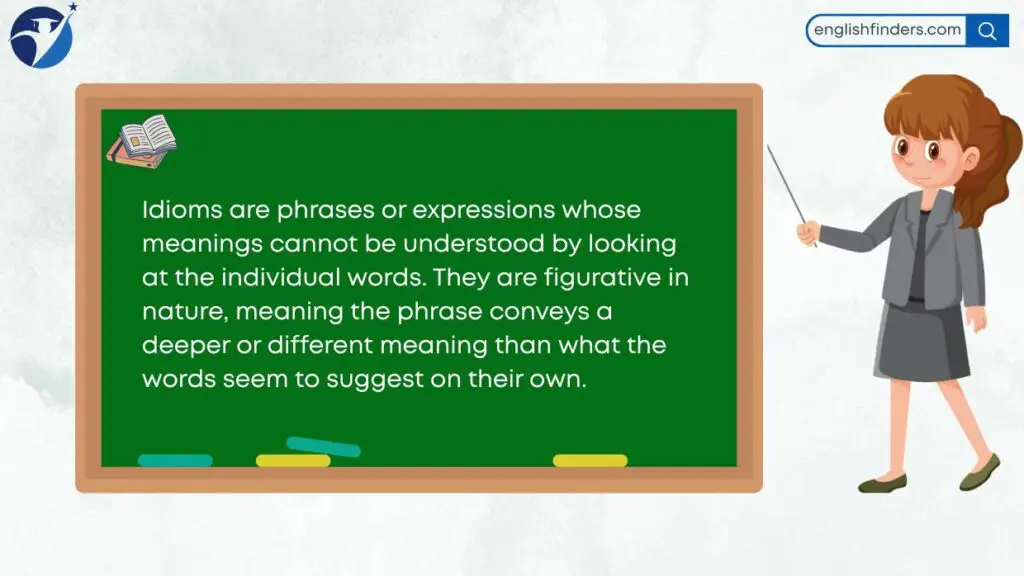
An idiom is a group of words with a special meaning. If you translate each word, the phrase usually makes no sense. “Break the ice” has nothing to do with real ice. It means saying something friendly so that people relax.
Many lists online mix idioms with other kinds of phrases. This table shows the difference.
| Type | What it is | Examples |
|---|---|---|
| Idiom | A fixed phrase whose meaning you cannot guess from the words | Break the ice, a piece of cake |
| Phrasal verb | A verb plus a small word like up, off or out | Give up, look after |
| Linking phrase | A phrase that connects ideas in a sentence | Of course, after all, in order to |
This page includes only real idioms.
100 Idioms and Their Meanings With Examples

Easy and Difficult
| Idiom | Meaning | Example |
|---|---|---|
| A piece of cake | Very easy | The driving test was a piece of cake. |
| An uphill battle | Something hard that takes a long time | Learning a language as an adult can be an uphill battle. |
| Not a bed of roses | Not easy or comfortable | Running a small business is not a bed of roses. |
| Easier said than done | Easy to talk about but hard to do | Saving money is easier said than done. |
| A tough nut to crack | A difficult problem or person | This math problem is a tough nut to crack. |
| Learn the ropes | Learn how to do a new job | It took me a month to learn the ropes at work. |
| Bite off more than you can chew | Try to do too much | I bit off more than I could chew with three courses. |
| In hot water | In trouble | He is in hot water for missing the meeting. |
| Up in the air | Not decided yet | Our vacation plans are still up in the air. |
| Smooth sailing (US) / plain sailing (UK) | Easy progress with no problems | After the first week, the project was smooth sailing. |
Time
| Idiom | Meaning | Example |
|---|---|---|
| At the eleventh hour | At the last possible moment | They signed the contract at the eleventh hour. |
| Once in a blue moon | Very rarely | My cousin visits us once in a blue moon. |
| Around the clock (US) / round the clock (UK) | All day and all night | Nurses work around the clock in this hospital. |
| In the long run | Over a long time; in the end | Studying a little every day helps in the long run. |
| In fits and starts | Not steadily; stopping and starting | The building work went on in fits and starts. |
| Call it a day | Stop working for today | We are all tired, so let’s call it a day. |
| In the nick of time | Just in time | The ambulance arrived in the nick of time. |
| Better late than never | Doing something late is better than not doing it | You finished the report? Better late than never. |
| Time flies | Time passes very quickly | Time flies when you are having fun. |
| Out of the blue | Suddenly and without warning | My old friend called me out of the blue. |
Money
| Idiom | Meaning | Example |
|---|---|---|
| Cost an arm and a leg | Be very expensive | That new phone costs an arm and a leg. |
| Make ends meet | Have just enough money to live | Many families work two jobs to make ends meet. |
| Hush money | Money paid to keep someone quiet | The politician was accused of paying hush money. |
| Break the bank | Cost too much money | A weekend trip won’t break the bank. |
| Tighten your belt | Spend less money than before | We need to tighten our belts this month. |
| A white elephant | Something expensive that is not useful | The new stadium became a white elephant after the games. |
| Money doesn’t grow on trees | Money is not easy to get | Turn off the lights. Money doesn’t grow on trees! |
| On a shoestring | With very little money | They started the company on a shoestring. |
| Pay through the nose | Pay much more than something is worth | We paid through the nose for those concert tickets. |
| Save for a rainy day | Save money for problems in the future | My grandmother always told me to save for a rainy day. |
Work and Study
| Idiom | Meaning | Example |
|---|---|---|
| Hit the books | Study hard (informal) | I have to hit the books this weekend. |
| Red tape | Official rules that cause delays | Getting a visa involves a lot of red tape. |
| Burn the midnight oil | Work or study late at night | She burned the midnight oil before her exam. |
| Learn something by heart | Learn it so well that you can say it from memory | We learned the poem by heart. |
| Pull your weight | Do your fair share of the work | Everyone on the team needs to pull their weight. |
| Back to the drawing board | Start planning again because an idea failed | The design didn’t work, so it’s back to the drawing board. |
| Get the ball rolling | Start something | Let’s get the ball rolling with a quick introduction. |
| Think outside the box | Think in a new, creative way | This puzzle makes you think outside the box. |
| Cut corners | Do something badly to save time or money | Never cut corners on safety. |
| Take someone to task | Criticize someone strongly | The manager took him to task for being late again. |
Feelings and Health
| Idiom | Meaning | Example |
|---|---|---|
| On cloud nine | Very happy | She was on cloud nine after the wedding. |
| Under the weather | A little sick | I’m feeling under the weather today. |
| Out of sorts | Not feeling well, or a little unhappy | He has been out of sorts since the trip. |
| Take something to heart | Be very upset by something someone says | Don’t take his comments to heart. |
| Crocodile tears | Sadness that is not real | He cried crocodile tears, but he wasn’t really sorry. |
| Over the moon (UK) | Extremely happy | We were over the moon when we heard the news. |
| Down in the dumps | Sad and without energy (informal) | She has been down in the dumps since she lost her job. |
| Keep your chin up | Stay positive in a hard time | Keep your chin up. Things will get better. |
| Get cold feet | Feel too nervous to do something you planned | He got cold feet just before his speech. |
| At a loss for words | So surprised that you cannot speak | I was at a loss for words when they gave me the award. |
Talking and Communication
| Idiom | Meaning | Example |
|---|---|---|
| Beat around the bush (US) / beat about the bush (UK) | Avoid saying something directly | Stop beating around the bush and tell me what happened. |
| A slip of the tongue | A small mistake when speaking | I called her by the wrong name. It was a slip of the tongue. |
| Break the ice | Say or do something to help people relax | He told a joke to break the ice. |
| Spill the beans | Tell a secret | Who spilled the beans about the party? |
| In a nutshell | In a few words | In a nutshell, the plan failed. |
| Get to the point | Talk about the most important thing | Please get to the point. We don’t have much time. |
| Speak your mind | Say what you really think | She always speaks her mind in meetings. |
| Hear it on the grapevine | Hear news from other people, not officially | I heard on the grapevine that you are moving. |
| Keep someone in the loop | Keep someone informed | Please keep me in the loop about the project. |
| Talk someone’s ear off (US) | Talk to someone for a very long time | My neighbor talked my ear off this morning. |
People and Relationships
| Idiom | Meaning | Example |
|---|---|---|
| The black sheep | A family member who is different, often in a bad way | He was always the black sheep of the family. |
| Through thick and thin | In good times and bad times | They stayed friends through thick and thin. |
| See eye to eye | Agree with someone | My brother and I don’t always see eye to eye. |
| Get on like a house on fire (UK) | Like each other very much from the start | The two kids got on like a house on fire. |
| A shoulder to cry on | Someone who listens when you are sad | My aunt was always a shoulder to cry on. |
| Bury the hatchet | Stop arguing and become friends again | After years of silence, they buried the hatchet. |
| Give someone the cold shoulder | Ignore someone on purpose | She gave me the cold shoulder at the party. |
| In the same boat | In the same difficult situation | We are all in the same boat with this deadline. |
| Blood is thicker than water | Family matters more than other relationships | He helped his brother because blood is thicker than water. |
| Rub someone the wrong way (US) / up the wrong way (UK) | Annoy someone | His jokes rub me the wrong way. |
Problems and Arguments
| Idiom | Meaning | Example |
|---|---|---|
| A bone of contention | A subject that people argue about | The car became a bone of contention between them. |
| Bad blood | Anger between people because of past problems | There is bad blood between the two teams. |
| Nip something in the bud | Stop a problem before it grows | The teacher nipped the bad behavior in the bud. |
| At sixes and sevens (UK) | Confused and disorganized | The office was at sixes and sevens after the move. |
| Fight tooth and nail | Fight very hard for something | The workers fought tooth and nail to keep their jobs. |
| In cold blood | Cruelly and calmly, with no emotion | The crime was committed in cold blood. |
| The last straw | The final problem that makes you lose patience | Missing the bus was the last straw. |
| Add fuel to the fire | Make a bad situation worse | Shouting will only add fuel to the fire. |
| Get out of hand | Become impossible to control | The party got out of hand after midnight. |
| Face the music | Accept the results of your actions | He broke the window, and now he has to face the music. |
Success and Failure
| Idiom | Meaning | Example |
|---|---|---|
| By leaps and bounds | Very quickly | Her English has improved by leaps and bounds. |
| Go up in smoke | Fail completely, or be destroyed | Our plans went up in smoke when the flight was canceled. |
| Out of the woods | No longer in danger or difficulty | The patient is out of the woods now. |
| By hook or by crook | In any way possible | I’ll finish this project by hook or by crook. |
| Build castles in the air | Make plans that will probably never happen | He builds castles in the air instead of looking for a job. |
| Hit the nail on the head | Say exactly the right thing | You hit the nail on the head with that answer. |
| Back on track | Making progress again after a problem | After the holidays, I got back on track with my studies. |
| Ups and downs | Good times and bad times | Every marriage has its ups and downs. |
| The lion’s share | The biggest part | The lion’s share of my salary goes to rent. |
| A red-letter day | A very special, happy day | My graduation was a red-letter day for my family. |
Truth and Understanding
| Idiom | Meaning | Example |
|---|---|---|
| Read between the lines | Understand a meaning that is not said directly | If you read between the lines, she isn’t happy with the plan. |
| In black and white | In writing | I want the agreement in black and white. |
| Not hold water | Not be believable or logical | His excuse doesn’t hold water. |
| A cock-and-bull story | A silly story that is not true | He told a cock-and-bull story about why he was late. |
| The ins and outs | All the details of something | She knows the ins and outs of the business. |
| Bring something to light | Make something known | The report brought new facts to light. |
| Null and void | Not legally valid | The old contract is now null and void. |
| Part and parcel | A normal and necessary part | Stress is part and parcel of the job. |
| In the dark | Not knowing about something | They kept us in the dark about the changes. |
| Take something with a grain of salt (US) / a pinch of salt (UK) | Don’t believe something completely | Take online reviews with a grain of salt. |
How to Use Idioms Naturally
- Learn them in a sentence. “I’m under the weather today” is easier to remember than the phrase alone.
- Keep the words fixed. You can change the verb tense (broke the ice), but not the main words. “Break the glass” is not an idiom.
- Check British or American. Some idioms are more common in one country. The labels in the tables help.
- Watch the situation. Most idioms are informal. In essays, reports and IELTS writing, a plain word is usually better.
Check your answer
Practice With Answers
Part A: Choose the Idiom
Use: a piece of cake, under the weather, break the ice, out of the blue, cost an arm and a leg
- The exam was so easy. It was ___.
- I’m staying home today because I feel ___.
- A good teacher plays a game on the first day to ___.
- He arrived ___, without calling first.
- Their wedding must have ___.
Show answers
- A piece of cake
- Under the weather
- Break the ice
- Out of the blue
- Cost an arm and a leg
Part B: What Does It Mean?
- She was on cloud nine.
- Let’s call it a day.
- His story doesn’t hold water.
- They buried the hatchet.
- Don’t spill the beans.
Show answers
- She was very happy.
- Let’s stop working for today.
- His story is not believable.
- They stopped arguing and became friends again.
- Don’t tell the secret.
Watch: Common English Idioms
Quiz: Test Yourself
- What does “a piece of cake” mean?
- If you are “under the weather,” you are:
- Which sentence uses an idiom correctly?
- “Stop beating around the bush” means:
- Which one is a real idiom?
- “Once in a blue moon” means:
- If you “make ends meet,” you:
- Where should you usually avoid idioms?
- “The lion’s share” is:
- If someone “spills the beans,” they:
Key Takeaways
- An idiom is a fixed phrase whose meaning you cannot guess from its words.
- Phrasal verbs and linking phrases like of course are not idioms.
- You can change the verb tense, but not the main words of an idiom.
- Some idioms are British and some are American.
- Most idioms are informal, so use plain words in formal writing.
Frequently Asked Questions
What is an idiom in English?
An idiom is a group of words with a meaning that is different from the single words. For example, “spill the beans” means to tell a secret, not to drop real beans.
Why should I learn English idioms?
Idioms help you understand native speakers, films and TV shows. Using a few of them well also makes your spoken English sound more natural.
How can I remember idioms more easily?
Learn a few at a time, always in a full sentence. Write your own example about your life, say it aloud, and look for the idiom when you read or watch English.
Can I use idioms in formal writing?
Usually not. Most idioms are informal, so they fit conversations, messages and stories. In essays, reports and exam writing, a clear plain word is better.
Can I use idioms if I am still learning English?
Yes. Start with common ones like “a piece of cake” and “under the weather.” Make sure you know the meaning and use them only where they fit.
Are idioms the same as phrasal verbs?
No. A phrasal verb is a verb plus a small word, like “give up” or “look after.” An idiom is a fixed phrase whose meaning you cannot guess, like “break the ice.” Some phrasal verbs are idiomatic, but they are a different group.
Related Articles

- Who vs Whom: The Simple Test and When Whom Still Matters - November 22, 2026
- Advice vs Advise: Noun or Verb, Sound and Examples - November 22, 2026
- Oxford Comma: What It Is, Examples and When to Use It - November 21, 2026
Wow! These idioms are so cool! I like It!
Thank u!
happy to be here
Thank u!
nice
Thanks!