
Last updated on October 17th, 2026 at 11:19 am
If I had woken up earlier, I would have caught the bus. The speaker did not wake up early, and the bus left. The sentence imagines a different past and a different result.
That is the third conditional. We use it to talk about unreal situations in the past. It helps us express regret, criticism and missed chances, and it shows how things could have turned out differently.
This lesson explains the structure and the uses of the third conditional. It gives 50 example sentences, then exercises, a quiz and a FAQ.
- The structure of the third conditional, with negative and question forms
- Five common uses, such as regret and criticism
- Variations with could have, might have and inversion
- 50 example sentences in five groups
- How the third conditional differs from the first and second conditionals
- How to avoid common mistakes, with exercises and a quiz
What Is the Third Conditional?
Quick Navigation
A third conditional sentence has two parts. The if-clause gives a condition that did not happen. The main clause gives the result that did not happen either.
Both parts are about the past, and both are unreal. In If I had known, I would have helped, I did not know, and I did not help. The facts cannot change now, but we can still imagine them.
Structure of the Third Conditional
The table shows the positive, negative and question forms.
| Form | Structure | Example |
|---|---|---|
| Positive | If + past perfect, would have + past participle | If I had left early, I would have arrived on time. |
| Negative | If + hadn’t + past participle, wouldn’t have + past participle | If I hadn’t left late, I wouldn’t have missed the train. |
| Question | Would + subject + have + past participle + if + past perfect? | Would you have gone if they had invited you? |
| Short answer | Yes, subject + would have. / No, subject + wouldn’t have. | Yes, I would have. |
The clauses can change places. Use a comma when the if-clause comes first. Do not use a comma when it comes second.
- If-clause first: If it had rained, we would have stayed at home.
- If-clause second: We would have stayed at home if it had rained.
In speech, we often shorten had to ’d and would to ’d. For example: If I’d known, I’d have called.
Uses of the Third Conditional
We use the third conditional in five main ways.
| Use | Example |
|---|---|
| Regret about the past | If I had studied more, I would have passed. |
| Criticism of someone | If you had listened, you wouldn’t have made that mistake. |
| A missed opportunity | If we had arrived earlier, we would have got good seats. |
| An imagined result in history | If he had won the battle, the country would have changed. |
| An excuse or an explanation | If the traffic hadn’t been bad, I would have been on time. |
Check your answer
Variations of the Third Conditional
We can change the pattern without changing the meaning. We often do this to sound more careful or more formal.
| Change | Example | Meaning |
|---|---|---|
| Could have in the result | If I had saved money, I could have bought a car. | It was possible |
| Might have in the result | If it had rained, the match might have stopped. | It was a small chance |
| Wouldn’t have | If she hadn’t called, I wouldn’t have known. | A negative result |
| Inversion (formal) | Had I known, I would have called. | Same as: If I had known |
| Negative inversion | Had we not left, we would have missed the show. | Same as: If we hadn’t left |
Inversion drops if and puts had before the subject. It sounds formal, so we use it more in writing than in speech.
50 Third Conditional Sentences
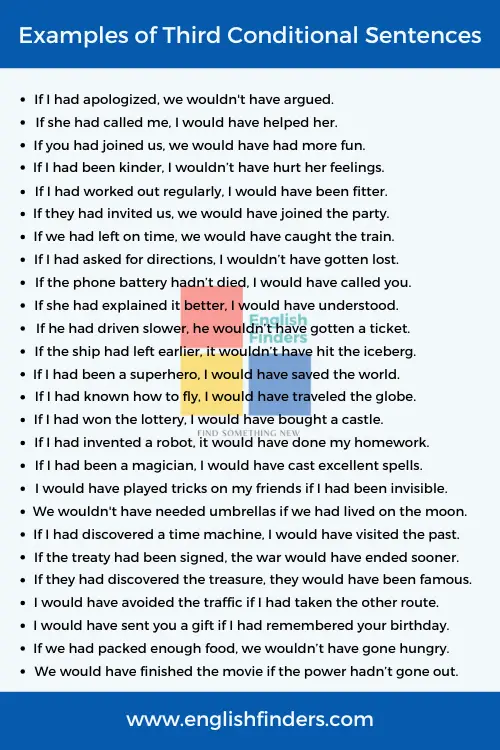
The sentences are in five groups. Each group shows one use or form.
Personal Regrets
| No. | Sentence |
|---|---|
| 1 | If I had studied harder, I would have passed the test. |
| 2 | If I had saved more money, I would have bought a better phone. |
| 3 | If she had practised every day, she would have won the competition. |
| 4 | If I had listened to my parents, I would have chosen a different school. |
| 5 | If we had left earlier, we would have caught the flight. |
| 6 | If he had been more careful, he would have kept his job. |
| 7 | If I had spoken up, my manager would have noticed my ideas. |
| 8 | If they had taken the map, they would not have got lost. |
| 9 | If I had learned to swim as a child, I would have felt safe on the boat. |
| 10 | If she had called me, I would have gone to the party. |
Missed Opportunities
| No. | Sentence |
|---|---|
| 11 | If we had arrived earlier, we would have got good seats. |
| 12 | If I had applied for the job, I would have moved to Dubai. |
| 13 | If he had accepted the offer, he would have earned more money. |
| 14 | If the shop had been open, I would have bought the dress. |
| 15 | If they had invited me, I would have joined the trip. |
| 16 | If you had come with us, you would have met my cousin. |
| 17 | If I had finished my degree, I would have found a better job. |
| 18 | If the team had scored in time, it would have won the match. |
| 19 | If she had entered the contest, she would have won the prize. |
| 20 | If we had booked a hotel, we would have had a room. |
History and What-Ifs
| No. | Sentence |
|---|---|
| 21 | If the printing press had not been invented, books would have stayed rare. |
| 22 | If the ship had not hit the iceberg, many more people would have survived the journey. |
| 23 | If the inventor had given up, we would not have electric light today. |
| 24 | If the explorer had turned back, he would not have found the new land. |
| 25 | If the war had ended sooner, millions of lives would have been saved. |
| 26 | If the scientist had ignored the result, the medicine would never have been discovered. |
| 27 | If the king had listened to his advisers, the empire would have lasted longer. |
| 28 | If the engineers had checked the bridge, it would not have fallen. |
| 29 | If the vaccine had arrived earlier, fewer people would have fallen ill. |
| 30 | If the phone had not been invented, communication would have developed more slowly. |
Negatives and Questions
| No. | Sentence |
|---|---|
| 31 | If I hadn’t missed the bus, I wouldn’t have been late. |
| 32 | If it hadn’t rained, we wouldn’t have cancelled the picnic. |
| 33 | If you hadn’t helped me, I wouldn’t have finished on time. |
| 34 | If he hadn’t lied, she wouldn’t have been angry. |
| 35 | If they hadn’t trained hard, they wouldn’t have won. |
| 36 | What would you have done if you had lost your passport? |
| 37 | Would you have gone if they had invited you? |
| 38 | Where would she have lived if she hadn’t moved to Canada? |
| 39 | Would the match have started if the rain had stopped? |
| 40 | How would they have travelled if the trains had been cancelled? |
Could Have, Might Have and Inversion
| No. | Sentence |
|---|---|
| 41 | If I had saved money, I could have bought a car. |
| 42 | If she had studied medicine, she could have become a doctor. |
| 43 | If it had snowed, the roads might have closed. |
| 44 | If they had asked, we might have helped. |
| 45 | If you had left sooner, you could have avoided the traffic. |
| 46 | Had I known the truth, I would have acted differently. |
| 47 | Had she asked for help, we would have come at once. |
| 48 | Had they not been late, they would have seen the start. |
| 49 | Had the company planned better, it might have kept its customers. |
| 50 | Had he taken the medicine, he could have felt better by morning. |
First, Second and Third Conditional
It is easy to mix the conditionals. The table shows the difference.
| Type | Structure | Meaning | Example |
|---|---|---|---|
| First | If + present simple, will + base verb | A real future possibility | If it rains, I will stay at home. |
| Second | If + past simple, would + base verb | An unreal present or future | If I had a car, I would drive to work. |
| Third | If + past perfect, would have + past participle | An unreal past | If I had had a car, I would have driven to work. |
Sometimes the past and the present mix. This is a mixed conditional. For example: If I had studied medicine, I would be a doctor now. The condition is in the past, but the result is in the present.
Check your answer
You can read more in our lessons on the first conditional and the second conditional.
Common Mistakes
| Common mistake | Better sentence | Why |
|---|---|---|
| If I would have known, I would have called. | If I had known, I would have called. | Do not use would have in the if-clause. |
| If I knew, I would have called. | If I had known, I would have called. | The if-clause needs the past perfect. |
| If she had studied, she would pass. | If she had studied, she would have passed. | The result needs would have + past participle. |
| If it had rained we would have stayed home. | If it had rained, we would have stayed home. | Add a comma after the if-clause. |
| If he had went earlier, he would have won. | If he had gone earlier, he would have won. | Use the past participle after had. |
Practice: Exercises on the Third Conditional
Exercise 1: Complete the Sentences
Write the verbs in the correct form.
- If I (study) harder, I (pass) the test.
- If she (not miss) the bus, she (arrive) on time.
- If they (invite) me, I (go) to the party.
- We (not get) wet if we (take) an umbrella.
- What (you / do) if you (lose) your passport?
Show answers for Exercise 1
- Had studied, would have passed
- Had not missed, would have arrived
- Had invited, would have gone
- Would not have got, had taken
- Would you have done, had lost
Exercise 2: Name the Conditional
Write first, second or third conditional.
- If it rains tomorrow, we will stay at home.
- If I had a car, I would drive to work.
- If he had left earlier, he would have caught the train.
- If she studies, she will pass.
- If we had known, we would have helped you.
Show answers for Exercise 2
- First conditional (a real future possibility)
- Second conditional (an unreal present)
- Third conditional (the train was missed)
- First conditional (a likely result)
- Third conditional (the speaker did not know)
Exercise 3: Correct the Mistake
Each sentence has one mistake. Write the correct sentence.
- If I would have known, I would have called you.
- If she had studied, she would pass the exam.
- If they knew the truth, they would have helped.
- If he had went earlier, he would have won.
- If we had left early we would have caught the bus.
Show answers for Exercise 3
- If I had known, I would have called you.
- If she had studied, she would have passed the exam.
- If they had known the truth, they would have helped.
- If he had gone earlier, he would have won.
- If we had left early, we would have caught the bus.
Quiz: Test Yourself
- What is the structure of the third conditional?
- What does the third conditional talk about?
- Which sentence is correct?
- Which sentence shows regret?
- Which sentence is the negative form?
- Which sentence uses inversion?
- Which modal shows a smaller chance in the result?
- Which sentence is the second conditional?
- Which sentence is a correct question?
- Which sentence is a mixed conditional?
Key Takeaways
- The third conditional is if + past perfect, would have + past participle.
- It talks about unreal situations in the past.
- Never use would have in the if-clause.
- Use could have or might have when the result is less certain.
- Inversion with had is a formal way to say the same thing.
Frequently Asked Questions
What is the third conditional?
The third conditional talks about an unreal situation in the past and its unreal result. It uses if + past perfect, then would have + past participle. For example: If I had known, I would have helped.
When do we use the third conditional?
We use it for regrets, criticism, missed opportunities, imagined results in history and excuses about the past.
Can we use would have in the if-clause?
No. The if-clause uses the past perfect. Say If I had known, I would have called. Do not say If I would have known.
What is the difference between the second and the third conditional?
The second conditional is about an unreal present or future: If I had a car, I would drive. The third is about an unreal past: If I had had a car, I would have driven.
Can we use could have or might have in the third conditional?
Yes. Could have shows that something was possible, and might have shows a smaller chance. For example: If it had rained, the match might have stopped.
What is inversion in the third conditional?
Inversion drops if and puts had before the subject. Had I known, I would have called means the same as If I had known, I would have called. It sounds formal.
Related Articles

- 100 Adjectives to Describe a Person: Positive Words with Examples - November 7, 2026
- Personification: Meaning, Examples and the Verbs Behind It - October 27, 2026
- Alliteration: Meaning, Examples and Sound Tricks - October 26, 2026