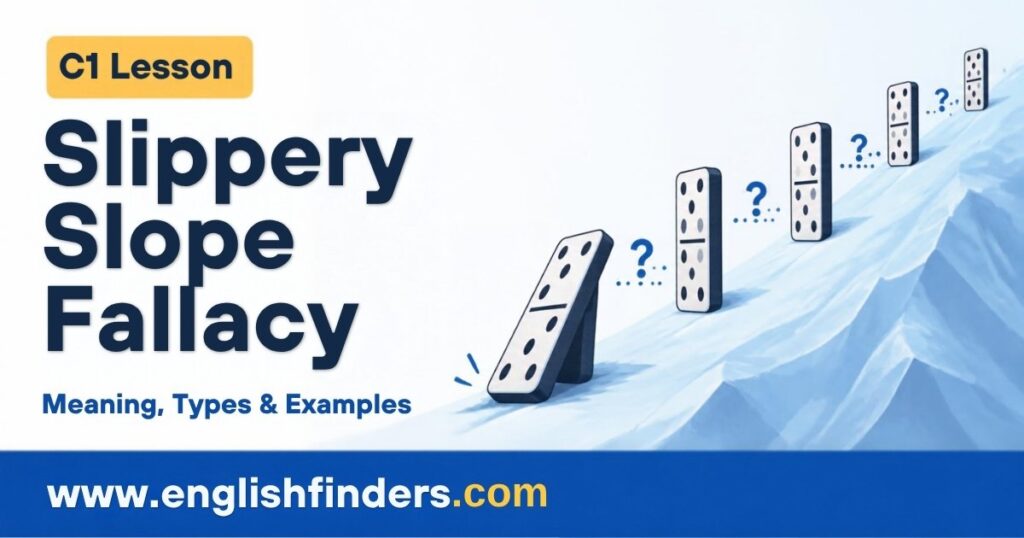
The slippery slope fallacy claims that one small step will lead to a chain of events that ends in disaster, without showing evidence that each step will really happen.
It imagines that once we start, we cannot stop, like sliding down an icy hill.
“If you skip your homework tonight, you’ll fall behind, fail your exams and never get into university.” Each step might happen, but none of them is certain, and that gap is where the fallacy lives.
Here are the three types, the cases where the argument is reasonable, and wording that keeps your own predictions honest.
- What the slippery slope fallacy is and its other names
- The three types of slippery slope argument
- When a slippery slope argument is reasonable
- The grammar of slippery slopes and how to make careful predictions
- Examples and polite replies, with a practice quiz
What Is the Slippery Slope Fallacy?
Quick Navigation
A slippery slope argument is a chain: A leads to B, B leads to C, and C leads to a terrible Z. The speaker usually wants you to reject A because of Z.
The problem is the links. Each step may be possible, but possible is not certain. When a speaker presents the whole chain as unavoidable and gives no evidence, the argument becomes a fallacy.
Phones allowed at lunch
Phones in class
No one listens
Everyone fails
Pronunciation and other names
| Phrase | Sounds like | IPA |
|---|---|---|
| Slippery slope | SLIP-uh-ree SLOHP | /ˌslɪp.ər.i ˈsləʊp/ |
Other names: the domino fallacy, the thin end of the wedge. A related idiom is “Give them an inch and they’ll take a mile.”
You can also say be on a slippery slope (to be in a situation that could get worse): “He’s on a slippery slope to serious debt.” See our slope dictionary page.
The 3 Types of Slippery Slope Argument
| Type | Idea | Example |
|---|---|---|
| Causal | One event causes the next, like falling dominoes | “If we cut the library budget, it will close, then the school will lose students.” |
| Precedential | One decision sets an example that must be followed | “If we give one student extra time, we’ll have to give it to everyone.” |
| Conceptual | There is no clear line, so small changes become big ones | “If one sweet is fine, why not two? Why not the whole box?” |
When Is a Slippery Slope Argument Reasonable?
Not every chain of consequences is a fallacy. Compare these two arguments.
| Fallacy | Reasonable |
|---|---|
| “If you eat one cookie, you’ll eat the whole box, gain weight and become seriously ill.” | “Nicotine is highly addictive, so a few cigarettes a day can easily become a regular habit. It is safer not to start.” |
| No evidence; every step is presented as certain. | Strong evidence supports the link; the language is careful (can, safer). |
The difference is evidence and probability. A good argument shows why each step is likely and admits that the chain could stop.
The Grammar of Slippery Slopes
Slippery slope arguments often use strong future forms and chained conditionals. Careful writers use hedging instead.
| Slippery slope language | Careful language |
|---|---|
| “If we do this, it will lead to…, and then…, and before you know it…” | “If we do this, it could lead to…” |
| “This will inevitably cause…” | “There is a risk that this may cause…” |
| “Once we start, there’s no going back.” | “We should monitor the effects carefully.” |
| “Everyone will want the same.” | “Some people might ask for the same.” |
For more practice, see our C2 lesson on hedging and boosting and the C1 lesson on speculating about the future.
Check your answer
Slippery Slope Examples
| Context | Example |
|---|---|
| Parenting | “If you let him stay up late tonight, he’ll expect it every night, and soon he won’t sleep at all.” |
| School | “If we cancel one exam, students will stop studying for all exams.” |
| Advertising | “Skip this insurance today, and one small accident could ruin your whole future.” |
| Politics | “If we allow this small tax, taxes will rise every year until no one can afford to live here.” |
| Technology | “If children use tablets, they’ll stop reading books, and soon nobody will be able to write.” |
The advertising example shows how slippery slopes often use fear, a misuse of pathos. Learn more in our lesson on ethos, pathos and logos.
How to Respond Politely
- “Is there evidence that one step really leads to the next?”
- “I can see the risk, but I don’t think the result is certain.”
- “Couldn’t we set a clear limit to stop it going further?”
- “Let’s look at what happened in places that already tried this.”
Common Mistakes Learners Make
- Calling every prediction a slippery slope. Predictions with good evidence are reasonable.
- **Using will for uncertain results in essays.** Use could, may or might.
- Confusing it with false cause. False cause claims one thing caused another; a slippery slope predicts a chain of future events.
- Spelling: slippery has a double p.
Practice: Test Your Understanding
Part A. Slippery slope fallacy or reasonable argument?
- “If you miss one gym session, you’ll miss them all and lose all your fitness.”
- “Doctors report that untreated infections can spread, so it’s safer to see a doctor early.”
- “If we let people bring dogs to the café, soon they’ll bring horses.”
- “If we raise the price by 50%, we may lose some regular customers.”
Show answers for Part A
- Fallacy – one missed session does not prove the rest will follow.
- Reasonable – there is medical evidence and careful language.
- Fallacy – an extreme and unsupported jump.
- Reasonable – a likely result with careful language (may).
Part B. Which type is it: causal, precedential or conceptual?
- “If we let one employee work from home, we’ll have to let everyone.”
- “If the factory closes, workers will move away, then shops will close.”
- “If five minutes late is OK, why not ten? Why not an hour?”
Show answers for Part B
- Precedential
- Causal
- Conceptual
Part C (writing). Write two sentences predicting the effects of a four-day school week. Use careful language (could, may, there is a risk that) and avoid a slippery slope. Check your writing with our AI Writing Feedback tool.
Quiz: Test Yourself
- What does the slippery slope fallacy claim?
- Which is another name for the slippery slope fallacy?
- “If we give one student extra time, we’ll have to give it to everyone.” Which type is this?
- “If one sweet is fine, why not two? Why not the whole box?” Which type is this?
- Which argument is reasonable, not a fallacy?
- Which sentence uses careful language?
- What does “be on a slippery slope” mean?
- How is a slippery slope different from false cause?
- Which idiom is related to the slippery slope?
- What makes a chain of consequences reasonable?
Key Takeaways
- The slippery slope fallacy claims a small step will lead to disaster without evidence for each link.
- Other names: the domino fallacy, the thin end of the wedge.
- Three types: causal, precedential and conceptual.
- It is reasonable only when evidence supports each step and the language is careful.
- In essays, replace will inevitably with could, may or there is a risk that.
Explore more reasoning mistakes in our guide to logical fallacies, or learn how arguments get twisted with the straw man fallacy.
Frequently Asked Questions
What is a slippery slope fallacy in simple words?
A slippery slope fallacy claims that one small step will lead to a chain of events ending in disaster, without giving evidence that each step will really happen.
What is an example of a slippery slope?
“If we let students use calculators, they’ll stop learning math, then they’ll fail their exams, and soon no one will be able to do basic sums.” Each step is assumed, not proved.
Is a slippery slope argument always a fallacy?
No. If there is good evidence that each step is likely to lead to the next, the argument can be reasonable. It becomes a fallacy when the chain is presented as certain without support.
What are other names for the slippery slope fallacy?
It is also called the domino fallacy or the thin end of the wedge. The idiom “Give them an inch and they’ll take a mile” often expresses the same idea.
What are the types of slippery slope arguments?
Writers usually describe three types: causal (one event causes the next), precedential (one decision sets an example for others) and conceptual (there is no clear line between small and large changes).
How do you avoid a slippery slope in an essay?
Give evidence for each link in the chain and use careful language such as “could,” “may” and “there is a risk that” instead of “will definitely” or “inevitably.”
Related Articles

- Literary Devices: 30 Common Devices with Meanings and Examples - October 9, 2026
- Bandwagon Fallacy: Meaning, Examples and Origin - October 8, 2026
- Straw Man Fallacy: Meaning, Examples and How to Respond - October 8, 2026