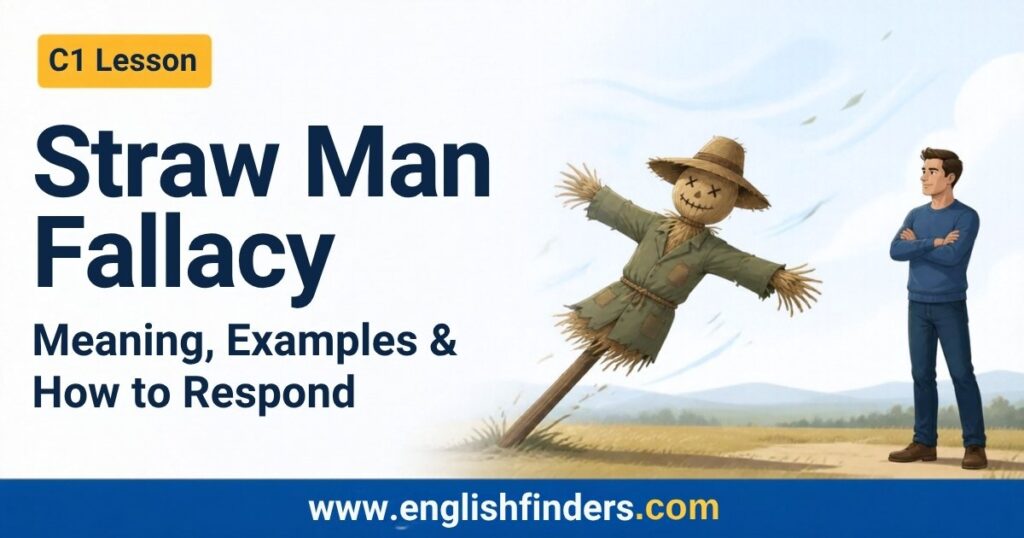
The straw man fallacy happens when someone twists another person’s argument into a weaker or more extreme version and then attacks that version instead. It looks like a win, but the real argument has not been answered.
If you have ever said “I’d like a quiet weekend” and heard “So you’re bored of me?”, you have met a straw man. Later we will meet its fair opposite, the steel man, a strong tool for essays.
- What a straw man argument is and why it has this name
- Five common ways people create a straw man
- Clear examples from everyday life
- The steel man: the fair alternative
- How to respond politely, with a practice quiz
What Is a Straw Man Fallacy?
Quick Navigation
A straw man has three steps. First, a person makes a claim. Next, the other person replaces it with a distorted version. Finally, they attack the distorted version and act as if they have won.
The name comes from a simple image: a man made of straw is easy to knock down. Beating one proves nothing about beating a real opponent.
Spelling and pronunciation
| Form | Use | Example |
|---|---|---|
| Straw man | Noun (most common) | “That’s a straw man.” |
| Straw-man | Before a noun | “A straw-man argument” |
| Strawman | One-word noun, also common | “He attacked a strawman.” |
| To straw-man | Informal verb | “Stop straw-manning my point.” |
Say it /ˈstrɔː ˌmæn/, with the stress on straw.
5 Common Ways to Create a Straw Man
| Technique | What happens | Example |
|---|---|---|
| Exaggeration | Makes the claim more extreme | “We need stricter rules for dogs in parks.” → “You want to ban dogs!” |
| Oversimplification | Removes the important details | “Taxes should rise for the top 1%.” → “You want to raise everyone’s taxes.” |
| Quoting out of context | Uses only part of what was said | “The film is long, but brilliant.” → “Even she says the film is too long.” |
| The weak man | Attacks the weakest supporter of a view | Answering a careless social media post instead of the expert research |
| The hollow man | Invents an opponent | “Some people say reading is a waste of time. They’re wrong.” (Who says this?) |
Straw Man Examples in Everyday Life
| Situation | What was said | Straw man reply |
|---|---|---|
| Family | “Can we eat out less this month?” | “So you never want us to have any fun?” |
| Work | “This report needs a few changes.” | “So you think all my work is useless?” |
| School | “Phones should be off during lessons.” | “Why do you hate technology?” |
| Politics | “We should review the city’s police budget.” | “My opponent wants to abolish the police.” |
| Environment | “We should use fewer plastic bags.” | “They want to ban all plastic, even in hospitals.” |
Check your answer
The Opposite: Steel Man Your Opponent
A steel man is the fair alternative. Before you disagree, you describe the other side’s argument in its strongest form. Then you respond.
This makes you more convincing. Readers and listeners trust a writer who clearly understands the other view. It is also excellent practice for the counter-argument paragraph in an essay.
You can practice this in our C1 lesson on conceding and refuting a counter-argument.
Language for Reporting Arguments Fairly
Straw men often begin with an unfair summary. Careful reporting verbs and hedging help you summarize fairly.
| Instead of… | Try… |
|---|---|
| “She thinks all homework is bad.” | “She argues that students may have too much homework.” |
| “He wants to destroy the economy.” | “He suggests raising some business taxes.” |
| “They hate cars.” | “They claim that cities could benefit from fewer cars.” |
For more practice, see our advanced reporting verbs worksheet and the C2 lesson on hedging and boosting.
Straw Man vs Other Fallacies
| Fallacy | What it does | Example |
|---|---|---|
| Straw man | Changes the other person’s argument | “So you want to ban all cars?” |
| Red herring | Changes the topic | “Cars? Let’s talk about the price of bread.” |
| Ad hominem | Attacks the person | “You don’t even drive, so what do you know?” |
How to Respond to a Straw Man
Stay calm and restate your real position clearly.
- “That’s not quite what I said. My point is that…”
- “I’m not saying we should ban cars. I’m saying we need more bike lanes.”
- “Let me be clear about what I’m suggesting…”
- “I agree that would be extreme, but it isn’t my position.”
Common Mistakes Learners Make
- Spelling: it is straw, not “strow” or “straw-men fallacy.”
- Calling every summary a straw man. A fair summary, even a short one, is not a fallacy.
- Confusing it with a red herring. A straw man stays on the topic; a red herring leaves it.
- Creating straw men in essays by accident. Words like all, never and completely can turn a fair summary into an unfair one.
Practice: Test Your Understanding
Part A. Straw man or fair summary?
- A: “We should limit sugar in school lunches.” B: “So you want children to eat only vegetables forever?”
- A: “Remote work saves time.” B: “So you think remote work helps people avoid long commutes?”
- A: “The museum should charge a small entry fee.” B: “So you want only rich people to see art?”
- A: “I’d like to read more books this year.” B: “So you want to read more often?”
Show answers for Part A
- Straw man – exaggeration.
- Fair summary – it restates the point accurately.
- Straw man – “a small fee” becomes “only rich people.”
- Fair summary
Part B. Which technique is used: exaggeration, quoting out of context, or hollow man?
- “Some people believe exercise is bad for you. Let me explain why they are wrong.”
- The report said: “The new bridge is expensive, but it will save lives.” A critic replies: “Even the report admits the bridge is a waste of money.”
- “You said we need a few more staff? So you want to double the team?”
Show answers for Part B
- Hollow man – an invented opponent.
- Quoting out of context – the critic keeps “expensive” and drops “it will save lives.”
- Exaggeration
Part C (writing). Choose an opinion you disagree with. Write a two-sentence steel man of that opinion, then one sentence with your response. Check it with our AI Writing Feedback tool.
Quiz: Test Yourself
- What does the straw man fallacy do?
- A: “Can we eat out less this month?” B: “So you never want us to have any fun?” What is B doing?
- “We need stricter rules for dogs in parks.” → “You want to ban dogs!” Which technique is this?
- “Some people say reading is a waste of time. They’re wrong.” Nobody actually said this. What is it called?
- What is a steel man?
- Which phrase often starts a straw man?
- How is a straw man different from a red herring?
- Which is the fairest way to report someone’s view?
- Someone twists your words. What is a calm reply?
- Which word can turn a fair summary into a straw man by accident?
Key Takeaways
- The straw man fallacy twists an argument into a weaker version, then attacks it.
- Common techniques: exaggeration, oversimplification, quoting out of context, the weak man and the hollow man.
- The fair alternative is the steel man: describe the other side at its strongest before you reply.
- Use reporting verbs and hedging to summarize views fairly.
- Respond calmly: “That’s not quite what I said. My point is…”
Next, learn how attacks on the speaker replace real arguments in our lesson on ad hominem, or see the full list of logical fallacies.
Frequently Asked Questions
What is a straw man fallacy in simple words?
A straw man fallacy happens when someone changes your argument into a weaker or more extreme version and then attacks that version instead of what you really said.
What is an example of a straw man argument?
Person A: “We should eat less meat.” Person B: “So you want to ban all farms and force everyone to be vegan?” Person B attacks an extreme claim that Person A never made.
Why is it called a straw man?
A man made of straw is easy to knock down. Beating one proves nothing about beating a real opponent. In the same way, defeating a weak version of an argument proves nothing about the real one.
What is the opposite of a straw man?
The opposite is a steel man: describing the other side’s argument in its strongest, fairest form before responding. It makes your own argument more convincing and more honest.
What is the difference between a straw man and a red herring?
A straw man stays on the topic but changes the other person’s argument. A red herring changes the topic completely to distract from the original question.
Is it straw man, strawman or straw-man?
All three are used. Straw man (two words) is the most common for the noun. A hyphen is common before another noun, as in “a straw-man argument.” Strawman as one word is also widely used.
Related Articles

- Bandwagon Fallacy: Meaning, Examples and Origin - October 8, 2026
- Straw Man Fallacy: Meaning, Examples and How to Respond - October 8, 2026
- Ad Hominem: Meaning, Types and Examples of the Fallacy - October 7, 2026