
Alliteration is the repetition of the same first sound in words that are close together. The sound usually belongs to a consonant, and it makes a phrase easier to say, hear and remember.
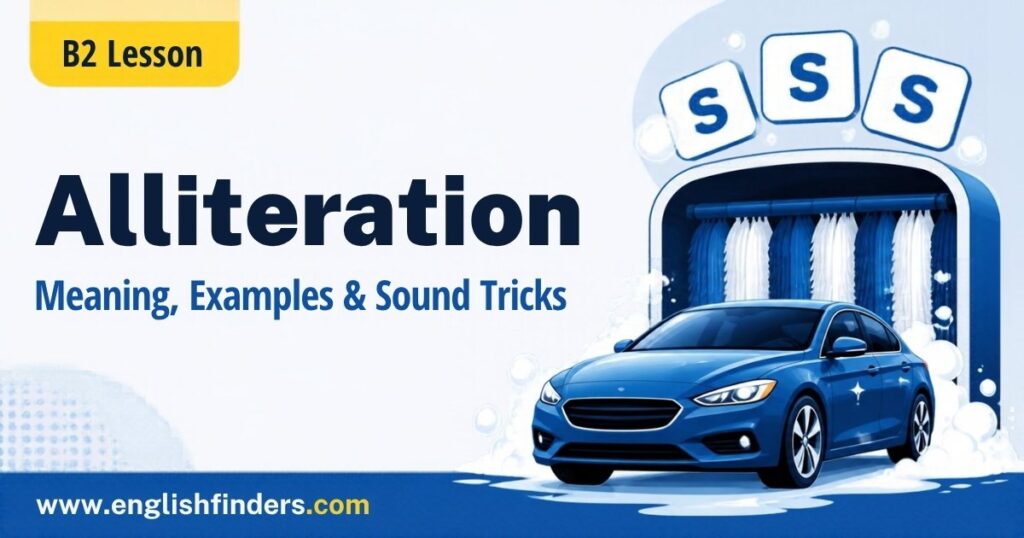
A sign outside a car wash promises: “Squeaky Clean in Sixty Seconds.” You probably read it in a rhythm, hitting each s sound. Nobody needs a poetry class to feel that bounce, and the owner knows you will remember the sign tomorrow.
The catch for learners is that English spelling hides sounds, so the letters on the page can fool you. That trap gets its own section below.
- What alliteration is and why writers use it
- How to say alliteration and its word family
- Why sound matters more than spelling
- Alliteration in ads, names, poems and fixed phrases
- How to use it in your own writing without overdoing it
What Is Alliteration?
Quick Navigation
Alliteration is a sound device. Two, three or more words that sit near each other begin with the same sound, and the ear connects them. The words do not have to be next to each other: “the sound of the sea” still counts.
Most alliteration uses consonants, such as b, s or m. Vowel alliteration exists too (“an angry ant”), but it is harder to hear, because many different vowel sounds can start a word.
How to Pronounce Alliteration
| Word | Sounds like | IPA | Part of speech |
|---|---|---|---|
| Alliteration | uh-lit-er-AY-shun | /əˌlɪt.əˈreɪ.ʃən/ | Noun |
| Alliterate | uh-LIT-er-ayt | /əˈlɪt.ə.reɪt/ | Verb |
| Alliterative | uh-LIT-er-uh-tiv | /əˈlɪt.ər.ə.tɪv/ | Adjective |
Useful patterns: use alliteration, a line full of alliteration, an alliterative name, the words alliterate on the letter p. The word comes from Latin and is linked to littera, “letter.” Listen on the alliteration dictionary page.
Sound, Not Spelling
This is where most learners slip. Alliteration depends on what you hear, not on the letter you see. Say the words aloud before you decide.
| Words | Alliteration? | Why |
|---|---|---|
| Cool, kind, queen | Yes | All start with a /k/ sound, spelled c, k and qu |
| Phone, fun, photo | Yes | Ph and f make the same /f/ sound |
| Cat, city | No | The c in city sounds like /s/ |
| Knife, nose | Yes | The k is silent, so both start with /n/ |
| Giant, goat | No | The g in giant sounds like /dʒ/, the g in goat like /g/ |
| Unicorn, yellow | Yes | Unicorn starts with a /j/ (“you”) sound, like yellow |
| Honest, owl | No | Both start with vowel sounds, but different ones |
Alliteration Examples
| Where | Example | What it does |
|---|---|---|
| Brand names | Coca-Cola, PayPal, Best Buy | Easy to say and remember |
| Comic book names | Peter Parker, Bruce Banner, Wonder Woman | Makes a character name stick |
| News headlines | “Storm Strands Shoppers at Mall” | Grabs attention in few words |
| Book titles | Pride and Prejudice, Sense and Sensibility | Sounds balanced and memorable |
| Tongue twisters | “Six slippery snails slid slowly south” | Practices a difficult sound |
| Everyday speech | “Back to basics”, “Time will tell” | Fixed phrases people already know |
Comic book creator Stan Lee is often quoted as saying he gave characters alliterative names so that he could remember them. Whether or not that is the whole story, the names clearly work on readers too.
Alliteration in Poetry
Poets have used alliteration for centuries. In The Rime of the Ancient Mariner, first published in 1798, Samuel Taylor Coleridge describes a ship moving fast with the line “The furrow followed free.” The f sounds feel quick and light, like the ship.
Shakespeare also made fun of it. In A Midsummer Night’s Dream, amateur actors perform a tragedy with this line: “Whereat, with blade, with bloody blameful blade, / He bravely broach’d his boiling bloody breast.” The heap of b sounds turns tragedy into comedy.
Alliteration in Fixed Phrases
Many common English expressions alliterate, and learning them as whole chunks gives you natural, ready-made language.
| Phrase | Meaning |
|---|---|
| Safe and sound | Not hurt or damaged |
| Part and parcel | A basic, expected part of something |
| First and foremost | Most importantly |
| Bigger and better | Improved and larger |
| Busy as a bee | Very busy |
| Dead as a doornail | Completely dead or not working |
| Now or never | You must act now |
Several of these are binomials, pairs joined by and in a fixed order. You can’t say “sound and safe.” Our C2 lesson on binomials and fixed pairs explains the order rules.
Alliteration vs Assonance vs Consonance
| Device | What repeats | Where | Example |
|---|---|---|---|
| Alliteration | The same sound | At the start of words | “Big brown bear” |
| Assonance | A vowel sound | Anywhere in the words | “Green trees in the breeze” |
| Consonance | A consonant sound | Anywhere, often at the end | “Pitter-patter of feet” |
Alliteration is one of the sound figures in our overview of figures of speech, where you can compare it with other devices.
Check your answer
How to Use Alliteration in Your Writing
- Titles and headings: “Five Fast Fixes for a Slow Laptop” sounds more inviting than “Five Quick Solutions for a Slow Laptop.”
- A closing line: end a speech or presentation with a short alliterative phrase people can repeat.
- Choose the sound for the mood: soft sounds like s, l and m feel calm; hard sounds like k, t and b feel strong or harsh.
- Keep it short: two or three words are usually enough. More than that sounds like a tongue twister.
- Pronunciation practice: write your own tongue twister for a sound you find hard, then use our pronunciation practice page.
Common Mistakes Learners Make
- Counting letters, not sounds: cat and city do not alliterate; phone and fun do.
- Forgetting silent letters: knee starts with /n/, and write starts with /r/.
- Overuse: a whole paragraph of alliteration sounds childish or comic in serious writing.
- Spelling the word: it is alliteration, with double l and a single t.
Practice: Test Your Understanding
Part A. Does each phrase contain alliteration? Answer yes or no.
- Fresh fruit for free
- Gentle giants
- Chilly city streets
- A photo of a fox
- Quick cooking classes
Show answers for Part A
- Yes – /f/ in fresh, fruit, free.
- Yes – both words start with /dʒ/.
- No – chilly starts with /tʃ/, city with /s/.
- Yes – photo and fox both start with /f/.
- Yes – quick, cooking and classes all start with /k/.
Part B. Complete each fixed phrase.
- We got home safe and ______.
- The new phone is bigger and ______.
- First and ______, thank you all for coming.
- Long hours are part and ______ of being a nurse.
Show answers for Part B
- Sound
- Better
- Foremost
- Parcel
Part C (writing). Invent a name and a three-word slogan for a small business, such as a bakery or a bike shop, using alliteration. Then write two sentences explaining your choice of sound. Get feedback with our AI Writing Feedback tool.
Quiz: Test Yourself
- What is alliteration?
- Which pair alliterates?
- Where is the main stress in alliteration?
- Why does “knife” alliterate with “nose”?
- Which phrase is a fixed expression with alliteration?
- “Storm Strands Shoppers at Mall” is an example of alliteration in…
- Which device repeats vowel sounds inside words?
- What effect do soft sounds like s, l and m usually create?
- Why is Shakespeare’s “bloody blameful blade” line funny?
- How do you spell the word correctly?
Key Takeaways
- Alliteration repeats the first sound of words that are close together.
- Listen for sounds, not letters: phone and fun alliterate, cat and city don’t.
- It is common in brand names, headlines, titles, poems and fixed phrases.
- Say uh-lit-er-AY-shun; spell it with double l, single t.
- Use two or three alliterative words, not a whole paragraph.
If sound devices interest you, the vowel version is next door in our lesson on assonance. For a device that plays with size instead of sound, try hyperbole.
Frequently Asked Questions
What is alliteration in simple words?
Alliteration is when two or more words close together start with the same sound, like “busy bees” or “Peter Parker.” Writers use it to make a phrase catchy, musical and easy to remember.
Does alliteration have to use the same letter?
No. Alliteration is about sound, not spelling. “Cool kids” alliterates because both words start with a /k/ sound. “Cat” and “city” do not, because the c in city sounds like an s.
What is the difference between alliteration and assonance?
Alliteration repeats the first sound of nearby words, usually a consonant: “wild wind.” Assonance repeats a vowel sound anywhere in the words: “the light of the fire.” Both make writing sound musical.
Do the alliterating words have to be next to each other?
No. Small words such as a, the, of or and can sit between them. “The sound of the sea” still alliterates on the s sound. The repeated sounds just need to be close enough to hear.
How do you pronounce alliteration?
Say uh-lit-er-AY-shun, with the main stress on the fourth syllable: /əˌlɪt.əˈreɪ.ʃən/. The verb alliterate is said uh-LIT-er-ayt, and the adjective alliterative is uh-LIT-er-uh-tiv.
Can you use too much alliteration?
Yes. One alliterative phrase can make a sentence memorable, but five in a row sound like a tongue twister or a joke. In essays and work emails, use it rarely, mainly in titles or a closing line.
Related Articles

- Alliteration: Meaning, Examples and Sound Tricks - October 26, 2026
- Analogy: Meaning, Examples and Phrases to Build One - October 26, 2026
- Hyperbole: Meaning, Pronunciation and Everyday Examples - October 25, 2026