
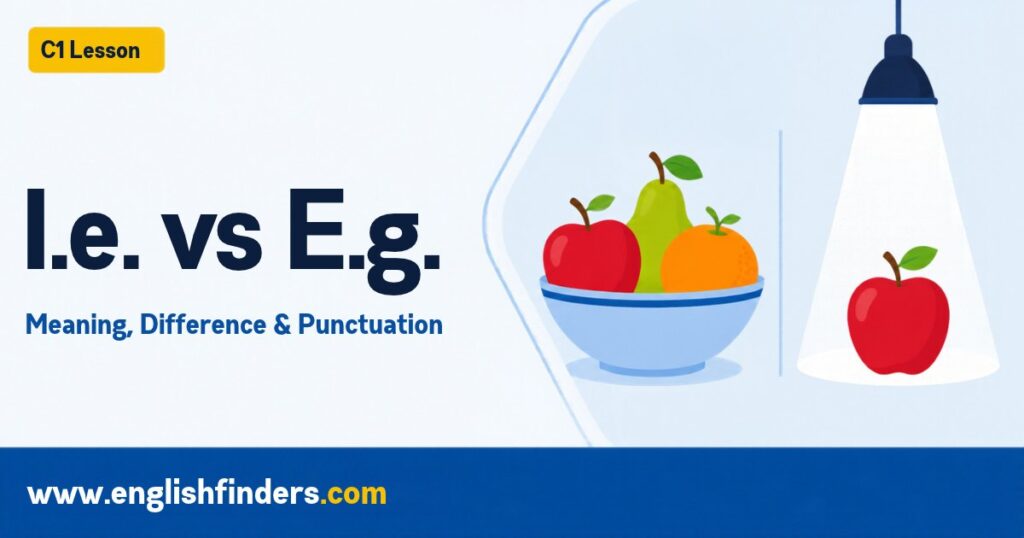
I.e. means “that is,” and e.g. means “for example.” British writers often drop the periods, so the question also appears as ie vs eg. The rule stays the same: i.e. names exactly what you mean; e.g. offers examples.
One office notice says, “Bring photo ID (e.g., a passport).” Another says, “Bring your photo ID (i.e., your passport).” The first lets you choose any ID; the second accepts only one. Two small letters change what you carry.
Meaning is the easy part. Punctuation is where careful writers still slip, so it gets a full section further down.
- What i.e. and e.g. stand for and a quick test for each
- How to read them aloud
- American and British punctuation
- Other Latin abbreviations you will meet: etc., et al., cf., N.B.
- When to write the words out instead
What Do I.e. and E.g. Mean?
Quick Navigation
| Abbreviation | Latin | Meaning | Test: can you replace it with… |
|---|---|---|---|
| i.e. | Id est | That is | “In other words” or “namely”? |
| e.g. | Exempli gratia | For the sake of example | “For example” or “such as”? |
After i.e., the reader gets the complete answer, usually one thing. After e.g., the reader gets a sample, and there are other possibilities you have not listed.
How to Read Them Aloud
| Abbreviation | Sounds like | IPA | Usual spoken form |
|---|---|---|---|
| i.e. | eye-EE | /ˌaɪˈiː/ | “That is” |
| e.g. | ee-JEE | /ˌiːˈdʒiː/ | “For example” |
Both ways are fine when you read a text aloud. In a presentation, “that is” and “for example” sound smoother than the letters.
I.e. and E.g. Side by Side
| Sentence with e.g. | Sentence with i.e. |
|---|---|
| “Bring a warm layer (e.g., a sweater or fleece).” | “Bring the warmest layer you own (i.e., your winter coat).” |
| “Some vegetables (e.g., carrots) last for weeks.” | “The vegetable in the soup (i.e., carrots) was overcooked.” |
| “Use a strong password (e.g., three random words).” | “Use the company password manager (i.e., KeyVault).” |
| “Some planets (e.g., Mars) have thin atmospheres.” | “The red planet (i.e., Mars) is our nearest outer neighbor.” |
On the left, there are other possible answers. On the right, there is only one. KeyVault is a made-up product name.
Check your answer
Punctuation: American and British Style
| Point | American style | British style |
|---|---|---|
| Periods | Always: i.e., e.g. | Often none: ie, eg |
| Comma after | Usually: “e.g., apples” | Often none: “eg apples” |
| Before the abbreviation | A comma or an opening bracket | A comma or an opening bracket |
| Capital letter | Lowercase, even in brackets | Lowercase |
| Italics | Not italic | Not italic |
Pick one style and keep it through the whole document. On a website for an American audience, “e.g.,” with both periods and a comma is the safest choice.
Brackets are the most common home for both abbreviations. In the main text of formal essays, many style guides prefer the words for example and that is, and keep the short forms for brackets, notes and tables.
More Latin Abbreviations
| Abbreviation | Latin | Meaning | Example |
|---|---|---|---|
| etc. | Et cetera | And so on | “Pens, paper, folders, etc.” |
| et al. | Et alii | And others (authors) | “Smith et al. (2019) found…” |
| cf. | Confer | Compare | “cf. Chapter 4” |
| vs. | Versus | Against | “The US vs. Canada” |
| N.B. | Nota bene | Note well | “N.B. The office closes early on Friday.” |
| c. / ca. | Circa | About (with dates) | “Born c. 1450” |
| viz. | Videlicet | Namely | Rare and old-fashioned; prefer namely |
Et al. is common in academic references and should only replace people’s names. Cf. means “compare,” not “see”: use it to point to a contrasting idea.
When to Write the Words Out
- Starting a sentence: write “For example,” not “E.g.,”.
- Speeches and formal letters: the full words sound more natural.
- Academic essays: check your style guide; many prefer the full words in running text.
- Notes, tables, brackets and emails: the abbreviations are perfect here.
Words like for example, namely and in other words are also signposts that guide your reader; see our C2 lesson on signposting and the B1 lesson on formal vs informal writing.
Common Mistakes Learners Make
- Using i.e. for examples: “fruit (i.e., apples and pears)” says that apples and pears are the only fruit.
- Adding etc. after e.g.: e.g. already means the list is incomplete.
- Mixing styles: “e.g.” on one line and “eg” on the next looks careless.
- Using ex. in formal work: it is classroom shorthand, not standard style.
Practice: Test Your Understanding
Part A. Choose i.e. or e.g.
- Bring something to read (___, a novel or a magazine).
- The meeting is at the usual time (___, 9 a.m.).
- Many sports (___, tennis and golf) use a ball.
- The author of Pride and Prejudice (___, Jane Austen) was born in 1775.
- Learn some greetings in Spanish (___, “hola” and “buenos días”).
Show answers for Part A
- e.g. – other things to read are possible.
- i.e. – it names the one usual time.
- e.g. – there are many other ball sports.
- i.e. – there is only one author.
- e.g. – these are two of many greetings.
Part B. Rewrite each sentence in American style. Fix any other problems.
- Bring some snacks eg crisps, fruit, etc.
- I.e. the project is late.
- We need a native speaker (i.e. someone who grew up speaking English) to check it.
Show answers for Part B
- “Bring some snacks (e.g., chips and fruit).” (no etc.; chips is the American word)
- “That is, the project is late.”
- “We need a native speaker (i.e., someone who grew up speaking English) to check it.”
Part C (writing). Write a short email (50–70 words) inviting colleagues to a team lunch. Use e.g. once and i.e. once, in brackets, with American punctuation. Get feedback with our AI Writing Feedback tool.
Quiz: Test Yourself
- What does e.g. mean?
- What does i.e. mean?
- “The capital of Japan (___, Tokyo) is huge.” Which fits?
- “Citrus fruits (___, lemons and limes) contain vitamin C.” Which fits?
- Which is standard American punctuation?
- What is wrong with “e.g., pens, pencils, etc.”?
- How should you start a sentence that gives an example?
- What does et al. mean in a reference?
- What does cf. ask the reader to do?
- Which memory trick matches i.e.?
Key Takeaways
- i.e. = “that is”: one exact meaning. e.g. = “for example”: some of many.
- Test: “in other words” → i.e.; “for example” → e.g.
- American style: “e.g.,” and “i.e.,” with periods and a comma; British style often drops both.
- Don’t follow e.g. with etc., and don’t start a sentence with E.g.
- Know the family: etc., et al., cf., vs., N.B., c.
For a formal linking word with its own grammar, read our lesson on albeit. If commas in lists still worry you, the Oxford comma lesson is next.
Frequently Asked Questions
What is the difference between i.e. and e.g.?
I.e. means “that is” or “in other words” and introduces the exact thing you mean. E.g. means “for example” and introduces one or more examples from a larger group. They are not interchangeable.
What do i.e. and e.g. stand for?
Both are Latin. I.e. stands for id est, “that is.” E.g. stands for exempli gratia, “for the sake of example.” English speakers usually read them aloud as “that is” and “for example.”
Do you put a comma after i.e. and e.g.?
In American English, yes: write “e.g.,” and “i.e.,” with periods and a comma. In British English, the periods and the comma are often left out (eg, ie). Whichever style you use, be consistent.
Can I use etc. after e.g.?
No. E.g. already tells the reader that your list is incomplete, so adding etc. repeats the idea. Write “e.g., apples and pears,” not “e.g., apples, pears, etc.”
Can I start a sentence with e.g.?
It is better not to. At the start of a sentence, write the words out: “For example,” or “That is,”. Most style guides keep the abbreviations for brackets, notes, lists and informal writing.
What does ex. mean?
Ex. is an informal American shorthand for “example,” common in school worksheets and notes. It is not standard in formal writing; use e.g. or “for example” instead.
Related Articles

- Albeit: Meaning, Pronunciation, and How to Use It - November 21, 2026
- I.e. vs E.g.: Meaning, Difference and Punctuation - November 21, 2026
- Empathy vs Sympathy: The Difference and What to Say - November 21, 2026