
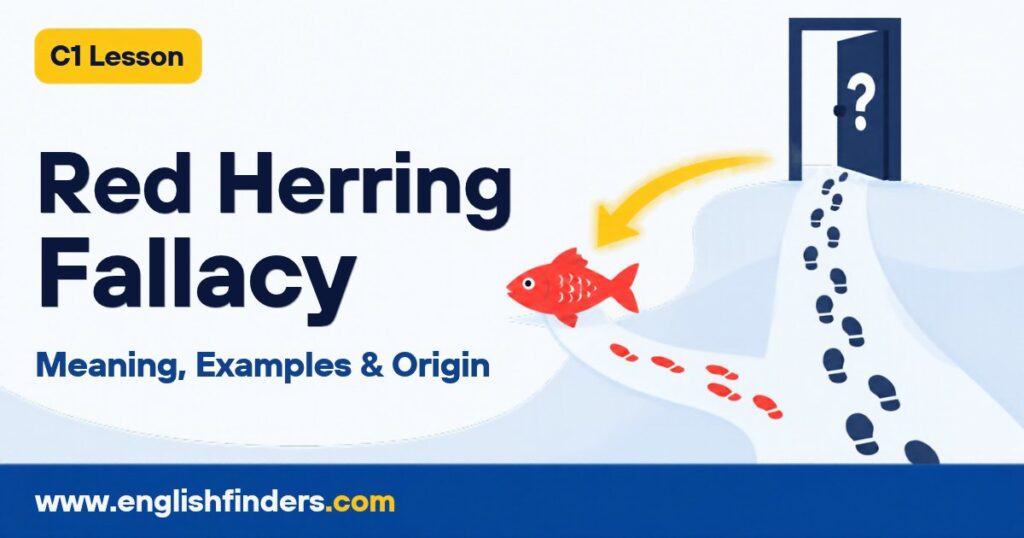
The red herring fallacy happens when someone brings in an irrelevant point to pull attention away from the real issue. Instead of answering the question, the speaker changes the subject, often to something more comfortable or more emotional.
The phrase has two other lives as well. In detective novels, a red herring is the false clue that sends readers after the wrong suspect, and in everyday English it means anything that misleads.
First, though, the logical fallacy: what it looks like, why it works, and how to steer a conversation back on track.
- What a red herring is and where the phrase comes from
- The three uses: logic, mystery stories and everyday idioms
- Examples from politics, work and family life
- The difference between a red herring, whataboutism and a straw man
- How to respond politely, with a practice quiz
What Is a Red Herring Fallacy?
Quick Navigation
In a discussion, there is a question on the table. A red herring is a reply that sounds related but leads somewhere else. If the listener follows it, the original question is forgotten.
Red herrings can be deliberate, like a politician avoiding a hard question. They can also be accidental, when someone simply gets carried away by a different topic.
Pronunciation and grammar
| Phrase | Sounds like | IPA | Grammar |
|---|---|---|---|
| Red herring | red HAIR-ing | /ˌred ˈher.ɪŋ/ | Countable noun: a red herring, red herrings |
Useful patterns: introduce / throw in a red herring, turn out to be a red herring, dismiss something as a red herring, That’s a bit of a red herring. See also our herring dictionary page.
Where Does “Red Herring” Come From?
A herring is a small sea fish. When it is smoked and salted, it turns a reddish-brown color and gets a very strong smell.
The phrase became popular after the English writer William Cobbett told a story in 1807. He described dragging a smoked herring across a trail to pull hunting dogs away from a hare.
He used it to criticize newspapers that were distracted by a false story.
Three Uses of “Red Herring”
| Use | Meaning | Example |
|---|---|---|
| Logic and debate | An irrelevant point used to change the subject | “Why talk about my grades when your room is a mess?” |
| Mystery stories | A false clue or innocent suspect | The nervous butler who seems guilty but is not |
| Everyday idiom | Anything that misleads or distracts | “We thought the noise was the engine, but that was a red herring.” |
In stories, a red herring is a deliberate and fair writing technique. It keeps readers guessing. Real clues that point to the true ending are foreshadowing; misleading ones are red herrings.
Red Herring Fallacy Examples
| Context | Question or issue | Red herring reply |
|---|---|---|
| Politics | “Why has the hospital waiting list doubled?” | “Our party has always cared deeply about families.” |
| Work | “Why was the report late?” | “Did you see how busy the office was this week?” |
| Family | “Did you finish your homework?” | “Mom, did you know my friend got a new puppy?” |
| Traffic stop | “You were driving too fast.” | “Shouldn’t you be catching real criminals?” |
| Advertising | “Is this snack healthy?” | “It comes in a fun, recyclable box!” |
Check your answer
Red Herring vs Similar Fallacies
| Fallacy | What it does | Example |
|---|---|---|
| Red herring | Changes the topic | “Never mind the budget. Look at our new logo.” |
| Whataboutism | Changes the topic to someone else’s faults | “You criticize our pollution, but what about other countries?” |
| Straw man | Stays on topic but twists the argument | “So you want to ban all factories?” |
| Ad hominem | Attacks the person | “You’re not a scientist, so be quiet.” |
Whataboutism is a type of red herring. All of these appear in our full guide to logical fallacies.
How to Spot a Red Herring
- Remember the original question. Write it down in a meeting or debate if you need to.
- Ask: does this answer it? A related topic is not the same as an answer.
- Notice emotional topics. A sudden move to something exciting or upsetting can be a distraction.
- Watch for “But what about…?” This is a common way to start a red herring.
How to Respond Politely
| Situation | Useful phrase |
|---|---|
| Bringing the topic back | “That’s an interesting point, but I’d like to come back to my question.” |
| Naming the problem gently | “I think we’re moving away from the main issue.” |
| Asking again | “Could you answer the question about the budget first?” |
| Accepting the new topic later | “Let’s discuss that next, but first…” |
These phrases are useful in meetings and speaking exams. Practice them in our C2 lesson on holding your own in an impromptu debate.
Common Mistakes Learners Make
- Spelling: it is herring (a fish), not “hearing.”
- Thinking it is always a lie. A red herring can be true; it is simply irrelevant to the question.
- Mixing it up with a straw man. A red herring leaves the topic; a straw man changes the other person’s argument.
- Using it as an adjective without “a.” Say “That’s a red herring,” not “That’s red herring.”
Practice: Test Your Understanding
Part A. Red herring or a relevant answer?
- “Why are prices so high?” “Costs for fuel and rent have risen by 20% this year.”
- “Why didn’t you call me back?” “Have you seen the weather outside? It’s crazy.”
- “Is the new drug safe?” “Our company gives millions to charity every year.”
- “Why is the road still closed?” “Workers found a broken pipe and need two more days.”
Show answers for Part A
- Relevant – it explains the prices.
- Red herring – the weather does not explain the missed call.
- Red herring – charity says nothing about safety.
- Relevant
Part B. Which meaning of red herring is used: logic, mystery story or everyday idiom?
- In the novel, the gardener’s muddy boots are a red herring.
- The mechanic said the strange noise was a red herring; the real problem was the battery.
- “Instead of explaining the tax rise, the minister threw in a red herring about immigration.”
Show answers for Part B
- Mystery story
- Everyday idiom
- Logic and debate
Part C (writing). Write a short dialogue (four lines) where one person uses a red herring and the other politely brings the conversation back. Check it with our AI Writing Feedback tool.
Quiz: Test Yourself
- What does a red herring do in an argument?
- “Why was the report late?” “Did you see how busy the office was this week?” What is the reply?
- What is a herring?
- In a mystery story, what is a red herring?
- Which sentence is correct?
- “You criticize our pollution, but what about other countries?” What type of red herring is this?
- Can a red herring be true?
- Which phrase is a common way to start a red herring?
- Someone changes the subject in a meeting. What is a polite reply?
- How is a red herring different from a straw man?
Key Takeaways
- The red herring fallacy uses an irrelevant point to change the subject.
- The phrase comes from a strong-smelling smoked herring used to pull dogs off a trail.
- Red herring has three uses: a logical fallacy, a false clue in mysteries, and an everyday idiom.
- Whataboutism is a type of red herring; a straw man is different because it stays on topic.
- Respond by returning politely to the original question.
Next, learn how arguments get twisted in our lesson on the straw man fallacy, or see how writers plant real clues with foreshadowing.
Frequently Asked Questions
What is a red herring in simple words?
A red herring is something that distracts attention from the real issue. In an argument, it is an irrelevant point used to change the subject. In a mystery story, it is a false clue.
What is an example of a red herring fallacy?
A reporter asks a mayor why the bus service is late every day. The mayor answers, “Our city has some of the most beautiful parks in the country.” The parks have nothing to do with the buses.
Why is it called a red herring?
A herring is a fish. When it is smoked, it turns reddish and smells very strong. The phrase became popular after William Cobbett wrote in 1807 about using a smoked herring to pull hunting dogs off a trail.
What is a red herring in a mystery story?
In mystery stories, a red herring is a false clue or a suspicious character who turns out to be innocent. It leads readers in the wrong direction so the real solution is a surprise.
What is the difference between a red herring and whataboutism?
Whataboutism is a type of red herring. It answers criticism by pointing to someone else’s bad behavior: “What about them?” All whataboutism changes the subject, but not every red herring is whataboutism.
How do you respond to a red herring?
Notice the change of subject and politely return to the original question. For example: “That’s an interesting point, but it doesn’t answer my question about the buses.”
Related Articles

- Red Herring Fallacy: Meaning, Examples and Origin - November 20, 2026
- Synonyms for Happy: 50+ Other Words with Examples - November 10, 2026
- Synonyms for Goal: 25+ Words with Meanings and Examples - November 8, 2026