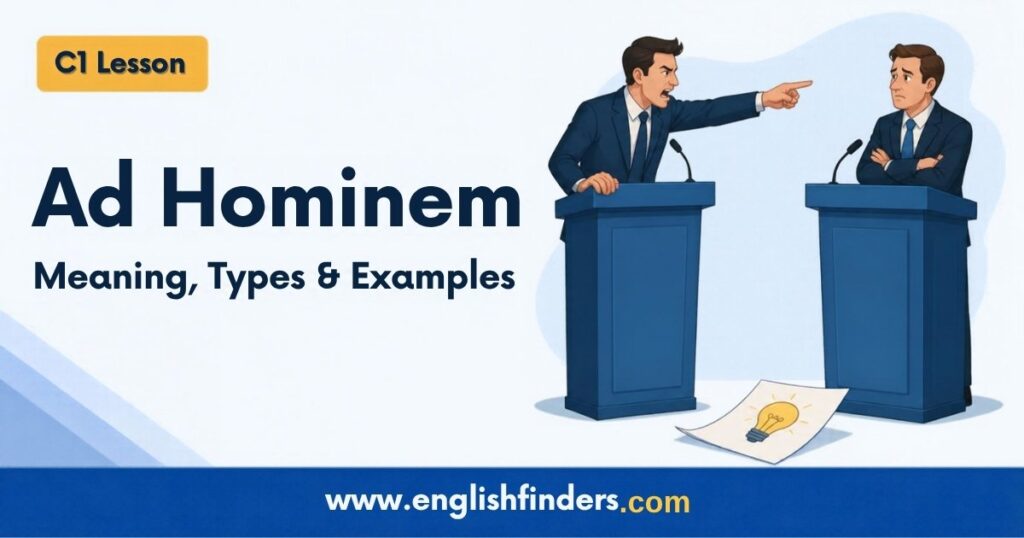
Ad hominem means attacking the person who makes an argument instead of the argument itself. It is one of the most common logical fallacies.
Imagine a colleague says, “Why listen to Sam’s budget plan? He can’t even manage his own money.” The plan has not been addressed at all. Only Sam has been attacked.
We’ll go through the five main types, when a personal point is actually fair, and what to say when it happens to you.
- What ad hominem means and how to pronounce it
- The five main types of ad hominem argument
- When a comment about a person is fair and when it is a fallacy
- Useful vocabulary for personal attacks
- Polite ways to respond, with a practice quiz
What Does Ad Hominem Mean?
Quick Navigation
The full Latin name is argumentum ad hominem, “an argument to the person.” Instead of asking “Is this idea right?”, the speaker asks “Who said it?” and then attacks that person.
The problem is simple: a good idea is still good if a person we dislike says it. A bad idea is still bad if a person we admire says it. The argument should be judged on its reasons.
How to pronounce ad hominem
| Phrase | Sounds like | IPA | Use |
|---|---|---|---|
| Ad hominem | ad HOM-ih-nem | /ˌæd ˈhɒm.ɪ.nem/ | Adjective or noun |
| Argumentum ad hominem | ar-gyoo-MEN-tum ad HOM-ih-nem | /ˌɑː.ɡjuˈmen.təm ˌæd ˈhɒm.ɪ.nem/ | Full Latin name |
Useful patterns: an ad hominem attack, ad hominem comments, resort to ad hominem attacks, The debate turned ad hominem. It is always two words: ad hominem.
The 5 Main Types of Ad Hominem
| Type | What happens | Example |
|---|---|---|
| Abusive | Insults the person’s character, looks or intelligence | “Only an idiot would believe that.” |
| Circumstantial | Says the person only argues this because of their job, money or situation | “Of course the farmer wants lower taxes on farms.” |
| Tu quoque (“you too”) | Points out that the person does the same thing | “You tell me to exercise, but you never go to the gym.” |
| Guilt by association | Links the person to a disliked group or person | “That idea came from a group that supported a terrible politician.” |
| Poisoning the well | Attacks the person before they even speak | “Before you hear her talk, remember she was fired from her last job.” |
When Is a Personal Point Not a Fallacy?
Not every comment about a person is ad hominem. It is fair when the person’s character or interests are directly relevant to the claim.
| Situation | Fair or fallacy? | Why |
|---|---|---|
| A witness who has lied in court before gives evidence. | Fair to question | Honesty is relevant to testimony. |
| A company pays for a study that praises its own product. | Fair to be careful | The conflict of interest is relevant. |
| A scientist’s study is rejected because she is “too young.” | Fallacy | Age says nothing about the data. |
| A plan is rejected because its author is unpopular. | Fallacy | Popularity says nothing about the plan. |
The test is simple: Does this fact about the person change how much we should trust this specific claim? If not, it is ad hominem.
Insult vs ad hominem
An insult alone is not a fallacy. “Your plan is too expensive, and you’re annoying” is rude, but the reason given (cost) is about the plan. It becomes ad hominem when the insult is the reason: “Your plan is wrong because you’re annoying.”
Check your answer
Ad Hominem Examples in Everyday Life
| Context | Example |
|---|---|
| Politics | “My opponent wants to fix the economy, but he’s been divorced twice.” |
| Workplace | “Let’s not take the intern’s suggestion seriously; she’s only been here a month.” |
| Online | “You can’t have an opinion on this; you don’t even live here.” |
| School | “Of course you think the test was unfair. You failed it.” |
| Sports | “The coach says we need more training, but he was a terrible player.” |
Useful Vocabulary for Personal Attacks
Words and phrases (tap a card)
A personal attackTap to reveal
MudslingingTap to reveal
A smear campaignTap to reveal
Character assassinationTap to reveal
Play the ball, not the manTap to reveal
How to Respond to an Ad Hominem Attack
Stay calm and bring the conversation back to the idea. These phrases help.
- “Whatever you think of me, what do you think of the idea?”
- “Let’s keep this about the plan, not about people.”
- “That may be true, but it doesn’t answer my point about the cost.”
- “Fair enough, I’m not perfect. But is the argument itself wrong?”
You can practice responding under pressure in our C2 lesson on rebuttal techniques.
Ad Hominem and Ethos
Ad hominem is closely linked to ethos, the appeal to a speaker’s trustworthiness. Fair arguments can discuss credibility; ad hominem misuses it by attacking the person to avoid the real question. Learn more in our lesson on ethos, pathos and logos.
Common Mistakes Learners Make
- Spelling: it is ad hominem, not “ad hominum” or “ad homonym.”
- Using it as one word. Write ad hominem, not “adhominem.”
- Calling every criticism ad hominem. Criticizing a person’s argument is normal and healthy.
- Forgetting relevance. Questioning an expert’s qualifications on their own topic can be fair.
Practice: Test Your Understanding
Part A. Which type of ad hominem is it? Choose abusive, circumstantial, tu quoque, guilt by association or poisoning the well.
- “You say I spend too much time on my phone, but you’re always on yours.”
- “Before the next speaker begins, remember that he has no real-world experience.”
- “Only a fool would vote for that.”
- “Of course the car company says electric cars are the future. They sell them.”
- “That theory is popular with people who believe the Earth is flat.”
Show answers for Part A
- Tu quoque
- Poisoning the well
- Abusive
- Circumstantial
- Guilt by association
Part B. Fair point or ad hominem?
- “Don’t trust his restaurant review. He owns the restaurant across the street.”
- “Don’t trust her math. She has terrible taste in music.”
Show answers for Part B
- Fair point – a competitor has a clear conflict of interest.
- Ad hominem – music taste has nothing to do with math.
Part C (writing). Write a short reply (three or four sentences) to this comment: “You’re too young to understand politics, so your opinion doesn’t count.” Bring the discussion back to the argument. Check your reply with our AI Writing Feedback tool.
Key Takeaways
- Ad hominem means attacking the person instead of the argument.
- The five main types: abusive, circumstantial, tu quoque, guilt by association, poisoning the well.
- A personal point is fair only when it is relevant to the claim, such as a conflict of interest.
- An insult is a fallacy only when it is used as the reason to reject an idea.
- Respond calmly: bring the focus back to the idea itself.
Next, see how arguments get twisted in our lesson on the straw man fallacy, or explore the full list of logical fallacies.
Frequently Asked Questions
What does ad hominem mean in simple words?
Ad hominem means attacking the person who makes an argument instead of the argument itself. The phrase is Latin for “to the person.” For example: “Don’t listen to his idea; he never finished school.”
What is an example of an ad hominem attack?
“You can’t give advice about saving money. You bought an expensive car last year.” The speaker attacks the person’s spending instead of checking whether the advice is good.
What are the main types of ad hominem?
The main types are abusive (insults), circumstantial (pointing to someone’s interests or situation), tu quoque (“you do it too”), guilt by association and poisoning the well.
Is every insult an ad hominem fallacy?
No. An insult is only an ad hominem fallacy when it is used as the reason to reject an argument. Someone can be rude and still give a fair reason, although rudeness rarely helps.
When is pointing to a person’s character not a fallacy?
When character is truly relevant. If a witness has lied in court before, questioning their honesty is reasonable. The fallacy happens when the personal point has nothing to do with the claim.
How do you pronounce ad hominem?
Say it /ˌæd ˈhɒm.ɪ.nem/, like “ad HOM-ih-nem.” The stress is on HOM. It is written as two words and is often used as an adjective, as in “an ad hominem attack.”
Related Articles

- Ad Hominem: Meaning, Types and Examples of the Fallacy - October 7, 2026
- Slippery Slope Fallacy: Meaning, Types and Examples - October 7, 2026
- Logical Fallacies: 15 Common Types with Examples - October 6, 2026