
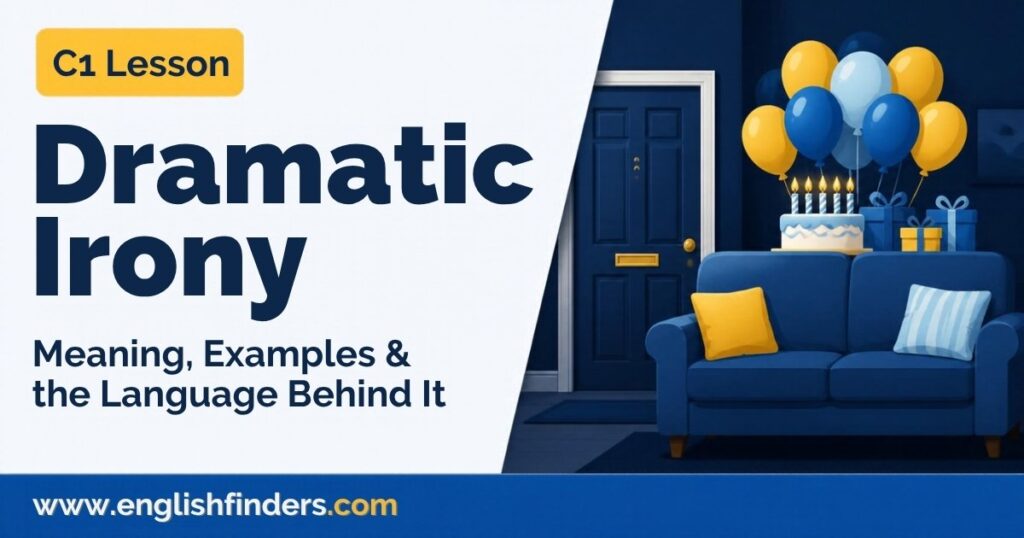
Dramatic irony is a technique in which the audience or reader knows something important that a character does not. The story makes us watch the character act on wrong information, and that gap in knowledge does the work.
Maya walks into her apartment, drops her bag and phones her sister to complain: “Thirty years old, and nobody even remembered.” We already know that twenty friends are crouching behind the sofa in the dark. Her sadness is real, but we are smiling.
Beyond literature class, the topic pays off in two practical ways: you learn to tell the three types of irony apart, and you pick up the grammar for describing a knowledge gap.
- What dramatic irony is and why writers use it
- How it differs from verbal and situational irony
- Examples from plays, novels and films
- The grammar and phrases that describe a knowledge gap
- How to write about dramatic irony in an essay
What Is Dramatic Irony?
Quick Navigation
The word irony comes from Greek eirōneia, “pretended ignorance.” In dramatic irony, nobody pretends: the character truly does not know. The irony sits between the stage and the audience.
Writers create the gap in a few ways. They show the audience a scene the character doesn’t see, let a narrator tell us a secret, or start the story with an ending we already know.
Pronunciation
| Word | Sounds like | IPA |
|---|---|---|
| Irony | EYE-ruh-nee | /ˈaɪ.rə.ni/ |
| Ironic | eye-RON-ik | /aɪˈrɒn.ɪk/ |
| Dramatic | druh-MAT-ik | /drəˈmæt.ɪk/ |
Useful patterns: a moment of dramatic irony, create dramatic irony, the dramatic irony of the scene, it is ironic that…. Listen on the irony dictionary page.
The Three Types of Irony
| Type | Where the irony is | Example |
|---|---|---|
| Verbal irony | In what someone says | Looking at the rain and saying, “Perfect beach weather.” |
| Situational irony | In what happens | A fire station burns down. |
| Dramatic irony | In who knows what | We know the letter is fake; the hero believes it. |
One way to remember them: verbal irony is about words, situational irony is about events, and dramatic irony is about knowledge.
Dramatic Irony Examples
Spoiler note: the first three examples reveal how famous plays end.
| Work | What the audience knows | What the character believes |
|---|---|---|
| Oedipus Rex, Sophocles | Oedipus himself is the killer he is hunting | He is a good king searching for a stranger |
| Romeo and Juliet, William Shakespeare | Juliet has taken a sleeping potion | Romeo thinks she is dead |
| Othello, William Shakespeare | Iago is lying and plotting | Othello keeps calling him “honest Iago” |
| Pantomime (British stage tradition) | The villain is creeping up behind the hero | The hero turns too late, while children shout “He’s behind you!” |
| Horror films | Someone is hiding in the house | The character goes upstairs alone |
| Romantic comedy | Two rivals at work are secretly writing to each other online | Each thinks the online friend is a stranger |
The tomb scene in Romeo and Juliet is painful because of what we know. Every word Romeo says over Juliet’s body is said to someone who is alive and about to wake. The audience wants to shout a warning but cannot.
Alfred Hitchcock is often quoted explaining suspense in a similar way: if the audience sees a bomb under a table and the characters don’t, an ordinary conversation becomes unbearably tense. The knowledge gap turns a dull scene into a gripping one.
Why Writers Use Dramatic Irony
- Tension: we wait for the character to find out (horror, thrillers).
- Comedy: we laugh at the character’s confident mistakes (farce, sitcoms).
- Tragedy: we feel pity because we can see the disaster coming.
- Involvement: knowing a secret makes the reader feel like a partner of the writer.
Dramatic irony also links to tone vs mood: the same knowledge gap can create a comic mood in one story and a dreadful one in another.
The Language of Dramatic Irony
When you describe dramatic irony, you need grammar that shows two levels of knowledge. These patterns do exactly that.
| Pattern | Example | Grammar note |
|---|---|---|
| Little does/did + subject + verb | “Little does she know that the letter is fake.” | Negative adverbial inversion: the auxiliary comes before the subject |
| Unaware that / without realizing | “He signs the contract, unaware that the company is bankrupt.” | A participle clause adds what the character doesn’t know |
| What he doesn’t know is (that)… | “What Maya doesn’t know is that twenty friends are hiding.” | A cleft sentence puts the hidden fact last, for emphasis |
| The audience knows…, but… | “We know Juliet is alive, but Romeo does not.” | Simple contrast between two points of view |
| Had he known… | “Had Romeo known, he would have waited.” | Third conditional with inversion (= If Romeo had known…) |
| If only she had… | “If only she had read the second page.” | A wish about the past: the audience’s frustration |
The first and fifth patterns use inversion, which sounds formal and literary. Our C1 lesson on negative adverbial inversion explains how it works.
Check your answer
How to Write About Dramatic Irony in an Essay
- Name the gap. Say exactly what the audience knows and what the character doesn’t.
- Quote the moment. Pick the line where the gap is clearest.
- Explain the effect. Does it create tension, humor or pity?
Example answer: “Shakespeare uses dramatic irony when Othello repeatedly calls Iago ‘honest.’ Because the audience already knows about Iago’s plot, each use of the word increases our sense of dread.”
Common Mistakes Learners Make
- **Using ironic for bad luck:** a traffic jam on the way to an important meeting is unlucky, not ironic.
- Mixing up the types: if the irony is in who knows what, it is dramatic irony, even when it is funny.
- Forgetting the audience: dramatic irony needs someone, the reader or viewer, who knows more than the character.
- Inversion errors: say “Little does he know,” not “Little he knows.”
Practice: Test Your Understanding
Part A. Verbal, situational or dramatic irony?
- A marriage counselor files for divorce.
- During a storm, a friend says, “Lovely day for a picnic.”
- The reader knows the “friendly neighbor” is the thief; the detective trusts him.
- A traffic safety officer is fined for speeding.
- A character plans a romantic dinner for a partner who, as viewers saw earlier, has just ended the relationship by text.
Show answers for Part A
- Situational – the result is the opposite of what we expect.
- Verbal – the speaker means the opposite.
- Dramatic – the reader knows more than the detective.
- Situational
- Dramatic – we know about the text; the character doesn’t.
Part B. Rewrite each sentence using the pattern in brackets.
- She doesn’t know that the train has been canceled. (Little does…)
- If he had known about the party, he wouldn’t have gone to bed early. (Had…)
- He smiles at the stranger. He doesn’t realize the stranger is his long-lost brother. (unaware that…)
Show answers for Part B
- “Little does she know that the train has been canceled.”
- “Had he known about the party, he wouldn’t have gone to bed early.”
- “He smiles at the stranger, unaware that the stranger is his long-lost brother.”
Part C (writing). Write a short scene (60–80 words) in which the reader knows something a character doesn’t. Use at least one phrase from the language table. Check your scene with our AI Writing Feedback tool.
Quiz: Test Yourself
- What is dramatic irony?
- “A fire station burns down.” Which type of irony is this?
- In Romeo and Juliet, what does the audience know that Romeo does not?
- Which sentence is correct?
- “Had she known, she would have stayed.” What does this mean?
- Which is NOT an example of irony in the strict sense?
- What does the audience shout in a British pantomime when the villain creeps up?
- Why does Othello calling Iago “honest” create dramatic irony?
- Which effect can dramatic irony create?
- In an essay, what should you explain after naming the knowledge gap?
Key Takeaways
- Dramatic irony means the audience knows more than a character.
- Three types of irony: verbal (words), situational (events), dramatic (knowledge).
- It can create tension, comedy or tragedy.
- Describe it with little does he know, unaware that, had she known.
- Don’t use ironic for simple bad luck.
Irony with a target in society is the heart of satire. To see how writers shape the atmosphere around a scene like this, read our lesson on tone vs mood.
Frequently Asked Questions
What is dramatic irony in simple words?
Dramatic irony is when the audience or reader knows something important that a character does not. We watch the character act without that knowledge, and the gap creates tension, humor or sadness.
What is an example of dramatic irony?
In Romeo and Juliet, the audience knows Juliet has only taken a sleeping potion. Romeo does not, believes she is dead and takes poison. The audience’s knowledge makes the scene painful to watch.
What are the three types of irony?
Verbal irony is saying the opposite of what you mean. Situational irony is when the result is the opposite of what was expected. Dramatic irony is when the audience knows more than a character.
What is the difference between dramatic irony and suspense?
Dramatic irony is the knowledge gap between audience and character. Suspense is the tense feeling of waiting to see what happens. Dramatic irony is one of the strongest ways to create suspense.
Is dramatic irony only used in plays?
No. The name comes from the theater, but the technique works in any kind of story. All it needs is an audience that has learned something a character hasn’t, whether from a narrator, a camera shot or an earlier scene.
What phrases describe dramatic irony in an essay?
Useful phrases include “Little does she know that…”, “unaware that…”, “The audience knows that…, but…”, and “Had he known…”. They show the gap between what the audience and the character know.
Related Articles

- Zeugma: Meaning, Examples and the Verbs That Make It Work - October 24, 2026
- Dramatic Irony: Meaning, Examples and the Language Behind It - October 24, 2026
- Satire: Meaning, Types, Examples and How to Spot It - October 24, 2026