
Last updated on October 16th, 2026 at 12:28 pm
If it rains tomorrow, we will stay at home. This sentence talks about a real possibility in the future. It might rain, and if it does, we know what will happen.
That is the first conditional. We use it to say what will happen if a certain condition is true. It helps us make predictions, plans, promises and warnings.
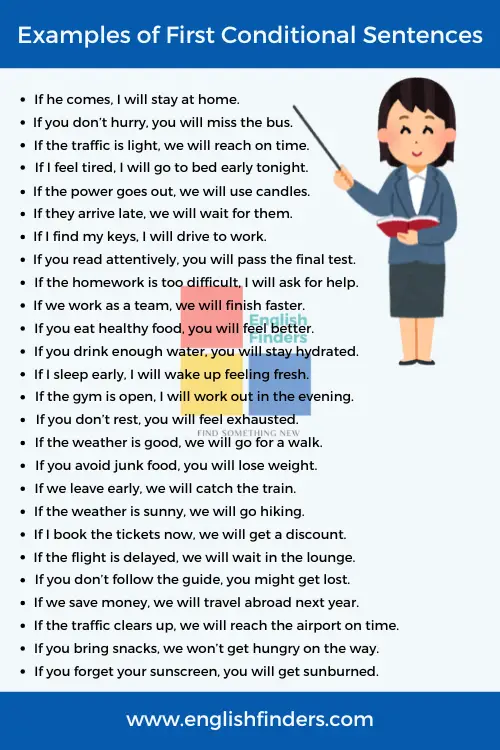
This lesson explains the structure and the uses of the first conditional. It gives 50 example sentences, then exercises, a quiz and a FAQ.
- The structure of the first conditional, with negative and question forms
- Five common uses, such as warnings and promises
- Variations with unless, when and modal verbs
- 50 example sentences in five groups
- How the first conditional differs from the zero and second conditionals
- How to avoid common mistakes, with exercises and a quiz
What Is the First Conditional?
Quick Navigation
A first conditional sentence has two parts. The if-clause gives the condition. The main clause gives the result.
We use the present simple in the if-clause, even though we talk about the future. We use will and the base verb in the main clause.
The condition is real and possible. We do not know if it will happen, but it can happen.
Structure of the First Conditional
The table shows the positive, negative and question forms.
| Form | Structure | Example |
|---|---|---|
| Positive | If + present simple, will + base verb | If you call me, I will answer. |
| Negative | If + present simple, will not (won’t) + base verb | If you don’t call me, I won’t answer. |
| Question | Will + subject + base verb + if + present simple? | Will you wait if I am late? |
| Short answer | Yes, subject + will. / No, subject + won’t. | Yes, I will. / No, I won’t. |
The two clauses can change places. Use a comma when the if-clause comes first. Do not use a comma when it comes second.
- If-clause first: If it rains, we will stay at home.
- If-clause second: We will stay at home if it rains.
Uses of the First Conditional
We use the first conditional in five main ways.
| Use | Example |
|---|---|
| A prediction | If it rains, the match will stop. |
| A plan | If I finish early, I will visit my aunt. |
| A promise | If you help me, I will give you a gift. |
| A warning | If you touch the stove, you will burn your hand. |
| Advice | If you sleep early, you will feel better. |
Check your answer
Variations of the First Conditional
We can change the pattern in a few ways. The meaning stays real and possible.
| Change | Example | Meaning |
|---|---|---|
| Unless (= if not) | Unless you hurry, you will miss the bus. | Same as: If you don’t hurry |
| When | When I get home, I will call you. | The event is sure to happen |
| As soon as | As soon as he arrives, we will start. | Right after the first event |
| Can in the result | If you finish, you can leave. | Permission |
| Might in the result | If it is cold, I might wear a coat. | A smaller chance |
| Should in the result | If you feel ill, you should rest. | Advice |
| An imperative | If you see Tom, tell him to call me. | An instruction |
Use if when we are not sure. Use when when we are sure. If I go to Paris means maybe. When I go to Paris means I will go.
50 First Conditional Sentences
The sentences are in five groups. Each group shows one use or form.
Predictions
| No. | Sentence |
|---|---|
| 1 | If the weather is nice tomorrow, we will go to the beach. |
| 2 | If you don’t charge your phone, it will run out of battery. |
| 3 | If prices go up, fewer people will buy the product. |
| 4 | If it rains, the match will stop. |
| 5 | If she practises every day, she will play better. |
| 6 | If the shop closes early, we will buy food elsewhere. |
| 7 | If you add more salt, the soup will taste better. |
| 8 | If the bus is late, I will arrive after nine. |
| 9 | If the team wins, the fans will celebrate in the streets. |
| 10 | If the road is wet, the cars will move slowly. |
Plans and Promises
| No. | Sentence |
|---|---|
| 11 | If I finish my homework early, I will watch a film. |
| 12 | If we save enough money, we will take a holiday this summer. |
| 13 | If I get the job, I will move to Dubai. |
| 14 | If you help me, I will give you a gift. |
| 15 | If I pass the exam, I will celebrate with my friends. |
| 16 | If you come to my house, I will cook dinner. |
| 17 | If she calls me, I will answer at once. |
| 18 | If I see him, I will tell him the news. |
| 19 | If you lend me the book, I will return it on Monday. |
| 20 | If we have time, we will visit the museum. |
Warnings and Threats
| No. | Sentence |
|---|---|
| 21 | If you touch the hot pan, you will burn your hand. |
| 22 | If you don’t hurry, you will miss the bus. |
| 23 | If you drive too fast, you will have an accident. |
| 24 | If you forget your passport, you won’t get on the plane. |
| 25 | If you eat too much sugar, your teeth will hurt. |
| 26 | If you cheat in the exam, the teacher will find out. |
| 27 | If you leave the door open, the cat will run away. |
| 28 | If you don’t wear a helmet, you will get hurt. |
| 29 | If you stay out in the sun, you will get sunburn. |
| 30 | If you lose the key, we won’t be able to get in. |
Advice and Rules
| No. | Sentence |
|---|---|
| 31 | If you study regularly, you will improve your grades. |
| 32 | If you sleep early, you will feel better in the morning. |
| 33 | If you feel tired, you should rest. |
| 34 | If you read every day, your vocabulary will grow. |
| 35 | If you don’t wear your uniform, you won’t be allowed into school. |
| 36 | If the light turns green, you can cross the street. |
| 37 | If you have a fever, you must see a doctor. |
| 38 | If you want a good job, you should learn English. |
| 39 | If you eat healthy food, you will stay strong. |
| 40 | If you need help, ask your teacher. |
Negatives and Questions
| No. | Sentence |
|---|---|
| 41 | If you don’t ask, you won’t get an answer. |
| 42 | If he doesn’t come, we won’t start the meeting. |
| 43 | If they don’t practise, they won’t win. |
| 44 | Unless you hurry, you will be late. |
| 45 | What will you do if you miss the train? |
| 46 | Will you call me if you need help? |
| 47 | Where will you go if it rains? |
| 48 | What will happen if I press this button? |
| 49 | Will she come if we invite her? |
| 50 | How will you get home if the bus doesn’t come? |
First, Zero and Second Conditional
It is easy to mix the conditionals. The table shows the difference.
| Type | Structure | Meaning | Example |
|---|---|---|---|
| Zero | If + present simple, present simple | A fact or a rule | If you heat ice, it melts. |
| First | If + present simple, will + base verb | A real future possibility | If it rains, I will stay at home. |
| Second | If + past simple, would + base verb | An unreal or unlikely situation | If I had a car, I would drive to work. |
Check your answer
You can read more in our lessons on the second conditional and the third conditional.
Common Mistakes
| Common mistake | Better sentence | Why |
|---|---|---|
| If I will see him, I will tell him. | If I see him, I will tell him. | Use the present simple in the if-clause. |
| If it will rain, we will stay home. | If it rains, we will stay home. | Do not use will after if. |
| If you study, you passed. | If you study, you will pass. | Use will + base verb in the result. |
| If it rains we will stay home. | If it rains, we will stay home. | Add a comma after the if-clause. |
| Unless you don’t hurry, you will be late. | Unless you hurry, you will be late. | Unless already means if not. |
Practice: Exercises on the First Conditional
Exercise 1: Complete the Sentences
Write the verb in the correct form.
- If it (rain) tomorrow, we (stay) at home.
- If you (study) hard, you (pass) the exam.
- If she (not call) me, I (not wait).
- We (go) to the beach if the weather (be) nice.
- If he (come), I (tell) him the news.
Show answers for Exercise 1
- Rains, will stay
- Study, will pass
- Doesn’t call, won’t wait
- Will go, is
- Comes, will tell
Exercise 2: Correct the Mistake
Each sentence has one mistake. Write the correct sentence.
- If I will finish early, I will call you.
- If it will rain, we will stay home.
- If you hurry, you missed the bus.
- Unless you don’t study, you will fail.
- If she comes we will start the film.
Show answers for Exercise 2
- If I finish early, I will call you.
- If it rains, we will stay home.
- If you hurry, you won’t miss the bus.
- Unless you study, you will fail.
- If she comes, we will start the film.
Exercise 3: Join the Sentences
Use if to join the two ideas.
- You work hard. You will get a good job.
- It is sunny. We will have a picnic.
- You don’t sleep. You will feel tired.
- He calls me. I will tell him the truth.
- We miss the train. We will take a taxi.
Show answers for Exercise 3
- If you work hard, you will get a good job.
- If it is sunny, we will have a picnic.
- If you don’t sleep, you will feel tired.
- If he calls me, I will tell him the truth.
- If we miss the train, we will take a taxi.
Quiz: Test Yourself
- What is the structure of the first conditional?
- Which sentence is correct?
- What does the first conditional talk about?
- Which word means if not?
- Which sentence is a warning?
- Where do we put the comma?
- Which sentence is correct?
- Which word do we use when we are sure the event will happen?
- Which is a first conditional question?
- Which sentence is the zero conditional?
Key Takeaways
- The first conditional is if + present simple, will + base verb.
- It talks about real and possible situations in the future.
- Never use will in the if-clause.
- Use a comma when the if-clause comes first.
- Unless means if not, and when shows a sure event.
Frequently Asked Questions
What is the first conditional?
The first conditional talks about a real or likely situation in the future. It uses if + present simple, then will + base verb. For example: If it rains, we will stay at home.
When do we use the first conditional?
We use it for predictions, plans, promises, warnings and advice about real future situations. For example: If you study, you will pass.
Can we use will in the if-clause?
No. Use the present simple in the if-clause. Say If it rains, we will stay at home. Do not say If it will rain.
What is the difference between if and unless?
Unless means if not. Unless you hurry, you will be late means If you do not hurry, you will be late.
What is the difference between the first and the second conditional?
The first conditional is for real or likely situations: If it rains, I will stay home. The second is for unreal or unlikely situations: If I had a car, I would drive.
Do we need a comma in a first conditional sentence?
Use a comma when the if-clause comes first: If it rains, we will stay home. Do not use a comma when the if-clause comes second: We will stay home if it rains.
Related Articles

- Figures of Speech: Meaning, Types and Examples - October 19, 2026
- Chiasmus: Meaning, Examples and How to Build One - October 19, 2026
- Antithesis: Meaning, Examples and the Grammar of Balance - October 17, 2026