
Last updated on October 8th, 2026 at 03:52 pm
The old dog is a phrase. So are in the morning and to win the race. None of them can stand alone as a sentence, but each one does a job inside one.
This lesson covers the five main types of phrases. Then come five more types for higher levels. After that come 50 example sentences and a short practice.
- What a phrase is, and how it differs from a clause and a sentence
- The five main types of phrases
- Five more types: gerund, infinitive, participle, appositive and absolute
- 50 example sentences with the phrase in bold
- How to find phrases in a sentence
What Is a Phrase?
Quick Navigation
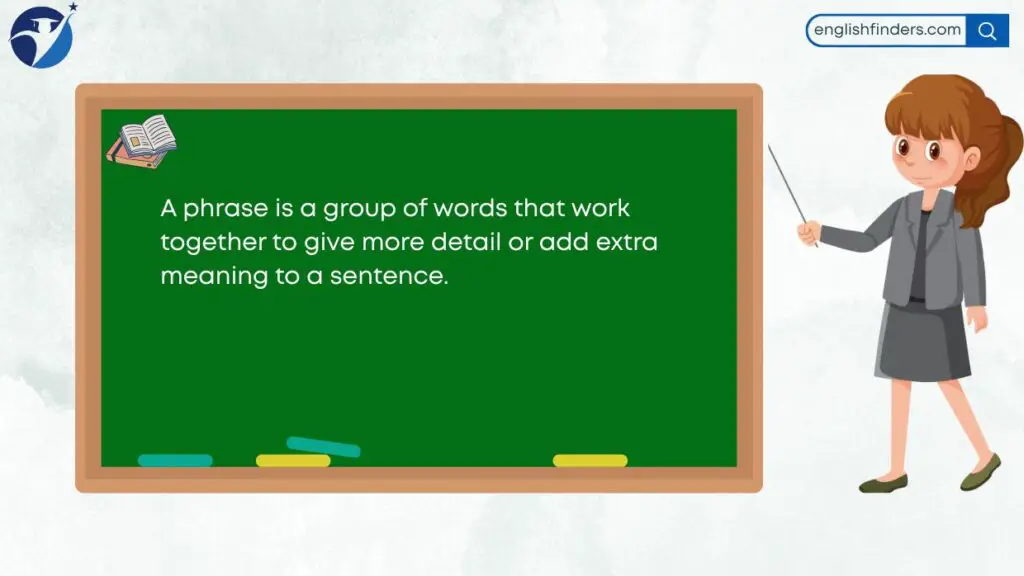
A phrase is a group of words that work together. It adds detail to a sentence. But it has no subject and verb of its own.
In “The girl with the red hat smiled”, with the red hat is a phrase. It tells us which girl.
| Group of words | Subject and verb? | Can it stand alone? | Example |
|---|---|---|---|
| Phrase | No | No | In the morning |
| Clause | Yes | Sometimes | Because she was late |
| Sentence | Yes | Yes | She was late because of the rain. |
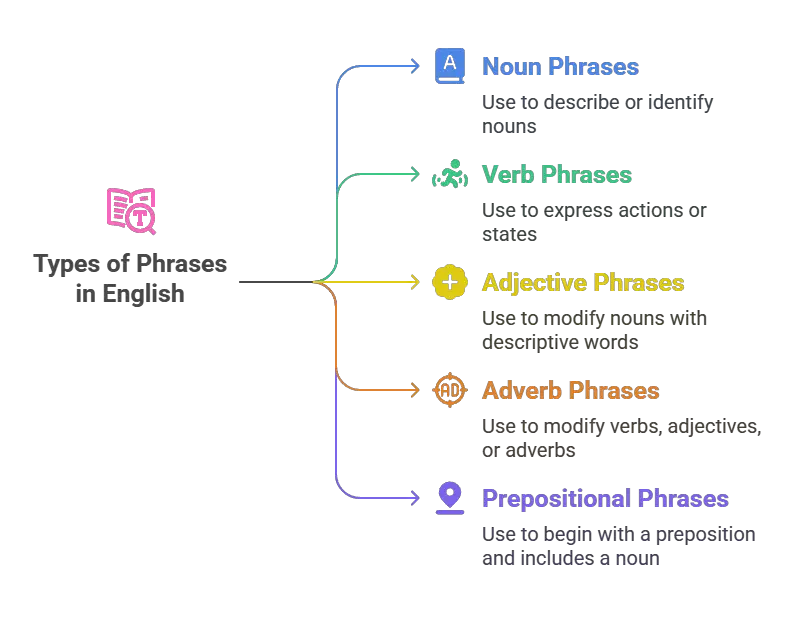
The 5 Main Types of Phrases
1. Noun Phrase
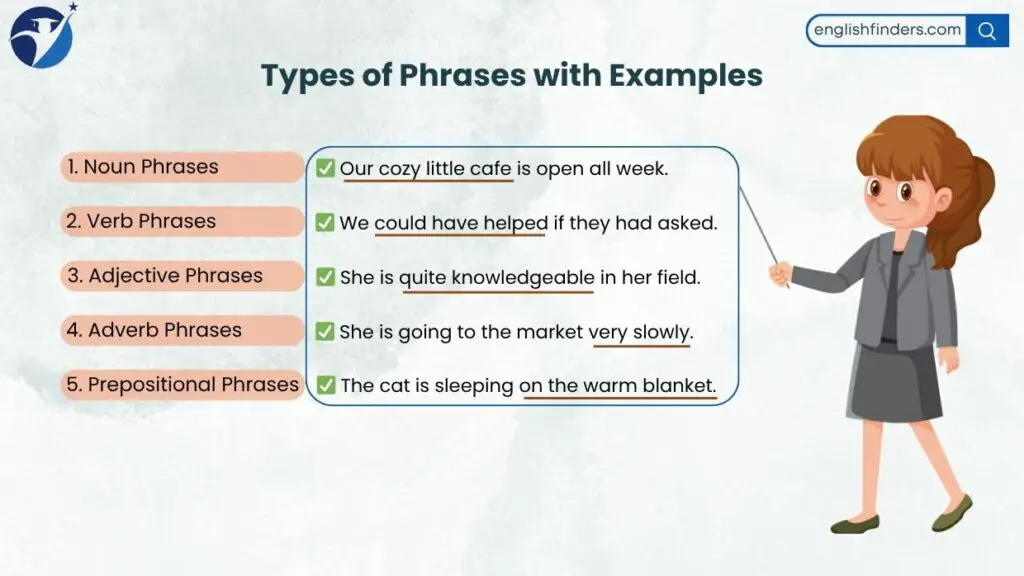
A noun phrase is a noun plus the words that describe it. It can do any job a noun can do, such as subject or object.
- The tall building stood in the middle of the city.
- I bought a pair of red shoes.
2. Verb Phrase
A verb phrase is a main verb plus any helping verbs, like has, been or will.
- She has been working on the project all day.
- We will be traveling next week.
3. Adjective Phrase
An adjective phrase describes a noun. It can be an adjective with extra words. It can also be a group of words that does the same job.
- The cake with chocolate icing was delicious.
- The room was full of happy children.
4. Adverb Phrase
An adverb phrase tells us how, when, where or why something happens.
- She speaks in a very calm voice.
- We left early in the morning.
5. Prepositional Phrase
A prepositional phrase starts with a preposition, like in, on or under. It ends with a noun or pronoun. It often does the job of an adjective or adverb phrase, so it can belong to two groups.
- He sat under the tree to read.
- The keys are on the table.
5 More Types of Phrases
Many grammar books stop at five types. Longer lists add these, which are useful at B1 level and above.
Gerund Phrase
A gerund phrase starts with an -ing word and works as a noun.
- Swimming in the sea is my favorite summer activity.
Infinitive Phrase
An infinitive phrase starts with to plus a verb.
- She wants to visit Japan next year.
Participle Phrase
A participle phrase starts with an -ing or -ed word and describes a noun.
- Smiling at the crowd, the singer waved.
Appositive Phrase
An appositive phrase gives another name for the noun right before it. It usually has commas around it.
- My brother, a nurse, works at night.
Absolute Phrase (Advanced)
An absolute phrase adds background to the whole sentence. It has a noun and a describing word, but no full verb.
- Her hands shaking, she opened the letter.
Quick Reference: Types of Phrases
| Type | What it does | Example |
|---|---|---|
| Noun phrase | Works as a noun | The old dog sleeps a lot. |
| Verb phrase | Shows the action, with helping verbs | She has been working. |
| Adjective phrase | Describes a noun | A house covered in vines |
| Adverb phrase | Tells how, when, where or why | She walked very slowly. |
| Prepositional phrase | Starts with a preposition | The cat is under the table. |
| Gerund phrase | An -ing word working as a noun | Reading novels relaxes me. |
| Infinitive phrase | To + verb | She wants to win the race. |
| Participle phrase | An -ing or -ed word describing a noun | Tired after work, he slept early. |
| Appositive phrase | Renames a noun | Sara, my best friend, is here. |
| Absolute phrase | Adds background to the sentence | The game over, we went home. |
50 Examples of Phrases in Sentences
Noun Phrases
- The young woman with the blue scarf is laughing.
- A stack of books sat on the table by the window.
- She is known as a brilliant scientist.
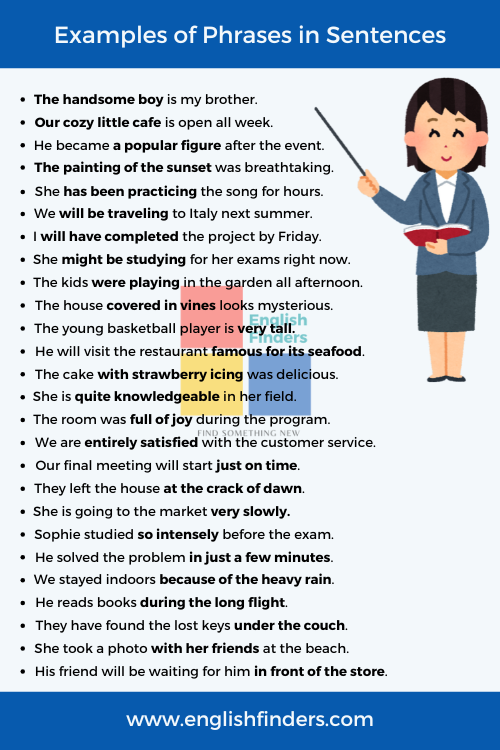
- The handsome boy is my brother.
- He became a popular figure after the event.
- Our cozy little café is open all week.
- A long list of ingredients was needed for the recipe.
- The painting of the sunset was beautiful.
- My favorite memory from the trip is seeing the Eiffel Tower.
- A talented musician will perform on stage next month.
Verb Phrases
- She has been practicing the song for hours.
- They are planning to visit their grandparents next month.
- He was watching TV when I called.
- We will be traveling to Italy next summer.
- She had finished her work before she left.
- The kids were playing in the garden all afternoon.
- I will have completed the project by Friday.
- She might be studying for her exams right now.
- We could have helped if they had asked.
- He was reading a book when the lights went out.
Adjective Phrases
- The child with a bright smile is her son.
- The house covered in vines looks mysterious.
- The young basketball player is very tall.
- The child with curly hair ran across the playground.
- He will visit the restaurant famous for its seafood.
- They moved into a home surrounded by trees.
- The cake with strawberry icing was delicious.
- She is quite knowledgeable in her field.
- The room was full of joy during the show.
- We are completely satisfied with the service.
Adverb Phrases
- She sang with great feeling at the concert.
- Our meeting will start right on time.
- They left the house at the crack of dawn.
- She walked to the market very slowly.
- We will finish the project in a few days.
- He spoke to us with kindness and patience.
- They walked through the busy streets of New York.
- Sophie studied very hard before the exam.
- He solved the problem in just a few minutes.
- We stayed indoors because of the heavy rain.
Prepositional Phrases
- He reads books during long flights.
- The cat is sleeping on the warm blanket.
- They found the lost keys under the couch.
- She took a photo with her friends at the beach.
- His friend will wait for him in front of the store.
- The bird flew over the trees.
- We waited by the entrance.
- She has kept the letter in her drawer for years.
- They hiked through the mountains all day.
- The kids built a sandcastle near the water.
Check your answer
Practice: Name the Phrase
What type of phrase is in bold?
- Swimming every morning keeps me healthy.
- She wants to learn Japanese.
- The keys are under the sofa.
- My neighbor, a retired teacher, helps me with homework.
- The little brown dog barked at the mail carrier.
- Tired after the long walk, we sat down.
Show answers
- Gerund phrase. 2. Infinitive phrase. 3. Prepositional phrase. 4. Appositive phrase. 5. Noun phrase. 6. Participle phrase.
Quiz: Test Yourself
- What does a phrase NOT have?
- What kind of phrase is under the table?
- In “She has been working all day”, which words form the verb phrase?
- “Swimming in the sea is fun.” What kind of phrase is in italics?
- “She wants to visit Japan.” What kind of phrase is in italics?
- “My brother, a nurse, works at night.” What kind of phrase is in italics?
- Which of these is a clause, not a phrase?
- Which questions does an adverb phrase answer?
- “The house covered in vines looks old.” What does the phrase in italics describe?
- How many main types of phrases do most grammar books list?
Key Takeaways
- A phrase is a group of words with no subject-verb pair of its own.
- The five main types are noun, verb, adjective, adverb and prepositional phrases.
- Prepositional phrases often do the job of an adjective or an adverb.
- Gerund, infinitive, participle, appositive and absolute phrases are useful at higher levels.
- If a group of words has a subject doing a verb, it is a clause, not a phrase.
Next, compare phrases with the types of clauses. Then see how both build the types of sentences.
Frequently Asked Questions
What are the five types of phrases?
The five main types are noun phrases, verb phrases, adjective phrases, adverb phrases and prepositional phrases. Each one does the job of a single part of speech.
What are the 12 types of phrases in English?
There is no fixed list of 12. Most grammars name five main types. Longer lists add gerund, infinitive, participle, appositive and absolute phrases, and some split the groups further.
What is the difference between a phrase and a clause?
A clause has a subject and a verb working together: “because she was late.” A phrase does not: “because of the rain.”
What are 10 examples of phrases?
The old dog, in the morning, to win the race, very slowly, has been working, under the table, full of joy, a pair of red shoes, swimming in the sea and my best friend.
What are the 100 most common phrases in English?
That question usually means everyday expressions like “How are you?” or “No problem”, not grammar phrases. Our lists of daily use sentences and common idioms cover those.
Can a phrase be a sentence?
Not in formal writing, because a phrase has no subject and verb of its own. In speech, short answers like “In the kitchen.” are normal, but they are fragments, not full sentences.
Related Articles

- Antithesis: Meaning, Examples and the Grammar of Balance - October 17, 2026
- Anaphora: Meaning, Examples and How to Use It - October 17, 2026
- Flashback: Meaning, Examples and How to Write One - October 16, 2026