
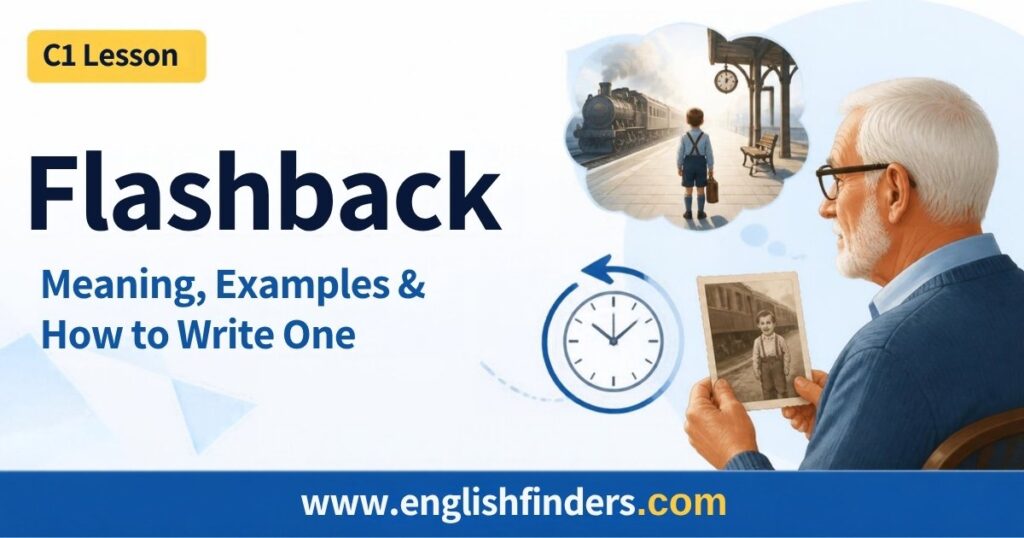
A flashback is a scene that takes the reader back to an earlier time in a story. The main action pauses, we see something from the past, and then the story returns to the present.
Writers use flashbacks to answer a question readers are already asking: why is this character like this? English grammar matters here too, because the reader needs a clear signal when the story moves back in time.
By the end, you will know the main types of flashbacks and the tense changes that move a story in and out of the past.
- What a flashback is and how to pronounce it
- The main types of flashback and how they are triggered
- Famous examples from books and films
- The grammar for moving into and out of a flashback
- How to write your own flashback, with a practice quiz
What Is a Flashback?
Quick Navigation
Most stories move forward in time: first this happened, then that happened. A flashback breaks that order on purpose. It jumps back to show something the reader needs to understand the present.
For example, a character might panic every time it rains. A flashback to a childhood flood explains why. Without it, the reader would only see the fear, not the reason.
How to pronounce flashback
| Word | Sounds like | IPA | Part of speech |
|---|---|---|---|
| Flashback | FLASH-bak | /ˈflæʃ.bæk/ | Noun |
| Flash back (to) | flash BAK | /flæʃ ˈbæk/ | Phrasal verb |
Useful patterns: a flashback to (a time), the story flashes back to…, in a flashback, we learn that…. You can hear the word on our flashback dictionary page.
Types of Flashback
| Type | How it works | Example |
|---|---|---|
| Memory flashback | A character remembers a past event as a full scene. | Looking at an old letter, she remembers the day it arrived. |
| Dream flashback | The past returns in a dream or nightmare. | Each night, he dreams of the accident. |
| Narrated flashback | A character tells another character about the past. | An old woman tells her grandson about the war. |
| Structural flashback | A whole chapter or section is set in the past. | Chapter 3 begins: “Twenty years earlier…” |
What triggers a flashback?
Flashbacks often begin with a trigger: something in the present that brings the past back. Common triggers include a smell, a song, a photo, a place, an object or a familiar phrase. Triggers make the jump in time feel natural rather than sudden.
Flashback Examples in Literature and Film
| Work | How it uses flashback |
|---|---|
| Death of a Salesman, Arthur Miller (1949) | Willy Loman keeps reliving earlier, happier moments with his sons. The memories show how badly his dreams have failed. |
| The Glass Menagerie, Tennessee Williams (1944) | The whole play is Tom’s memory of his family, which he narrates from the future. |
| Wuthering Heights, Emily Brontë (1847) | Most of the story is told as a long recollection by the housekeeper, Nelly Dean. |
| Citizen Kane (1941 film) | The life of Kane, a powerful newspaper owner, is pieced together through flashbacks from people who knew him. |
| The Godfather Part II (1974 film) | The film moves between Michael’s present and his father Vito’s early life. |
You can read more about the first two works in our summary of Death of a Salesman and our guide to The Glass Menagerie characters.
Grammar for Writing a Flashback
This is the part many learners find difficult. If your main story is in the past simple, you need a clear way to move further back in time.
- Enter with the past perfect. This tells the reader you are going further back. She had grown up in a small fishing village.
- Continue in the past simple. After one or two sentences, switch back so the scene feels alive. Every morning, she ran down to the harbor to meet the boats.
- Use a time signal. Words like years earlier, back then, as a child and that summer help the reader follow.
- Return clearly. Use a signal such as now, today or a return to the trigger. Now, standing on the empty beach, she understood why she had come back.
| Stage | Tense | Example |
|---|---|---|
| Main story | Past simple | Anna opened the old wooden box. |
| Entering the flashback | Past perfect | Her grandmother had given it to her on her tenth birthday. |
| Inside the flashback | Past simple | They sat together by the fire, and her grandmother told her stories. |
| Returning | Past simple + time signal | Now the box felt heavier than ever. |
To review the past perfect, see our guide to the past perfect tense or the B1 lesson The Past Perfect – What Happened Before.
Check your answer
Flashback vs Similar Techniques
| Technique | What it does | Example |
|---|---|---|
| Flashback | Shows a scene from the past | We see the hero’s childhood fire. |
| Flash-forward | Shows a scene from the future | “Years later, she would remember this day.” |
| Foreshadowing | Hints at the future without showing it | A storm before a fight |
| Backstory | Any background information about the past | “He had lost his job the year before.” |
| In medias res | Starts the story in the middle of the action | The Odyssey begins near the end of Odysseus’s journey. |
How to Write a Good Flashback
- Have a reason. Every flashback should explain something the reader needs to know now.
- Use a trigger. Link the past to something in the present scene.
- Keep it focused. Show one important moment, not a whole life story.
- Make the borders clear. Use time signals and tense changes so readers never get lost.
- Return with new understanding. The present scene should feel different after the flashback.
- Going back: “It was the summer of…”, “Years earlier…”, “She remembered the day…”, “As a child, he had…”
- Coming back: “Now…”, “The memory faded as…”, “Back in the present…”, “Today, …”
Common Mistakes Learners Make
- Staying in the past perfect too long. Use it to enter the flashback, then switch to the past simple.
- No clear signal. Without time words, readers may not realize the story has moved back.
- Too many flashbacks. If the story keeps jumping, readers lose track of the present.
- Using a flashback just for decoration. If it does not change how we understand the present, cut it.
Practice: Test Your Understanding
Part A. Flashback, flash-forward or foreshadowing?
- “Years later, she would become the town’s first female mayor.”
- The story pauses, and we see the hero as a boy hiding from his angry father.
- Dark clouds gather as the two families sit down to dinner.
- Chapter 5 opens: “Twenty years earlier, in a small village in Wales…”
Show answers for Part A
- Flash-forward – it jumps ahead to the future.
- Flashback – it shows an earlier scene.
- Foreshadowing – the weather hints at trouble.
- Flashback – a whole section set in the past.
Part B. Put the verbs in the correct tense to create a flashback.
“Maria held the old ticket in her hand. Twenty years earlier, she ___ (buy) it for her first trip abroad. She ___ (be) nervous and excited, and she ___ (not sleep) the night before.”
Show answers for Part B
Part C (writing). Write a short paragraph (80–100 words) that starts in the present, uses a trigger, moves into a flashback and returns. Check it with our AI Writing Feedback tool, or test your tenses in the Grammar Quiz.
Quiz: Test Yourself
- What is a flashback?
- Which tense usually takes the reader into a flashback?
- “Twenty years earlier, she ______ the ticket for her first trip abroad.”
- After the first sentence or two of a flashback, which tense should you usually switch to?
- “Years later, she would become the town’s first female mayor.” What is this?
- What is a trigger in a flashback?
- An old woman tells her grandson about the war. Which type of flashback is this?
- Which phrase helps the reader return to the present?
- What does in medias res mean?
- Which is a common mistake with flashbacks?
Key Takeaways
- A flashback interrupts the story to show an earlier event.
- Flashbacks are often started by a trigger: a smell, a song, a photo or a place.
- Grammar: enter with the past perfect, continue in the past simple, and signal the return.
- Foreshadowing looks forward; a flashback looks back.
- Use flashbacks only when they help the reader understand the present.
Next, see how writers hint at the future in our lesson on foreshadowing, or bring scenes to life with imagery.
Frequently Asked Questions
What is a flashback in simple words?
A flashback is a scene that takes the reader back to an earlier time in a story. The main story pauses, the reader sees something from the past, and then the story returns to the present.
What is an example of a flashback?
In Arthur Miller’s play Death of a Salesman, Willy Loman keeps reliving happy moments from years earlier. These flashbacks show how far his life has fallen from his hopes.
What is the difference between a flashback and a flash-forward?
A flashback moves back in time to show earlier events. A flash-forward jumps ahead to show events that will happen later. Both interrupt the normal order of the story.
What tense do you use for a flashback?
When the main story is in the past simple, start the flashback with the past perfect (“She had grown up by the sea”), then switch to the past simple to tell it. Signal clearly when you return.
Why do writers use flashbacks?
Writers use flashbacks to explain a character’s motives, reveal a secret, give background information or build emotion. A well-placed flashback helps readers understand why the present matters.
Is a flashback the same as backstory?
Not exactly. Backstory is any information about a character’s past. A flashback is one way to show it as a full scene. Backstory can also be given in a single sentence of explanation.
Related Articles

- Flashback: Meaning, Examples and How to Write One - October 16, 2026
- Circular Reasoning: Meaning, Examples and How to Spot It - October 14, 2026
- False Dilemma: Meaning, Examples and How to Respond - October 14, 2026