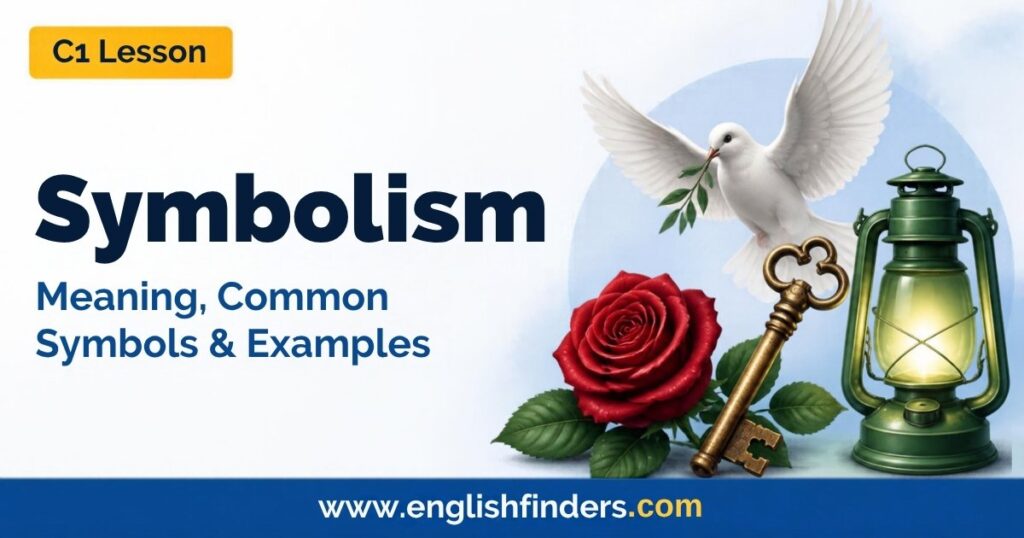
Symbolism is the use of an object, color, character or action to represent a bigger idea. A writer might use a dove to suggest peace, a storm to suggest danger, or a broken mirror to suggest bad luck.
Symbols let writers say a lot without saying it directly. When a mother plants a tree on the day her son is born, the tree grows alongside the boy and quietly stands for him.
Next come the most common symbols, a few famous ones from literature, and a simple method for writing about symbols in an essay.
- What symbolism means and how to pronounce it
- Common symbols and what they usually represent
- Famous symbols in literature
- The difference between a symbol, a metaphor, a motif and an allegory
- How to analyze symbolism in an essay, with a practice quiz
What Is Symbolism?
Quick Navigation
A symbol has two layers. On the surface, it is a real thing in the story: a light, a bird, a ring. Underneath, it carries an idea: hope, freedom, love.
The writer usually does not explain the second layer. Readers discover it by noticing details, especially things that appear more than once or at important moments.
How to pronounce symbolism
| Word | Sounds like | IPA | Part of speech |
|---|---|---|---|
| Symbolism | SIM-buh-liz-um | /ˈsɪm.bə.lɪ.zəm/ | Noun |
| Symbol | SIM-bul | /ˈsɪm.bəl/ | Noun |
| Symbolize (US) / symbolise (UK) | SIM-buh-lize | /ˈsɪm.bə.laɪz/ | Verb |
| Symbolic | sim-BOL-ik | /sɪmˈbɒl.ɪk/ | Adjective |
Useful patterns: X symbolizes Y, X is a symbol of Y, X stands for Y, X represents Y. See more on our symbol dictionary page.
Common Symbols and What They Usually Mean
Many symbols are shared across stories, films and art. Here are some common ones in English-speaking cultures.
| Symbol | Usual meaning |
|---|---|
| Dove | Peace |
| Red rose | Love and romance |
| Owl | Wisdom |
| Lion | Courage and strength |
| Snake | Danger or betrayal |
| Spring | New beginnings, youth |
| Winter | Old age, death or hardship |
| Storm | Conflict, anger or trouble |
| Light | Hope, truth or knowledge |
| Darkness | Fear, evil or the unknown |
| A road or path | Life’s journey and choices |
| A key | A solution or a secret |
| Scales | Justice |
| A broken mirror | Bad luck |
Colors as symbols (tap a card)
RedTap to reveal
GreenTap to reveal
WhiteTap to reveal
BlackTap to reveal
Famous Symbols in Literature
| Work | Symbol | What it represents |
|---|---|---|
| The Great Gatsby, F. Scott Fitzgerald | The green light on Daisy’s dock | Gatsby’s hopes and his dream of the future |
| To Kill a Mockingbird, Harper Lee | The mockingbird | Innocence; harming the innocent is a kind of sin |
| Lord of the Flies, William Golding | The conch shell | Order, rules and democracy |
| The Scarlet Letter, Nathaniel Hawthorne | The red letter “A” | Sin and shame, which later gains new meanings |
| Macbeth, William Shakespeare | Blood | Guilt that cannot be washed away |
Notice that the meaning often changes as the story develops. In Lord of the Flies, the conch stands for order. When it breaks, the boys’ last sense of order breaks too.
Symbolism vs Metaphor vs Motif vs Allegory
These terms are close, so learners often mix them up. This table shows the difference.
| Term | What it is | Example |
|---|---|---|
| Symbol | A real object in the story that stands for an idea | The green light in The Great Gatsby |
| Metaphor | A direct comparison in the language | “Hope is a light in the dark.” |
| Motif | Something that repeats and supports a theme | Darkness appearing again and again in Macbeth |
| Allegory | A whole story where characters and events stand for ideas | Animal Farm, where the farm stands for a political revolution |
Symbolism is also close to allusion. An allusion points to a famous story; a symbol builds meaning inside the story itself.
Check your answer
How to Spot Symbols When You Read
Ask yourself these questions as you read a story or poem.
- Does an object appear more than once? Repetition is a strong clue.
- Does it appear at an important moment? Symbols often show up at the start, the turning point or the ending.
- Does the writer describe it in unusual detail? Extra attention usually means extra meaning.
- Does it connect to a theme? Ask, “What bigger idea could this object stand for?”
- Does its meaning change? Watch how the object changes as the characters change.
How to Write About Symbolism in an Essay
A clear paragraph about a symbol has three steps: name it, explain it and connect it.
Useful phrases: symbolizes…, represents…, stands for…, can be seen as a symbol of…, this suggests that…, which reflects…
Common Mistakes Learners Make
- Seeing symbols everywhere. Not every object is a symbol. Look for repetition, focus and links to the theme.
- Giving one fixed meaning. Symbols can have more than one meaning, and context matters.
- Spelling: it is symbolism and symbolize (US) or symbolise (UK). The noun symbol has one l.
- Describing, not explaining. Saying “There is a green light” is not analysis. Explain what it means and why it matters.
Practice: Test Your Understanding
Part A. What does each symbol usually represent?
- A dove
- A heavy chain
- Sunrise
- A ticking clock
- A crown
Show answers for Part A
- Peace
- A lack of freedom, being trapped
- A new beginning, hope
- Time running out, pressure
- Power, royalty or authority
Part B. Symbol, metaphor or allegory?
- “Her smile was sunshine.”
- A story in which animals take over a farm to show how a revolution can go wrong.
- A wedding ring that a character keeps taking off and putting back on.
Show answers for Part B
- Metaphor – a direct comparison.
- Allegory – the whole story stands for something else.
- Symbol – a real object that represents the character’s doubts about the marriage.
Part C (writing). Choose an object that is important in your life, such as a watch or a photo. Write three sentences explaining what it symbolizes for you. Check them with our AI Writing Feedback tool.
Quiz: Test Yourself
- What is symbolism?
- In many stories, what does a dove usually represent?
- Which sentence uses symbolize correctly?
- Where is the stress in symbolic?
- In The Great Gatsby, what does the green light on Daisy’s dock represent?
- In Lord of the Flies, what does the conch shell stand for?
- “Her smile was sunshine.” Is this a symbol or a metaphor?
- A whole story where the characters and events stand for ideas is called…
- Why should you read a symbol in its cultural context?
- Which is a clue that an object might be a symbol?
Key Takeaways
- Symbolism uses something concrete to stand for an abstract idea.
- Useful verbs: symbolize, represent, stand for.
- Common symbols include doves (peace), storms (trouble) and light (hope), but meanings depend on culture.
- A symbol is a real thing in the story; a metaphor is a comparison; an allegory is a whole story with a hidden meaning.
- In essays, name the symbol, explain it and connect it to a theme.
Continue with our lesson on imagery, or explore the full set in our guide to literary devices.
Frequently Asked Questions
What is symbolism in simple words?
Symbolism is when a writer uses an object, color, character or action to stand for a bigger idea. For example, a dove often stands for peace, and a storm can stand for trouble or anger.
What is an example of symbolism?
In The Great Gatsby, the green light at the end of Daisy’s dock stands for Gatsby’s hopes and dreams. It is a real light in the story, but it also carries a deeper meaning.
What is the difference between a symbol and a metaphor?
A metaphor directly compares two things, such as “Life is a journey.” A symbol is a real object in the story that quietly represents an idea. Readers must notice it and work out the meaning.
Can a symbol mean different things?
Yes. Many symbols depend on culture. White is linked to weddings in many Western countries, but in parts of Asia it is traditionally linked to mourning. Context always matters.
What is the difference between a symbol and a motif?
A symbol is one object or image with a deeper meaning. A motif is something that repeats through a story, such as darkness or water, and helps build its theme. A motif can include several symbols.
How do I write about symbolism in an essay?
Name the symbol, explain what it represents, and show how it connects to a theme. For example: “The caged bird symbolizes the character’s lack of freedom, a theme that runs through the novel.”
Related Articles

- Symbolism: Meaning, Common Symbols and Examples in Literature - October 11, 2026
- Imagery: Meaning, 7 Types and Examples in Writing - October 10, 2026
- Literary Devices: 30 Common Devices with Meanings and Examples - October 9, 2026