
Last updated on October 14th, 2026 at 04:31 pm
Read this sentence: Although it was raining, he went for a walk. It has two parts. One part can stand alone as a sentence, and the other part cannot.
That is a complex sentence. It joins a main idea to a smaller idea with a word such as although, because or if.
This lesson shows the most common complex sentences in English. It has 20 examples in four groups and a simple method to spot the clauses. Exercises, a quiz and an FAQ follow.
- What a complex sentence is, and how to find its two clauses
- The most common joining words, grouped by job
- 20 common complex sentences in four groups
- When to use a comma
- How a complex sentence differs from a simple or compound sentence
What Is a Complex Sentence?
Quick Navigation
Before defining a complex sentence, we need to understand what a clause is. A clause is a group of words with a subject and a verb. A main clause (also called an independent clause) makes sense alone. A dependent clause does not make sense alone. It needs the main clause.
A complex sentence has one main clause and one or more dependent clauses. The two parts are joined by a subordinating conjunction, which is a word such as because or although.
You can use this three-step method to find the clauses:
- Find the joining word, such as because, although, when or if.
- Find the part that starts with the joining word. It cannot stand alone, so it is the dependent clause.
- The other part is the main clause.
When the bell rang, the students left. The joining word is when. When the bell rang cannot stand alone, so it is the dependent clause.
Want more depth? Read our guide to complex sentences, or see 50 more examples of complex sentences.
Common Joining Words for Complex Sentences
Each joining word shows a different relationship between the two ideas. The table groups the most common words by their job.
| Job | Common joining words | Example |
|---|---|---|
| Time | When, whenever, after, before, as soon as, while, until | I will call you as soon as I arrive. |
| Reason | Because, since, as | She stayed home because she felt sick. |
| Contrast | Although, though, even though, while | Although he is young, he is very talented. |
| Condition | If, unless, provided that, as long as | If you work hard, you will succeed. |
| Place | Where, wherever | We stayed where the view was best. |
Some complex sentences use who, which or that instead. These are relative pronouns, and they start a relative clause: The girl who sits next to me is my cousin.
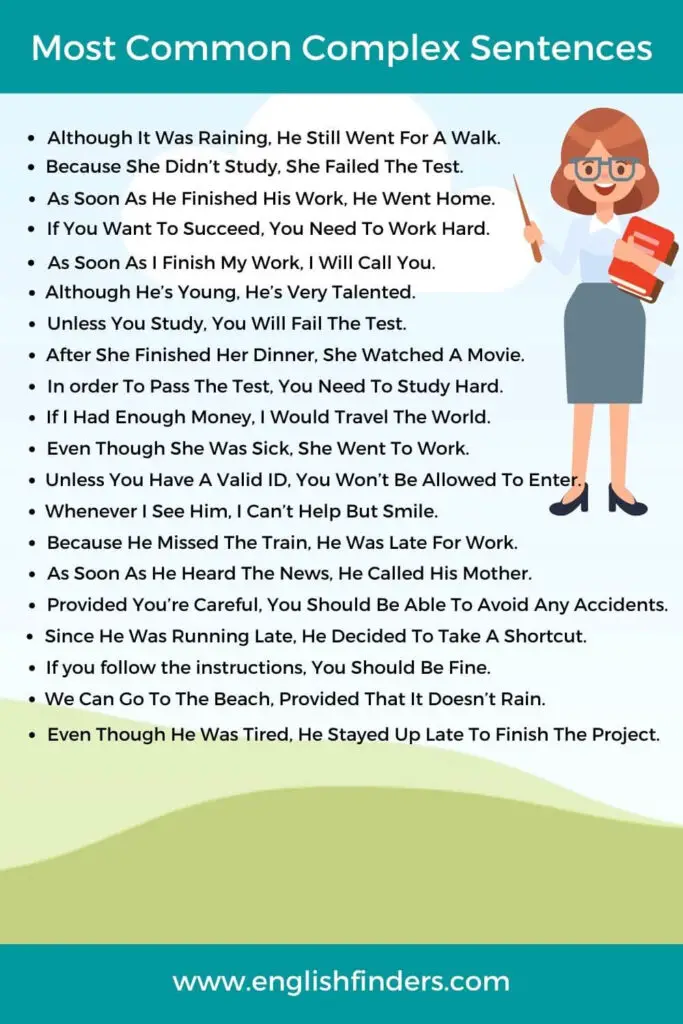
20 Most Common Complex Sentences
The sentences are in four groups. The joining word is in bold in each one.
Time
| No. | Sentence | What it shows |
|---|---|---|
| 1 | After she finished dinner, she watched a movie. | One action follows another |
| 2 | I will call you as soon as I arrive home. | One action happens right after another |
| 3 | When the bell rang, the students left the room. | Two actions at the same time or one after another |
| 4 | Whenever I see him, I smile. | Something that happens every time |
| 5 | Before you leave, please turn off the lights. | One action happens first |
Reason
| No. | Sentence | What it shows |
|---|---|---|
| 6 | Because he missed the train, he was late for work. | The reason for the result |
| 7 | She stayed home since she felt sick. | A known reason |
| 8 | As it was raining, we cancelled the picnic. | A reason, in a short form |
| 9 | He passed the exam because he studied every night. | The reason comes second |
| 10 | Since the shop was closed, we went to the market. | A reason and a new plan |
Contrast
| No. | Sentence | What it shows |
|---|---|---|
| 11 | Although it was raining, he went for a walk. | Two ideas that do not match |
| 12 | Even though she was tired, she finished the project. | A stronger contrast |
| 13 | He is very talented, although he is young. | The contrast comes second |
| 14 | While I like tea, my brother prefers coffee. | Two different choices |
| 15 | Though the food was cheap, it tasted great. | A surprise |
Condition
| No. | Sentence | What it shows |
|---|---|---|
| 16 | If you work hard, you will succeed. | A real possibility |
| 17 | Unless you study, you will fail the test. | Unless means if not |
| 18 | We can go to the beach if it does not rain. | The condition comes second |
| 19 | If I had more money, I would travel the world. | An unreal or unlikely situation |
| 20 | You will be fine provided that you follow the instructions. | A condition that must be met |
Check your answer
Where Does the Comma Go?
The comma depends on the order of the clauses. If the dependent clause comes first, use a comma. If the main clause comes first, you usually do not need one.
| Order | Example | Comma? |
|---|---|---|
| Dependent clause first | Although it was raining, he went out. | Yes |
| Main clause first | He went out although it was raining. | No |
Simple, Compound and Complex Sentences
It helps to compare the three kinds of sentences.
| Type | Structure | Example |
|---|---|---|
| Simple | One main clause | She sang. |
| Compound | Two main clauses joined by and, but or or | She sang, and he danced. |
| Complex | A main clause and a dependent clause | She sang because she was happy. |
Our guide to compound sentences explains the middle type in detail.
Common Mistakes
| Common mistake | Better sentence | Why |
|---|---|---|
| Because he was late. | Because he was late, he missed the bus. | The first part cannot stand alone. |
| Although he was tired, but he worked. | Although he was tired, he worked. | One joining word is enough. |
| Although it rained we went out. | Although it rained, we went out. | Use a comma after a dependent clause at the start. |
| Unless you do not study, you will fail. | Unless you study, you will fail. | Unless already means if not. |
| If I will have time, I will come. | If I have time, I will come. | Use the present simple after if for a real possibility. |
Practice: Exercises on Complex Sentences
Exercise 1: Find the Dependent Clause
Write the dependent clause in each sentence.
- Although she was tired, she kept working.
- I will call you when I arrive.
- He was late because the bus broke down.
- If it rains, we will stay home.
- She smiled whenever she saw her dog.
- Unless you hurry, you will miss the train.
Show answers for Exercise 1
- Although she was tired
- When I arrive
- Because the bus broke down
- If it rains
- Whenever she saw her dog
- Unless you hurry
Exercise 2: Join the Sentences
Join each pair with the word in brackets.
- She was ill. She went to work. (even though)
- He studied hard. He wanted to pass. (because)
- You leave. Turn off the lights. (before)
- It is cold. We will go out. (although)
- You practice. You will improve. (if)
Show sample answers for Exercise 2
- Even though she was ill, she went to work.
- He studied hard because he wanted to pass.
- Before you leave, turn off the lights.
- Although it is cold, we will go out.
- If you practice, you will improve.
Exercise 3: Choose the Correct Word
Choose the best joining word.
- (Although / Because) he was rich, he lived a simple life.
- She was late (because / although) the train was delayed.
- (If / Unless) you study, you will pass.
- (Unless / If) you hurry, you will miss the bus.
- I stayed home (since / although) I felt sick.
Show answers for Exercise 3
- Although
- Because
- If
- Unless
- Since
Quiz: Test Yourself
- What does a complex sentence have?
- Which part of this sentence is the dependent clause? “Because he was tired, he went to bed.”
- Which word shows contrast?
- Which sentence is correct?
- What does unless mean?
- Which sentence is a complex sentence?
- Which sentence needs a comma?
- Which sentence has a reason?
- Which sentence is a fragment?
- Which sentence is correct?
Key Takeaways
- A complex sentence has one main clause and at least one dependent clause.
- Common joining words show time, reason, contrast and condition.
- A dependent clause cannot stand alone.
- Use a comma when the dependent clause comes first.
- Use only one joining word between two clauses.
Frequently Asked Questions
What is a complex sentence?
A complex sentence has one main clause and at least one dependent clause. For example: Because he missed the train, he was late for work.
What are the most common joining words in complex sentences?
Common words are because, although, when, if, since, after, before, unless and while. They show reason, contrast, time and condition.
How do you find the dependent clause?
Find the joining word, such as because or although. The part that starts with it cannot stand alone, so it is the dependent clause.
When do you use a comma in a complex sentence?
Use a comma when the dependent clause comes first. For example: Although it was raining, he went out. You usually need no comma when the main clause comes first.
What is the difference between a complex and a compound sentence?
A compound sentence joins two main clauses with and, but or or. A complex sentence joins a main clause and a dependent clause with a word such as because.
Can a complex sentence start with because?
Yes, but it needs a main clause as well. Because he was late, he missed the bus is correct. Because he was late alone is a fragment.
Related Articles

- Circular Reasoning: Meaning, Examples and How to Spot It - October 14, 2026
- False Dilemma: Meaning, Examples and How to Respond - October 14, 2026
- Hasty Generalization: Meaning, Examples and How to Avoid It - October 13, 2026